

UN begins search for Guterres’ successor with first straw poll
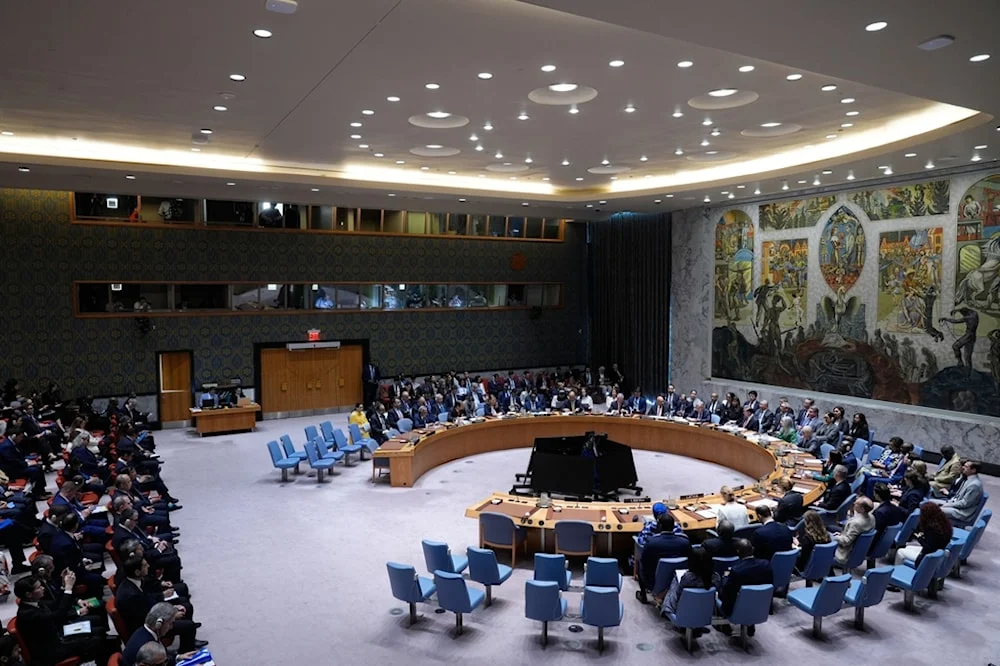
Al Mayadeen The Security Council meets at the United Nations Headquarters, May 26, 2026.
The UN Security Council will hold its first confidential straw poll on Thursday to assess support for seven candidates seeking to succeed the incumbent secretary-general.
The race to lead the United Nations will formally enter its first voting stage on Thursday, when the Security Council holds a confidential ballot to assess the standing of seven declared candidates seeking to succeed Secretary-General Antonio Guterres, Reuters reported.
Guterres, who has headed the organization since 2017, is scheduled to leave office at the end of December after completing two consecutive five-year terms.
The closed-door exercise will provide the first indication of which contenders enjoy meaningful support among the Council’s 15 members and which could face resistance as the selection process advances.
Seven Candidates enter initial round
The current field includes nominees from Latin America, Africa, and the Caribbean.
Among them are International Atomic Energy Agency Director General Rafael Grossiof Argentina and former Chilean President Michelle Bachelet.
They are joined by former Costa Rican Vice President Rebeca Grynspan, former Ecuadorian Foreign Minister Maria Fernanda Espinosa, and former Guyanese Foreign Minister Carolyn Rodrigues-Birkett.
Former Senegalese President Macky Sall and veteran Ugandan diplomat Olara Otunnu are also competing for the post.
Otunnu was the latest to join the race, submitting his candidacy last week. Additional contenders may still be nominated before the Security Council reaches a final decision.
Ballots test backing and opposition
Unlike a formal Council vote, the straw poll does not immediately select or eliminate a candidate.
Instead, each Security Council member indicates whether it wishes to “encourage”, “discourage”, or express “no opinion” regarding every contender.
The ballots are secret, and no officials other than representatives of the 15 Council members take part in the session.
In the opening rounds, all Council members use the same type of ballot. This prevents candidates from knowing whether a negative response came from an elected member or from one of the five permanent members with veto power: China, France, Russia, the United Kingdom and the United States.
Later rounds are expected to distinguish the votes of the permanent members by using differently coloured ballots.
That stage is particularly important because a single “discourage” vote from a permanent member could signal that a candidate would be blocked during the formal selection process.
Contest may continue through to the Autumn
Diplomats have yet to identify a clear favourite, raising the possibility of several rounds of voting over the coming months.
Previous secretary-general contests have involved repeated straw polls as weaker candidates withdrew and Council members negotiated around possible vetoes.
The process is expected to move toward a conclusion by late September or early October, although discussions could extend beyond that period if the permanent members fail to agree on an acceptable nominee.
Once a consensus emerges, the Security Council will formally recommend one candidate to the UN General Assembly.
A successful candidate must receive at least nine votes in the Council and avoid a veto from any permanent member.
The General Assembly, which includes all 193 UN member states, then votes on the recommendation. Historically, it has endorsed the Council’s chosen nominee.
Council President confirms timetable
The Democratic Republic of the Congo, which currently holds the rotating presidency of the Security Council, announced that the first poll would be conducted on Thursday morning.
Congolese Ambassador to the UN Zenon Mukongo Ngay confirmed the schedule during remarks to reporters on Tuesday.
He said Otunnu would be included in the ballot despite entering the competition after the completion of informal hearings involving the other candidates.
Otunnu has a notable connection to the voting mechanism itself. According to his curriculum vitae, he introduced the straw poll method for selecting a secretary-general while serving as Security Council president in 1981.
The eventual winner will assume leadership of the United Nations at a time of deep geopolitical division and increasing pressure for institutional reform.
The next secretary-general will also face demands to reduce costs, eliminate overlapping mandates and address criticism of the organisation’s expanding administrative structure.