

Grief and Rising
– Nora Hoppe – Al Mayadeen English
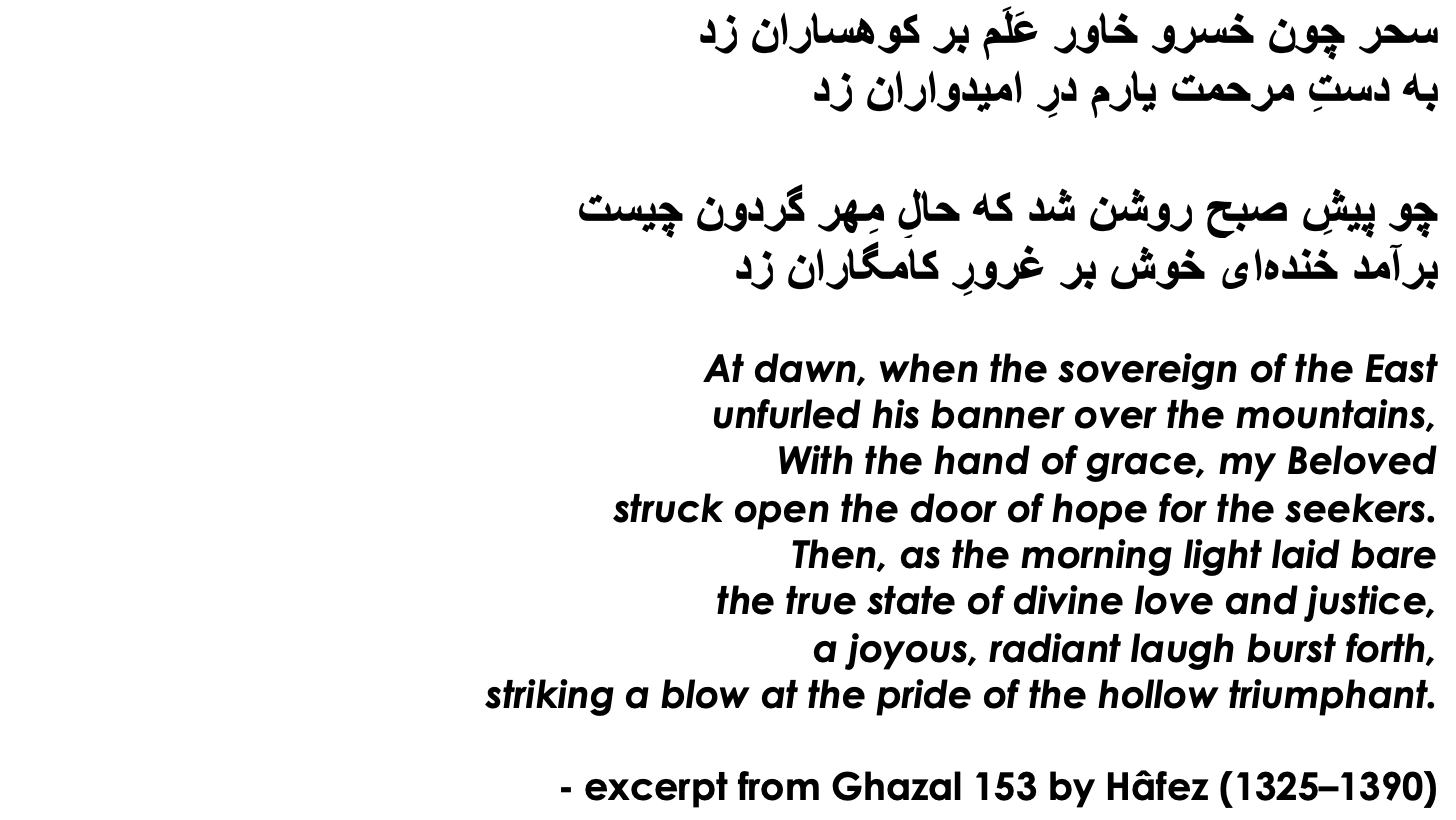
These lines by Hâfez were often recited by a mother to a child who would become a legendary leader of the Resistance – Ayatollah Seyyed Ali Khamenei. And he would carry these verses, together with the memory of his mother, in his heart for the rest of his life.
To Seyyed Ali Khamenei these lines were more than mere poetry; they were a living inheritance – rhapsodic words of hope and resistance that shaped a soul.
For Hâfez is not simply describing a sunrise. He is describing the moment of cosmic justice that occurs when the light of truth – the sun, the Beloved, the awakening people – rises.
Today, we may see these lines as a “prophecy” framing the People’s funeral ceremony for Ayatollah Seyyed Ali Khamenei as a cosmic event: a dawn of awakening where divine justice is laid bare, when the People of Iran, in their unity and grief, realise the true state of “divine love and justice” and rise to challenge the forces of imperialism. The “radiant laugh” becomes the sound of liberation, echoing the defiant joy of the people who, through years of suffering, have found unity and purpose. It is a laugh that “strikes a blow” at the pride of all those – whether foreign imperialists or even some “westoxified” compatriots – who believe they can oppress a people of indomitable spirit.
The Leader as a Mirror of the People
Who was this man that millions are mourning?
To know a man is not so much to hear what he said but to see how he lived… and to see his resonance in others.
A few mosaic fragments from his early life: a childhood spent in a humble, deeply religious, highly cultivated home; affectionate, erudite parents devoted to educating their children in Qor’anic studies and many other fundamental fields of learning, amongst which poetry was indispensable; the persistent absorption of the value of struggle and resolve; periods of imprisonment, torture and exile under the Shah’s SAVAK; the first assassination attempt on him – conducted by the MEK – in which he lost the use of his right arm…
These experiences did not embitter him. They taught him patience, resilience, resolve, humbleness and wisdom. They deepened his compassion and his connection to the Mustazafin (the oppressed), to whom he felt eternally duty-bound. This commitment came to form the core of Iran’s political and foreign policy doctrine.
Ayatollah Seyyed Ali Khamenei supported the liberation of Palestine over decades with military, logistical, and political assistance in the struggle to eradicate the terrorist Zionist entity from the region. His compassion extended equally to the people of Lebanon, who also sustained decades of suffering under Zionist invaders; he viewed Hezbollah and the Lebanese resistance as crucial pillars of a unified struggle. Under his leadership Iran also supported the Ansar Allah in their battle to free themselves from Saudi domination. He championed the struggle against apartheid in South Africa – Nelson Mandela called him “my leader”. And Thomas Sankara and Ayatollah Seyyed Ali Khamenei were united in the conviction that their peoples would never be free under Western domination.
He was a man of high culture: a philosopher, a poet, a literary scholar. He spoke four languages. He happened also to be a brilliant military strategist who conceived the Mosaic Defence Strategy leading Iran to victory in the Ramadan War against the world’s so-called superpower.
Yet the immense love and heartache expressed in the widespread mourning for Ayatollah Khamenei are rooted in his personal qualities: his humanity, compassion, sincerity, humility, and loyalty – universal virtues that resonate across all cultures. The people revered him not for his theological authority or his strategic virtuosity alone, but for his moral character: his simple lifestyle, his steadfastness, and his care for the common person. For many, he was a father figure.
The Shared Language of the Heart: Unity in Grief
The mourners embracing, weeping, chanting for Palestine and Lebanon even in their own grief – this is the language of the heart, a language that transcends all boundaries of age, class, ethnicity, faith and ideology. (In one video, 99-year-old Ayatollah Jannati – “older than ‘Israel’” – marches laboriously in the funeral procession.) It is the language of a heart that feels for others in the world beyond its national and religious borders.
The people have recognised that their suffering is connected to the suffering of others in the world, caused by a common enemy enshrouded in supremacy, colonialism and ruthless power.
This profound unity in grief is not a passive sorrow. It is a force that demands action… and it is intensifying. The unity itself is both a political and spiritual statement.
From Grief to Justice: The Revolutionary Fire
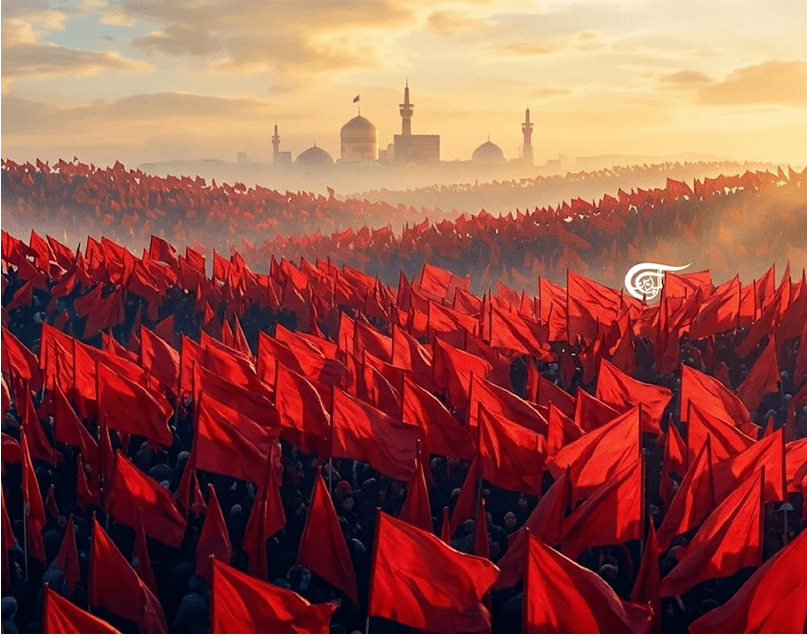
There are not just tears at the funeral ceremony but red flags – inscribed with “O You Who Avenge the Blood of Husayn” – and red wristbands that denote a demand for vengeance.
They seek vengeance for their beloved leader, who was savagely murdered in his home alongside other members of his family in a state-of-the-art, precision-targeted assassination carried out by a joint U.S. and Israeli airstrike. They seek vengeance for all the innocents massacred in schools, playgrounds, homes and workplaces. They seek vengeance for the ongoing Genocide against Palestine, now spread to Lebanon. They seek vengeance for the centuries-long brutal attempt to destroy their civilisation.
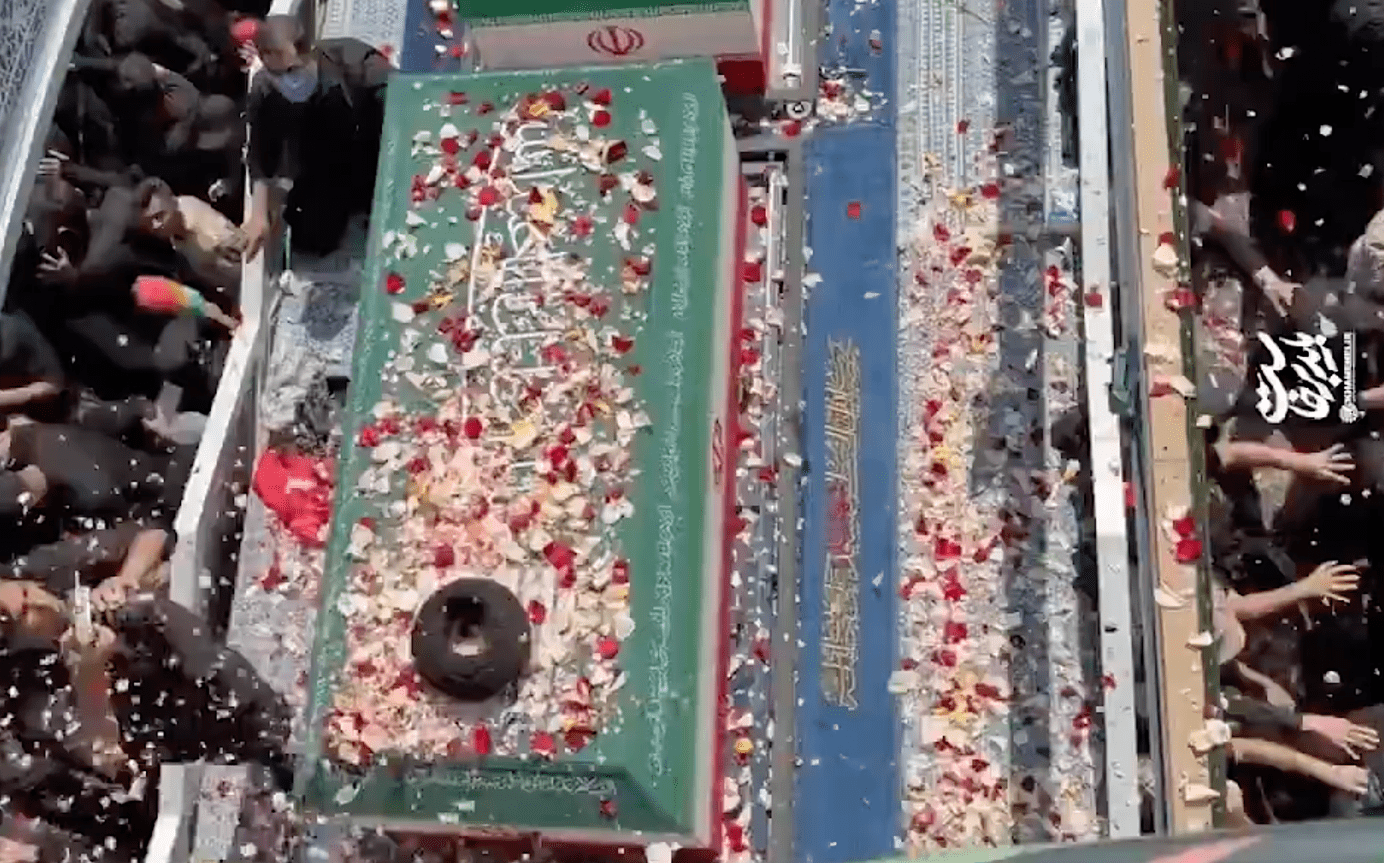
The sea of red flags is the ultimate signal that the path of resistance remains the path of the people. Aerial footage shows the procession taking on the appearance of rivers of throbbing blood in an enormous pulsating heart.
The Revolution never ended. It is ongoing.
The Leader’s Legacy: A Servant of the People
In a world yearning for authentic leadership, this ceremony demonstrates that true spiritual authority arises from character, not from institutional power; that a strong leader serves his people by making them strong; that the true sovereignty of a state lies within its people.
In a world that teaches us to numb ourselves, to gorge on bread and circuses, to avoid the pains of reality, the Iranian people have chosen to feel – deeply, fully, and together. This is an act of rebellion against the very structure of neoliberal society – a system that offers us illusions: consumption, status, endless distraction. The Iranian people have shown us what is real: love, sacrifice, solidarity, and the courage to stand for justice.
The lessons of the Iranian street are a testament that a nation united in faith and purpose can stand up to the most formidable of global powers and chart its own destiny.
From Grief to a New Consciousness: The Global Dawn
The Iranian Street Ceremony of Grief is, at its deepest level, a call for a new world – a world where spiritual community is based on shared humanity, where leadership is rooted in character, where grief becomes a source of strength, and where solidarity with the oppressed is a sacred duty.
For all peoples seeking liberation from oppression, colonialism and Western neoliberal capitalism, this event offers concrete lessons: the importance of historical consciousness, solidarity beyond borders, and the rejection of materialism.
The vast sea of grief in and around the Imam Khomeini Grand Mosalla, flooding the city in a procession of mourning black and raging red, marked a uniquely sacred moment in the history of humanity. It is the image of millions of united people – estimated so far at nearly 25 million – who refused to surrender their souls. It is the largest funeral procession in the history of mankind. And it is thus an auspicious sign for mankind.
The dawn has broken, the banner is raised, the door of hope is open.
Postscript…

* * *
* In a short film, Ayatollah Seyyed Ali Khamenei reminisces about his mother reciting lines to him from Ghazal 153 by Hâfez.