

Venezuela – A Deliberate Devastation?
Was the Venezuela Quake a natural disaster? Or a man-made disaster?
By Peter Koenig
——-
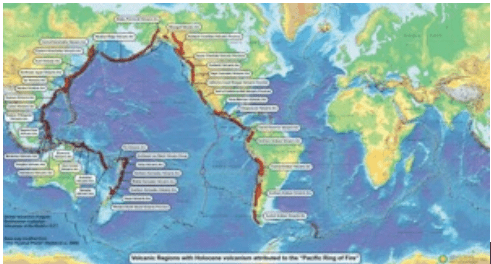
Venezuela’s two big quakes of 24 June 2026 (7.2 followed less than a minute later by one of 7.5 Richter scale), also called a “doublet”, apparently did not happen, because the country sits on the Pacific Ring of Fire. They happened because northern Venezuela lies on the active boundary between the Caribbean and South American plates, where major strike-slip faults like the Boconó and San Sebastián systems build up and release stress. (see Featured Image: “Ring of Fire Map”- public domain)
Connection to the Ring of Fire
The Ring of Fire is the circum-Pacific belt around the Pacific Plate, and it is a different tectonic system from Venezuela’s plate boundary. Venezuela belongs to the Caribbean–South America margin, not the Pacific subduction ring.
So, is it then a sheer “coincidence” that almost simultaneously happened a series of lesser Pacific Ring of Fire seismic tremors, of about 5 to 6 Richter strength?
They included, Japan: offshore of Iwate Prefecture along the Japan Trench, at magnitude 6.9, and Northern California, near Redwood Valley in Mendocino County, at magnitude 5.6, plus a number of lesser ones, in the Philippines, especially the southern Philippines / Mindanao (though, this was reported with 7.8), which is repeatedly cited in Ring of Fire quakes; Papua New Guinea (PNG); Solomon Islands and nearby Pacific islands, which are commonly grouped with PNG in the same seismic belt.
As of the latest confirmed reporting, 2 July 2026, the Venezuela earthquakes on 24 June 2026 had killed 1,719 people. The number of missing was, according to Reuters, 55,000, while Euronews cited up to 68,000 missing, meaning the death toll may rise substantially.
[Current numbers from Venezuela: Venezuela’s earthquake death toll has risen to 2,954 and 16,592 people have been reportedly injured.]
UNDP estimates direct physical damage: about US$6.7 billion, with a stated range of US$4.7 billion to US$8.7 billion. It does not include wider economic disruption costs, infrastructure knock-on effects, or long-term reconstruction expenses. UNDP also notes that the total impact is usually much higher, often around 1.5 to 3 times the direct damage.
A rough, commonly cited Venezuelan Government valuation of her hydrocarbon riches is about US$18 trillion, an approximate figure confirmed by Forbes, using a conservative oil price around $60 per barrel.
Given the sophisticated weather engineering technologies, including earthquakes, the US controls (see this https://www.globalresearch.ca/monster-high-crime-weather-engineering/5870475 ), is it a legitimate, intellectually honest question: The “coincidence” is striking, the geopolitical context is suggestive [full re-imposition of the new Monroe (Donroe) doctrine, plus Venezuela being the world’s hydrocarbon-richest country), in this shape-shifting day and age we are living, is it reasonable to ask whether more is going on than meets the eye?
Could the Venezuelan seismic shocks have been placed deliberately in the context of the vulnerable Pacific Ring of Fire, where earthquakes are frequent? – For now, it remains an open question, not (yet) a demonstrated fact.
—–
Peter Koenig is a geopolitical analyst, regular author for Global Research, and a former Economist at the World Bank and the World Health Organization (WHO), where he worked for over 30 years around the world. He is the author of Implosion – An Economic Thriller about War, Environmental Destruction and Corporate Greed; and co-author of Cynthia McKinney’s book “When China Sneezes: From the Coronavirus Lockdown to the Global Politico-Economic Crisis” (Clarity Press – November 1, 2020).
Peter is a Research Associate of the Centre for Research on Globalization (CRG). He is also a non-resident Senior Fellow of the Chongyang Institute of Renmin University, Beijing.
It would not be a shock if the Venezuelan earthquakes were caused by an American weather weapon. The USA’s HAARP (High-frequency Active Auroral Research Program) is definitely real, although the Americans sincerely and adamantly insist that it is purely for innocent scientific research–just like they sincerely and adamantly insist that… Read more »
one thing is crystal clear – the failure to impose their will in Eurasia has left the empire in a situation where they absolutely must own the entire Western Hemisphere.
‘Dutchsince’ is my go to for earthquake stuff. His basic premise is that most earthquakes are precipitated by electromagnetic activity and propagate around the plate boundaries as low frequency em waves, mostly these originate from activity near the roots of Hunga Tonga-Hunga Haʻapai at around 19.47S below Fiji. He more… Read more »
What I should also have said is that the concrete was criminally inadequate for reinforced structural use, I’m guessing it was pumped too wet, too weak and too cheaply, that’s a lot of officials and companies who should be held to account, especially if the concrete of their houses was… Read more »
John, please take a look at the history of earthquakes in the area before we start accusing people of this or that. Wikipedia is good enough. And let us remember that building codes probably fell into a heap in the many years of sanctions. But which ones were old buildings… Read more »
Many of the collapsed buildings were social housing built by the state. I don’t know who was complicit in ignoring building codes and material standards but from the little I’ve seen of devastation the concrete was not up to the job. Reports also state that they had skimped on the… Read more »