

Pentagon reveals its attacks in Latin America are just the beginning
From Misión Verdad
With “total operation extermination” and Trump’s threats against Cuba, more U.S. military strikes in the region can be expected.
While the government continues to bomb Iran, a senior Pentagon official revealed that U.S. wars in the Western Hemisphere are also expanding, and unveiled an initiative called “Total Operation Extermination.”
The attacks on the Latin American drug cartels are “just the beginning,” Joseph Humire, acting undersecretary of National Defense and Security Affairs of the Americas, told members of the House Armed Forces Committee last week.
The aforementioned pointed out that many more attacks are coming in Latin America, statements expressed a day after President Donald Trump again hinted at the annexation of Cuba by the United States. “I think I will have the honor of … getting Cuba,” he said on March 16. “Whether it’s releasing her or taking her, I think I can do whatever I want with her.”
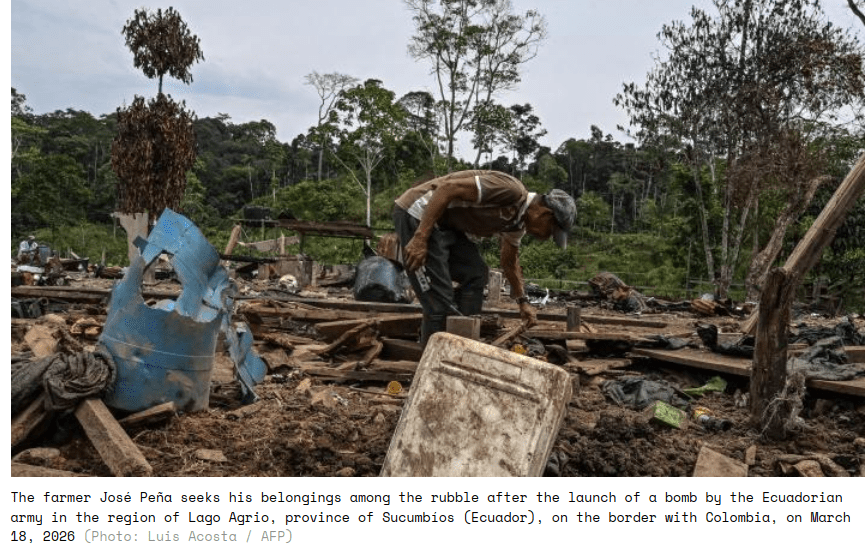
Humire announced that the War Department backed “bilateral kinetic actions against cartel targets along the Colombia-Ecuador border” — a term used by the Pentagon to refer to the March 3 attacks on “designated terrorist organizations” unidentified, which The Intercept had already reported. “The joint operation, called ‘Total Operation Extermination’, is the beginning of an Ecuadorian military offensive against transnational criminal organizations, with the support of the United States,” he said.
The campaign between these two States has already spread to Colombia after, on 3 March, a farm was bombed or hit by a “richech effect”, which left a 227 kg unexploded bomb in the country’s border region. In response to a request for comment, the U.S. Southern Command. The U.S. referred The Intercept to a statement posted on X by Ecuador’s Defense Ministry confirming that the bomb had fallen in Colombia.
Humire referred to the facts as “joint ground attacks” and claimed that the United States was providing the southern country with “capacities that they would not otherwise have.” Since then, Washington has carried out at least one more action together with Quito. “Yes, as @POTUS has said, we are also bombing narco-terrorists on the ground,” war secretary Pete Hegseth wrote on X on March 6 in announcing the new onslaught. Days later, in a report on war powers announcing the intervention of the U.S. armed forces in the “hostilities” of that country, the White House informed Congress “the military action carried out on March 6, 2026 against the facilities of narco-terrorists affiliated with a designated terrorist organization.”
The maneuvers in Ecuador are also part of the Operation Southern Launch — and constitute an expansion of it — the U.S. military’s illegal campaign for attacks on vessels in the Caribbean Sea and the eastern Pacific Ocean. Washington has carried out 46 attacks since September 2025, the balance of which is the destruction of 48 vessels and the deaths of nearly 160 civilians. The last one, perpetrated on March 19 in the Pacific, claimed the lives of two other people and left one survivor. The Trump administration claims that its victims are members of at least one of the 24 or more cartels and criminal gangs it claims to be at war with, but refuses to name them.
“To throw oneself into war on the whim of one man is the exact opposite of what the Constitution demands.”
“This administration hardly superficially refers to the constitutional or international law that regulates the use of force. But these rules exist for a reason,” said Rebecca Ingber, a former State Department attorney and currently a professor at New York’s Cardozo Law School. “To throw themselves into war on the whims of one man is the exact opposite of what the Constitution demands.”
Gen. Francis Donovan, commander of U.S. Southern Command, told lawmakers last week that “attacks on ships are not the solution,” but hinted at an even broader campaign. “What we are preparing at the moment could be a Southern Spear expansion, but in reality it is a campaign process against the cartels that will generate total systemic friction throughout this network,” he told members of the Senate Armed Services Committee. “I think these kinetic attacks — against boats — are just a small part of it.”
Humire did not know how many land actions were taking place in almost 20 countries in Latin America and the Caribbean. “I don’t have an exact figure,” he answered a question. But when Rep. Adam Smith, D-Wash., and a senior member of the House Armed Services Committee, asked if the Defense Department would “go on to carry out many more ground attacks,” Humire replied, “Yes, senior member.”
The War Secretariat did not respond to the request to clarify what the magnitude of that increase might be.
Humire said the U.S.-Ecuador campaign was “marking the pace of regional operations focused on deterrence against cartel infrastructure throughout Latin America and the Caribbean.” The word “deterrence” has become a popular Pentagon euphemism to refer to the use of lethal attacks, in contrast to the U.S. government’s previous efforts to mobilize economic, diplomatic and military means to convince adversaries to abandon a specific line of action. “Deterrence has an intimidating effect on narco-terrorists and increases the risks of their movements,” Humire said.
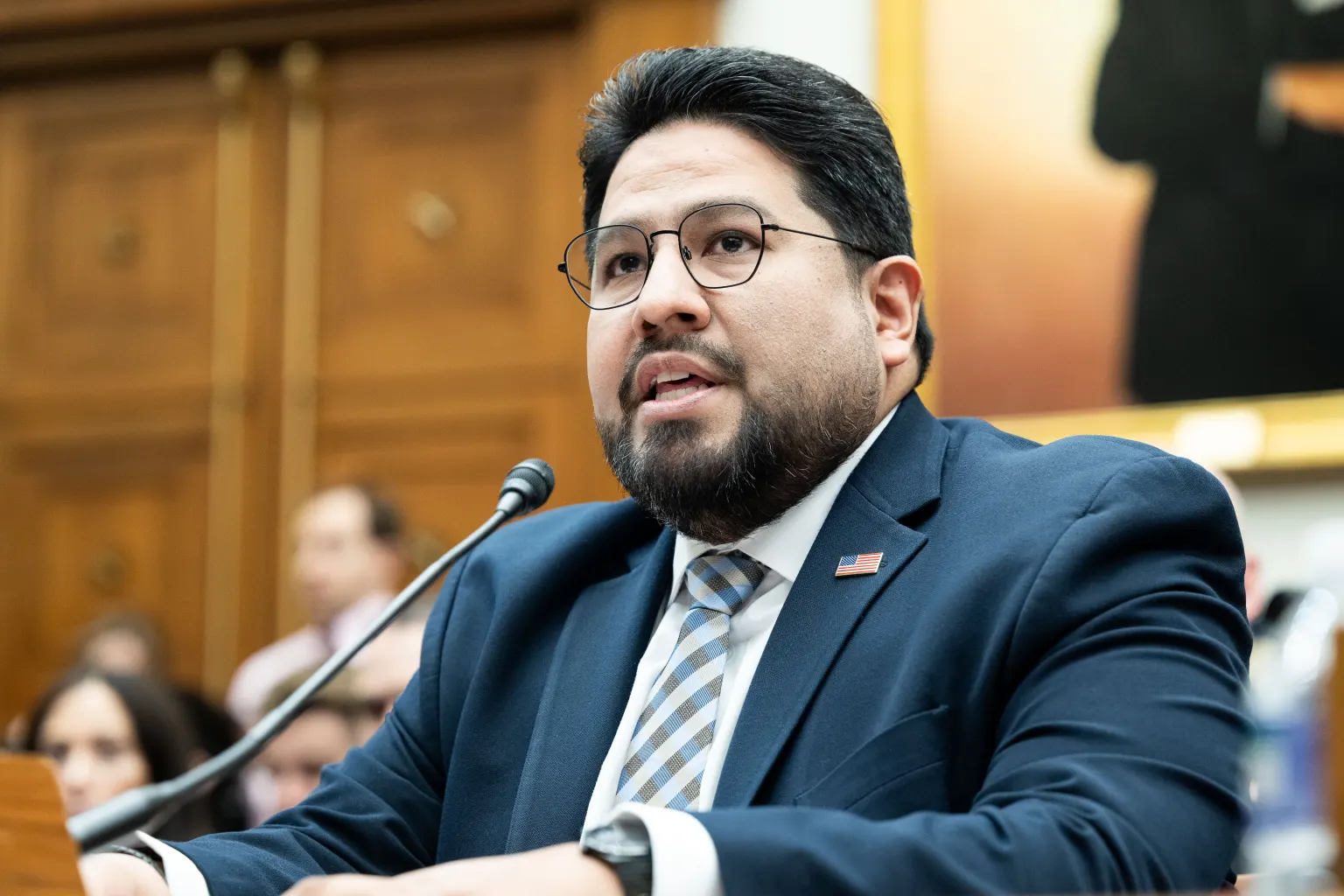
Photo caption: Joseph Humire, Acting Undersecretary of War for National Defense and Security Affairs of the Americas, during his speech at a hearing of the House Armed Services Committee held in Washington, D.C., March 17, 2026. Photo: Michael Brochstein/Sipa USA via AP Images
In January, the United States attacked Venezuela and kidnapped the country’s president, Nicolás Maduro. Now he rules the country through a puppet regime. Federal prosecutors have reportedly drafted a criminal indictment against Venezuela’s interim president, Delcy Rodriguez, and threaten her with corruption and money laundering charges if she fails to comply with Trump administration orders. The president also recently hinted at the possibility of making Venezuela the 51st U.S. state.
The government is reportedly developing an operation to bring about regime change in Cuba with the aim of overthrowing President Miguel Díaz-Canel as a precondition for negotiations between the United States and that island nation. U.S. officials are said to be leaning toward Raul Guillermo Rodriguez Castro, grandson of Raul Castro, 94, former Cuban president and brother of Cuba’s leader between 1959 and 2008. Díaz-Canel spoke on X on Tuesday night about Washington’s plans to “take over the country” and said he would encounter “unbeatable resistance.”
“I have Cuba under control,” Trump said recently, noting that his costly war to change the regime in Western Asia is of priority at the moment. “We will take care of Iran before Cuba.” Trump imposed an oil blockade on the island in January, which plunged the country into a humanitarian crisis. The national electricity grid of the antille has already collapsed three times this month, with a blackout that lasted more than 29 hours. U.N. human rights experts condemned Trump’s fuel embargo as “a grave violation of international law and a grave threat to a democratic and equitable international order.”
The tycoon, who has repeatedly spoken of ” taking ” Cuba, is the latest in a long list of U.S. presidents who have tried to overthrow the Cuban government. During the Cold War the CIA carried out the disastrous invasion of bay of Pigs in 1961. The agency also tried to assassinate Fidel Castro on at least eight occasions. The United States also carried out a covert campaign of bombings against the country’s sugar mills and burning cane fields, among other acts of sabotage.
Following the failure of the Bay of Pigs, the Pentagon drew up top-secret plans to pave the way for an attack on the island. In the spring of 1962 the Joint Chiefs of Staff distributed a top secret memo entitled “Justification of U.S. military intervention in Cuba.” It described numerous false flag operations that could be used to justify a U.S. invasion, including a plot to “sink a ship loaded with Cuban refugees (real or simulated)” and even stage a modern incident in the style of “Remember the Maine” by blowing up an American ship in Cuban waters and thus blaming Cuba for the fact. Other plans by the country for covert actions on the island gave specific priority to the attack on Cuba’s electricity grid.
When asked if the Joint Chiefs of Staff was currently participating in similar actions, the spokeswoman, Commander Annabel Monroe, referred The Intercept to the Southern Command, which in turn referred The Intercept to the State Department, which did not respond to the request for comment.
Humire claimed that the War Department was “currently focused on partner-led deterrence operations” but did not rule out the possibility of unilateral U.S. actions across Latin America. He pointed out that, in addition to Ecuador, Washington had signed agreements with 17 partner countries in the Western Hemisphere, within the framework of the so-called Coalition of the Americas against the cartels. This international body, officially announced by Trump at its “Escudo de las Américas ” summit earlier this March, will focus on “bilateral and multilateral operations against cartels and terrorist organizations.”
Humire was asked whether any of the 18 countries were concerned about sovereignty issues regarding the possibility of the United States carrying out attacks on their territories. “The coalition members specifically signed a joint security declaration in which they mentioned that they want this support and that most of them are looking for it,” he said. However, the brief statement they signed is surprisingly vague and offers little concrete information about it.
Humire also pointed out that the United States had resorted to the diplomacy of gunboats in Venezuela to pressure Cuba and contribute to “achieving the submission of Nicaragua”, as well as “orienting the Caribbean in a direction favorable to American interests.”
Recent official leaks over the possible formal indictment of the United States against Colombian President Gustavo Petro for drug-related crimes — the official motive for Maduro’s kidnapping and reportedly used to keep his successor, Rodriguez, at bay — suggest that the United States could use that tactic as a measure of pressure, or as a pretext, for eventual military action.
Petro has denied having ties to drug traffickers. “It seems that Petro could be on the spotlight,” a former defense official, who spoke on condition of anonymity due to his current employment, told The Intercept. The source said the leaks about the possible accusation against Petro, along with the U.S.-Ecuadorian attack — which has stoked tensions on the border between the two South American countries — increasingly seem like a coordinated campaign to foster “discord,” but rather the conflict. When asked in January about attacking Colombia, Trump replied, “I think it’s okay.”
U.S. maneuvers on the border between Colombia and Ecuador come after the United States has recently established a “permanent FBI presence in Ecuador,” joined by officials from the U.S. Drug Enforcement Agency (DEA) and the Department of Homeland Security. Just before Washington began attacks on the border between those two countries, Donovan traveled to Quito, Ecuador’s capital, to meet with President Daniel Noboa and senior Ecuadorian defense officials.
In August 2025, Lt. Col. Phillip Vaughn, commander of an Expeditionary Task Force tasked with overseeing Air Force special operations in the Caribbean and South America, coordinated a series of meetings aimed at improving “interoperability between U.S. and Ecuadorian forces” in order to “combat illicit actors operating along the northern border of Ecuador” with Colombia, including “scenarios
The American offensive in the Western Hemisphere is part of what Trump and others have called the “Donroe Doctrine”: a distorted version of the Monroe Doctrine of 1823. While President James Monroe’s policy aimed to prevent Europe from colonizing and interfering in the Western Hemisphere, Trump has wielded his variant as a license for the United States to do just that.
The National Security Strategy, released late last year, defines the “Trump Corollary” to the Monroe Doctrine as a “powerful restoration of American power and priorities,” based on the “readjustment of our global military presence to address urgent threats in our hemisphere.” Humire defined the “immediate security perimeter of the United States” as “from Alaska to Greenland in the Arctic, through the Gulf of America, the Panama Canal and the surrounding countries.” Trump has also threatened to annex Greenland — and possibly Iceland — to turn Canada into one of its states and deploy military strikes in Mexico.
Humire also detailed efforts to pressure Panama to break its ties with China and thus guarantee access to the Panamanian property channel, which, however, he called a “U.S. national asset.”
In addition to his wars in the Western Hemisphere, Trump has also launched attacks on Iran, Iraq, Nigeria, Somalia, Syria and Yemen during his second term, most of them scenarios of U.S. conflicts during the war on terror.
Smith, the top member of the House Armed Services Committee, told Humire that Trump’s wars in America also appeared to be transforming into a new “eternal conflict” without a clear goal or a “end point.” When asked what “level of achievement” would be needed to “stop kinetic action,” Humire responded with a torrent of words about border security, terrorism and cartels. When Smith interrupted him to clarify whether attacks on the vessels would continue unceasingly, Humire replied confusingly, “No, right.”
This article was originally published on The Intercept on March 23, 2026
Bastards are overextending themselves. Good.
When the sudden collapse comes, it’ll be spectacular.
The Global South will have the last laugh.
imo, this is craig murray’s best work; very near a long awaited redemption. truth rises from empire’s murk of spin & lies & it is resolute. suddenly i understand why in the photographs of a handcuffed/blindfolded maduro, he was smiling & all but danced in spite of a noticeable limp.… Read more »
apologies…obviously this is OT & ought to have been a reply to craig murray’s report on venezuela.