

China’s mediation in Cambodia-Thailand conflict
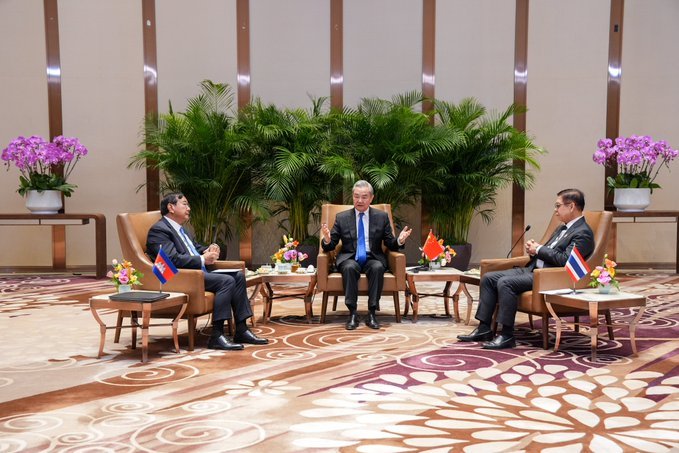
Trump again, by inference, claimed some kind of influence on the Cambodia-Thailand mediation for a lasting peace agreement. China, in turn, said little, but created a media extravaganza with photos. They posted the images at the Foreign Affairs site to show who was responsible and a real part of the process and left the Chinese Press in English to editorialize and tell the story.
I’ve watched the Chinese Foreign Office develop over many years from the first days when they were stiff, formal, and correct. Now they feel like old friends. We’ve been through the wolf-warrior period, the period where the spokespeople comically resorted to using flash cards for the western press, the day a spokesperson lost it and blasted the message (about Hong Kong at the time).
Now they can steer a media campaign excellently. They’ve not only grown into a more professional organization but with more experience, have developed into diplomats that are beloved by the Chinese People. These people are rock stars! They say what they do and do what they say. China’s ‘opening up’ is epitomized by their Foreign Affairs office.
At the trilateral Foreign Ministers’ meeting, Chinese FM Wang Yi said: Since the outbreak of the border conflict between #Cambodia and #Thailand, #China has upheld the spirit of the Global Security Initiative proposed by President Xi Jinping and actively engaged in mediation and… pic.twitter.com/ccgzpJCOhF
— Lin Jian 林剑 (@SpoxCHN_LinJian) December 29, 2025
Wang Yi Meets with Deputy Prime Minister and Minister of Foreign Affairs and International Cooperation of Cambodia Prak Sokhonn
Press Release of China-Cambodia-Thailand Fuxian Meeting
On 28 and 29 December 2025, Foreign Ministers and senior military officials of China, Cambodia and Thailand held a meeting by the Fuxian Lake, Yunnan Province of China. China welcomed the Joint Statement of the 3rd Special General Border Committee (GBC) Meeting signed between Cambodia and Thailand on 27 December 2025. The three sides stressed that the Joint Statement serves the fundamental and long-term interests of the people of the two countries. It sends out a positive signal, and is conducive to peace and stability of the region. It fully demonstrates that dialogue and consultation is a practical and effective way to resolve complex disputes.
The three sides had in-depth exchanges on consolidating ceasefire and working step by step through mutual efforts to resume normal exchanges, rebuild political mutual trust, improve Cambodia-Thailand bilateral relations, and safeguard regional stability, with the key outcomes as follows:
1.The immediate priority is to consolidate the ceasefire, and ensure full and effective implementation of the Joint Statement. China supports the commitment of Cambodia and Thailand in this regard through mutual efforts with a view to ensuring that it is comprehensive and lasting, and laying the foundation for rebuilding peace. In this connection, the three sides support the Joint Boundary Commission in accordance with the Joint Statement of the 3rd Special GBC Meeting on 27 December 2025.China is ready to provide all necessary support to Cambodia and Thailand in advancing humanitarian de-mining through the Joint Coordinating Task Force and bilateral arrangements, and to provide substantive assistance for the ASEAN Observer Team (AOT) to ensure its effective functioning. The Chinese military will maintain contact with the Cambodian and Thai militaries to provide support for the consolidation of ceasefire, when necessary and upon request by both Cambodia and Thailand.
2.The next key step is to work towards resuming normal exchanges. China welcomes the efforts of Cambodia and Thailand to endeavour to resume exchanges and communication in all areas and all levels, with a view to restoring exchanges and cooperation, and restoring livelihood of the displaced people in the border areas in accordance with the Joint Statement of the 3rd Special GBC Meeting on 27 December 2025.China is ready to provide humanitarian assistance immediately for livelihood needs of the displaced people in the affected border areas.
3.Cambodia and Thailand will work to rebuild political mutual trust. China welcomes the efforts of Cambodia and Thailand to rebuild engagement through diplomatic channels, and to promote contact between the two Foreign Ministers. Cambodia and Thailand agree to foster a sound atmosphere for the planned Fifth Lancang-Mekong Cooperation Leaders’ Meeting to be held in Thailand at appropriate time, and ensure its success.
4. The long-term goal is to improve Cambodia-Thailand bilateral relations. China encourages Cambodia and Thailand to create conditions for resuming normal diplomatic relations step by step. China is willing to provide platform,when necessary, for the two sides to conduct more comprehensive and effective communication.
5.The shared responsibility is to safeguard regional stability. Cambodia and Thailand express their commitment to settling disputes by peaceful means, and to making concerted efforts with regional countries to address common risks and challenges, in accordance with the United Nations Charter, the ASEAN Charter, and the Treaty of Amity and Cooperation in Southeast Asia. The three countries agree to take more effective measures to combat transboundary crimes such as telecom and online scams, to protect the life and property of the people in the region.
Cambodia and Thailand appreciate China’s strong support in promoting talks between the two countries, taking into account the comfort levels of both sides. In the spirit of the Anning Outcome, China will continue to play a constructive role in facilitating the rebuilding of trust and achieving lasting peace between Cambodia and Thailand in the Asian way, with the aim of building a community with a shared future with neighbouring countries.
: Global Times editorial: It’s no accident the intl community widely recognizes China’s mediation in Cambodia-Thailand conflict
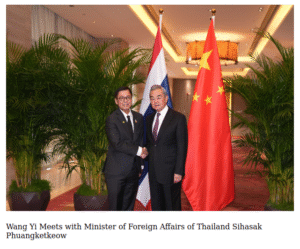
On Saturday, Cambodia and Thailand signed a joint statement agreeing to a ceasefire at the Special General Border Committee (GBC) meeting. Immediately afterward, Deputy Prime Minister and Minister of Foreign Affairs and International Cooperation of Cambodia Prak Sokhonn and Minister of Foreign Affairs of Thailand Sihasak Phuangketkeow lead delegations to meet in Yunnan from Sunday to Monday. During the mediation, both Cambodia and Thailand expressed appreciation and gratitude for China’s positive role. International opinion widely holds that, in what has been called “one of the most serious armed confrontations between ASEAN countries since the end of the Cold War,” China played a key mediating role in bringing the two sides to a ceasefire.
The Cambodia-Thailand border conflict has dragged on for weeks, causing heavy casualties and forcing hundreds of thousands of people from their homes. It poses a direct challenge to regional peace and stability while also affecting the overall unity and cooperation within ASEAN. For a long time, international conflict mediation has encountered multiple structural difficulties, such as the sovereignty and independence of the parties involved, the impartiality of the mediator, and the uncertainty of outcomes. Moreover, traditional mediation led by Western countries has frequently placed heavy emphasis on so-called “human rights” and “democratic transformation,” even taking sides or using coercive pressure to force the parties involved to quickly sign agreements, often complicating and worsening conflicts. Such approaches, marked by Western-centrism, have also faced deep trust deficits.
In this Cambodia-Thailand conflict, not only did both parties thank China, but regional countries broadly welcomed its efforts – even typically critical Western media acknowledged China’s mediation this time. This was no coincidence.
Since the situation grew tense, China has consistently upheld an objective and impartial stance, conducting multiple rounds of shuttle diplomacy and providing a high-level platform for direct talks between the two sides. Several key points clearly emerge from this. First, China avoided taking sides or forming factions, instead acting as “a friend and close neighbor to both countries” to promote de-escalation and ceasefire – a concrete manifestation of the principle that “our security and safety are bound together.” Second, it did not overstep its role, stressing its “support for ASEAN’s mediation efforts” – a steadfast adherence to its longstanding commitment to upholding ASEAN centrality. Third, it refrained from fanning the flames, maintaining throughout that “dialogue and consultation are a viable and effective way to resolve complex disputes,” with its diplomatic actions demonstrating rationality, pragmatism, and a non-confrontational approach. Fourth, it attached no political conditions whatsoever, making the parties involved feel comfortable and providing humanitarian supplies to Cambodia – the first batch of which has already arrived in Phnom Penh – vividly embodying the humanitarian spirit of “standing together through thick and thin.”
China has clearly stated that it will “play a constructive role in its own way for Cambodia and Thailand to consolidate the ceasefire, resume exchanges, rebuild political trust, achieve turnaround in bilateral relations and uphold regional peace.” This indicates that China’s goals extend far beyond merely establishing a temporary ceasefire agreement; it is committed to promoting a fundamental improvement in the relationship between the two sides.
The Cambodia-Thailand conflict stems from long-standing border disputes. China hopes to use the ceasefire as an opportunity to promote the establishment of a long-term dialogue mechanism, helping both Cambodia and Thailand gradually resolve historical issues and embark on a path toward long-lasting peace. China’s mediation efforts are not about imposing its own solutions on others; rather, it always respects the sovereignty of the parties involved and the central role of ASEAN. With a sincere attitude and flexible diplomatic wisdom, China aims to “build bridges” for resolving conflicts, and the results are evident.
The recent series of mediation practices, which builds on previous initiatives that facilitated reconciliation between Saudi Arabia and Iran, have made it increasingly clear to the world China’s unique path of participation in global conflict governance. Unlike many past mediations dominated by the West, China does not adopt a condescending approach, impose political conditions, or seek geopolitical advantages. This new mediation paradigm is rooted in the fundamental principle of “shared destiny,” and addresses the trust dilemmas inherent in traditional international conflict mediation. The parties involved need not worry about bias from the mediator or fear encroachments on their sovereignty; instead, they can choose to trust in the sincerity and goodwill of “friends and neighbors.” The willingness of Cambodia and Thailand to engage in negotiations in China immediately following the ceasefire reflects a strong recognition of China’s fairness and reliability, as well as their confidence in China’s diplomatic philosophy.
From the Palestine-Israel conflict and the Iran nuclear issue to the Yemen issue, and the Syria issue, and Cambodia-Thailand conflict, China has consistently engaged constructively in resolving global hotspot issues. China’s value is further reflected in its advocacy for and its practice of building a community with a shared future for humanity.
Cambodia and Thailand are closely connected with China and are important partners in the Belt and Road Initiative. China’s active efforts in facilitating dialogue for peace represent a vivid practice of a model of security for Asia that features security for all, seeks common ground while shelving differences, and promotes dialogue. These efforts also provide endogenous momentum and lasting support for conflict resolution. They demonstrate to the world that Chinese wisdom and concepts are not abstract ideas but are embodied in a series of concrete and tangible actions for peace. This is the certainty and positive energy that China offers to a world filled with uncertainties.