

Mightier Dragon: The J-20 Grows Up
This is from Godfree Roberts and his substack is https://herecomeschina.substack.com/
In 2021 China completed the world’s fastest hypersonic wind tunnel, capable of Mach 30 airflow speeds, while America’s latest, at the University of Notre Dame reaches only Mach 10. While the generational gap in fighter jets draws attention, the disparity in scientific infrastructure is even more striking. In fact, the Pentagon has considered bypassing wind tunnel testing altogether, opting instead for direct flight tests, reflecting how a lack of high-end testing platforms has placed the US in a reactive position. Charriot Zhai
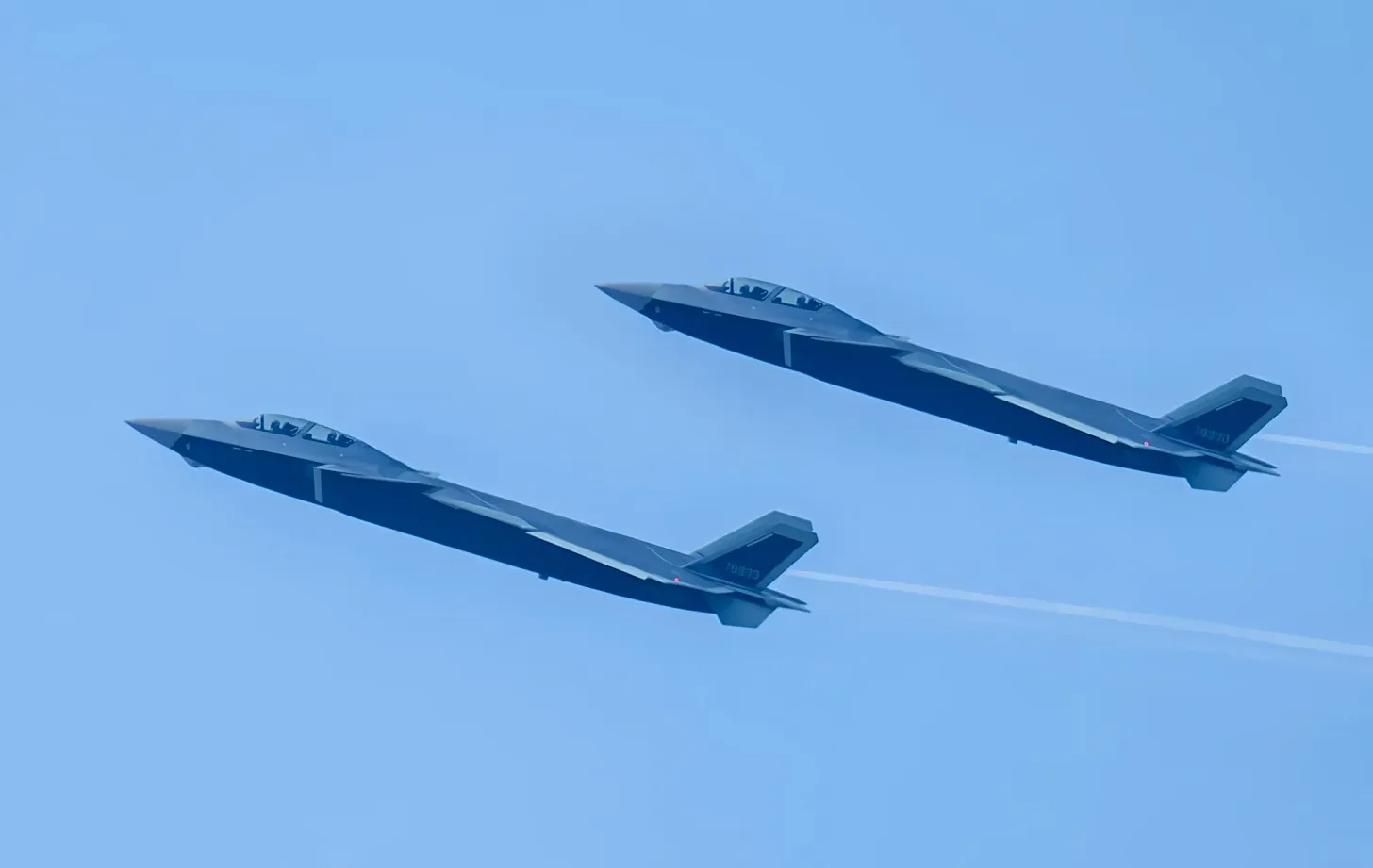
Rumors of a two-seat version of the J-20 emerged in 2018 and the twin-seater J-20S was unveiled at the Zhuhai Airshow last year. Now there are rumors that it might be designated as operational in September, on the 80th anniversary of Japan’s defeat in World War II. While much attention has been placed on China’s fourth-generation jets and two and sixth-generation aircraft are now under test, the J-20 remains the most important tactical jet program as these upgrades demonstrate.
The package
With its radar-absorbing materials and low-observable shape, 2,000 km combat radius, massive internal weapons bay and advanced electronic countermeasures (ECM) to disrupt enemy detection and communications, the J-20 is well suited for long-range strike and air superiority missions. Its active electronically scanned array (AESA) radar offers better target detection and tracking than rivals’, and its integrated sensor fusion–as demonstrated by the Pakistan Air Force–combines data from radar, infrared, and satellites for enhanced situational awareness.
Its a mix of air-to-air missiles, like the PL-15 and PL-10, and precision-guided munitions in internal bays preserve its stealth profile while allowing long-range engagement. External hardpoints hold additional payloads.
Number go up
Since Chengdu Aerospace1 switched from production lines to pulsed manufacturing2, each aircraft advances at intervals. Each station completes its task within a set time (takt time) and the line pauses until all stations are ready to move forward. The result? Output of J-20s rose to 120 this year, compared to Lockheed Martin’s 156 F-35s. And while the F-35 uses fuel-hogging afterburners to reach supersonic speeds, the J-20’s engines let it cruise supersonically without afterburners, for fuel-efficient high-speed operations and superior range.
Engines

Shenyang Liming, maker of the J-20’s WS-15 engine, above, took 19 years to bring it to production. Its 181 kN of thrust give the J-20 fuel-efficient supersonic cruise speed without afterburners (‘supercruise’) and its 360º thrust-vectoring provides more agility than the F-22’s 180º. Since the J-20 is a twin, Shenyang Liming must produce at least 240 engines for the new planes plus 20-30 spares, for an annual output approaching 300 engines. Plus, of course, engines for its accompanying drones.
Pratt & Whitney’s F119 engine, which powers the legendary F-22 Raptor, took 26 years to reach production. Its 156 kN of thrust makes super cruise possible for the Raptor. But Pratt & Whitney’s F135 engine gives the F-35 just 125 kN of thrust, making it incapable of supercruise. P&W makes 160 of them annually.
Drones: two heads better

The twin seat J-20, above, now in service, is the first 5G fighter with a weapons officer to guide its drones–a concept we have discussed in the past. Loyal Wingman drones will accompany and probably precede crewed aircraft into battle and fly deeper into hostile airspace, clearing a way through air defenses and otherwise supporting crewed aircraft. Without heavy, expensive pilot support systems, drones weigh and cost considerably less than the J-20, and are more amenable to mass production and, probably, a single engine.
Strategic deployment

Most of the airframe is painted dark gray, except the leading and trailing edges, intake lips and radome, perhaps indicating a new radar-absorbent coating to enhance low observability. Thomas Newdick
The J-20’s combat radius is 1,200 nautical miles (2,000–2,200 km) with internal fuel, and it has a retractable refueling probe. Its A2/AD role prioritizes targeting US bases within range of an unrefueled attack launched from Hainan’s Lingshui Air Base. Vulnerable air bases include Kadena, Okinawa (750 nautical miles); Futenma, Okinawa (750 nm) and Yokota, Japan (1,600 nm).
There is little doubt that the J-20 is the world’s premier fighter-bomber and, on current form, will remain so for the next quarter century. A sobering thought for the once-mighty US Air Force.
—
Chengdu’s rival, Shenyang Aerospace, just expanded its factory to 280,000 sq.m., dwarfing Lockheed Martin’s F-35 facilities, with capacity to build 200+ advanced fighters annually – surpassing America’s F-35 production at its peak. The factory’s four pulse assembly lines could soon make China the top global arms exporter.
Traditional production lines move products continuously through independent workstations.