

President Putin: Meeting with Government members
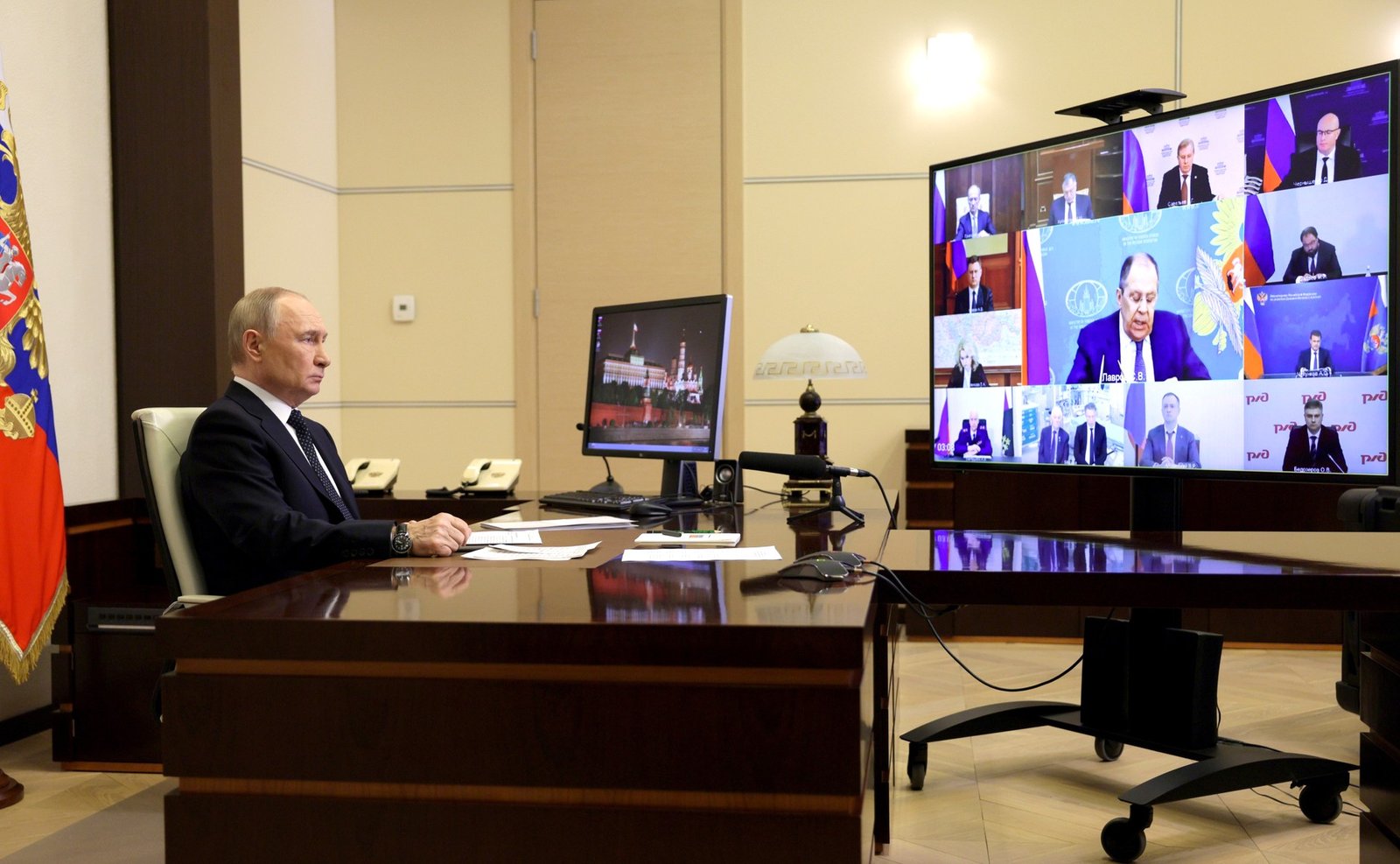
The President held a meeting with Government members, via videoconference.
Formal Kremlin Summary:
Vladimir Putin spoke on the recent terrorist attacks in the Bryansk and Kursk regions. Some of the key takeaways:
🔸The Government and regional authorities were instructed to take all necessary measures to help the families of the victims and the injured.
🔸The incident in the Bryansk region was an intentional attack on civilians. International law deems such acts terrorism.
🔸The decisions to blow up railways in the Bryansk and Kursk regions were most certainly made by the political authorities of Ukraine.
🔸The crimes against civilians, committed ahead of the next round of the peace talks that had been proposed by Russia, were undoubtedly an attempt to disrupt the negotiations.
🔸The strike on civilians was intentional, and this only serves to confirm Russia’s concerns that the illegitimate Kiev regime is gradually devolving into a terrorist organisation, with its sponsors becoming accomplices of terrorists.
President of Russia Vladimir Putin: Colleagues, good afternoon.
Today, during our regular Government meeting, we will discuss ways to ensure technological sovereignty with regard to communication services.
But before we begin, I would like to ask Mr Medinsky to share the results of his trip and talks in Istanbul.
Mr Medinsky, please.
Presidential Aide Vladimir Medinsky: Mr President, colleagues,
Be advised, the bilateral talks in Istanbul began with a restricted-format meeting that lasted more than three hours, followed by an expanded discussion, which included members of the delegations. The discussion was in Russian.
We presented the other side with our two-part draft memorandum on a peaceful settlement. The first part contained terms for a long-term peace agreement. The second part spelled out the ceasefire terms. The memorandum is guided by the basic principles that you formulated at the Foreign Ministry last June. The Ukrainian side promised to study it and give its comments later.
In general, during the talks, they reaffirmed their proposals, which basically include two main points. First, they want to begin with a 30- or 60-day unconditional ceasefire. Second, this ceasefire period is to be used to prepare for a summit meeting of the two heads of state. They set it all out in their version of the memorandum, which was handed over to us on May 28.
Humanitarian issues were also discussed on the sidelines. We called for focusing on working out the terms of peace rather than another temporary truce, and conveyed your opinion that a meeting at the level of heads of state is possible, but it needs to be substantively prepared to achieve results. The heads of state should approve agreements, not spend time working out the details. It is up to them to make final decisions on the drafts that have been fully prepared and coordinated.
When it comes to humanitarian issues, we agreed on the following.
First. Conduct an equal prisoner of war exchange, at least 1,000 people from either side, primarily from among those wounded, severely ill and below the age of 25. The final numbers of this equal exchange are being approved. We expect approximately 1,200 people from either side. It will be the biggest POW swap on record. We are ready to begin on June 7–9. We are fully prepared.
Second. Establish a communication line to promptly resolve urgent issues of immediate transfers of gravely wounded prisoners of war outside the framework of general exchanges.
Third. We proposed, unilaterally, to transfer to Kiev over 6,000 bodies of Ukrainian troops. They will be transferred using refrigerator cars where they are currently kept. We are ready to begin shortly. We understand Ukraine may have bodies of our troops as well although in much smaller numbers. But we are ready to take them over, if any.
Next. We have proposed arranging humanitarian pauses in certain sectors of the front, two or three days at a time, to collect remains, because it is impossible to do so under fire, for security reasons. Initially, they upheld our proposal and took it in, but literally two hours later, Zelensky publicly declined this potential agreement. Nevertheless, we are ready to revisit it.
Finally, the Ukrainian side handed over to us the list of 339 children allegedly kidnapped from the territory of Ukraine. Here is the list. We are working on it, through the office of the Commissioner for Children’s Rights. We will investigate every name.
But I must note that, for propaganda purposes, they earlier claimed that tens and hundreds of thousands of children had been brought over here. In fact, the actual number is 339 and we still need to check how many are in Russia, evacuated by our soldiers from under fire, and how many will eventually turn up in Europe, as experience shows.
Mr President, to conclude, we have established an effective communication channel on humanitarian issues. For other matters, the ball is in their court.
My report is complete. Thank you.
Vladimir Putin: Thank you.
Mr Lavrov, what do you think of the outcome of the talks?
Foreign Minister Sergei Lavrov: Thank you, Mr President.
Colleagues,
Mr Medinsky spoke about the main results. I believe that this is important and useful. The process of direct talks, which you previously agreed on in one of the latest telephone conversations with Donald Trump, is underway.
As we know, both rounds yielded tangible results, including the 1,000 for 1,000 POWs swap. Now, as head of our delegation Vladimir Medinsky said, additional agreements on a new swap, which is as large as the previous one, and not just of war prisoners in equal proportions, but also of the seriously wounded, the sick, plus the return of the dead bodies, have been made.
I believe it is better to always have a channel of communication. It enables us to address urgent humanitarian concerns above all else. At this stage, the coordination of reciprocal humanitarian measures as goodwill gestures and steps toward building trust is especially vital. As I have noted, we are seeing real progress in this area.
In light of what was just mentioned regarding the proposal for a brief two- or three-day pause to allow for the dignified recovery of the bodies of the deceased along parts of the contact line – where wounded individuals may still remain – I consider Kiev’s categorical and harsh rejection of this initiative to be a grave mistake. This comes on top of similar refusals of our proposals for humanitarian pauses during Easter and during the celebrations of the 80th anniversary of the Great Victory.
Nevertheless, Mr President, despite all this, and despite the serious criminal provocations that have taken place in recent days, I believe it is important not to fall into the trap of these provocations, which are clearly designed to derail the talks and continue arms deliveries from European nations.
I believe that all means to achieve the just goals of the special military operation, including negotiations, must be put to use. The Foreign Ministry is actively engaged in Vladimir Medinsky’s delegation.
Vladimir Putin: I agree. There was a report that there also was some comment made by the Ukrainian side about the composition and level of our delegation.
Sergei Lavrov: Yes, Mr President, the comment was anonymous, but it was spread in the media. Nobody approached us with specific questions or specific ideas. Journalists asked about this, and we explained what the level of assistant to the President of the Russian Federation means.
Vladimir Putin: Mr Medinsky, was there anything?
Vladimir Medinsky: No, Mr President, I told you everything. Thank you.
Vladimir Putin: Okay, good. Thank you very much.
I invited Mr Bastrykin to our meeting. I would like to ask him to report on the results of the investigation into the railway explosions in the Bryansk and Kursk Regions.
Mr Bastrykin, go ahead, please.
Chairman of the Investigative Committee Alexander Bastrykin: Mr President,
On June 1, 2025, the Investigative Committee opened and is currently investigating three criminal cases of terrorist attacks on railway infrastructure facilities in the Bryansk and Kursk Regions.
As a result, a passenger and a freight train were derailed, resulting in fatalities and injuries of varying severity among civilians and railway personnel.
The first attack occurred at 10:33 p.m. on May 31, 2025, at the 43rd kilometre of the Pilshino–Vygonichi section of the Moscow Railway in the Bryansk Region. Three explosive devices were detonated, causing the collapse of a road overpass above the railway tracks.
A passenger train travelling from Klimovo to Moscow, carrying 388 passengers, collided with the fallen debris. The locomotive and the first two carriages were derailed.
As a result, 122 individuals were affected. Tragically, seven people lost their lives: the train driver and six passengers. A total of 66 people were physically injured, including four young children.
The locations of the three explosive devices have been identified, and their components recovered. Experts have determined that the devices were fitted with a foreign-manufactured plastic explosive, with an estimated yield of approximately 15 kg in TNT equivalent. Significantly, it was also established that a Ukrainian-manufactured LoRa control unit was used to carry out the detonation.
The second terrorist attack occurred on the night of June 1, 2025. A railway bridge at the intersection of the 43rd kilometre of the Trosna-Kalinovka highway in the Kursk Region was blown up.
The destruction of the railway tracks resulted in the derailment and crash of a train of empty freight cars transported along the Bryansk–Ostapovo–Mikhailovsky Rudnik route. The locomotive caught fire, and the train driver and two of his assistants received bodily injuries of varying severity.
An inspection of the incident site established that five improvised explosive devices had been detonated simultaneously on the railway track and beneath the supports of a railway bridge. According to expert assessments, the devices were loaded with a foreign-made plastic explosive.
Explosive ordnance disposal specialists involved in the inspection determined that the devices had been activated using the same Ukrainian-made LoRa control modules installed on the railway tracks.
The third terrorist attack occurred on the morning of June 1 in the Bryansk Region. Five explosive devices were detonated beneath the railway track at the sixth kilometre of the Unecha-Zhecha section, as an RZhD (Russian Railways) diagnostic locomotive was passing through.
The detonation occurred directly beneath the locomotive. The railway track and the locomotive were damaged. Two unexploded devices were discovered at the crime scene with the assistance of experts. The confiscated foreign-made plastic explosive weighed at least two kilogrammes.
Preliminary estimates indicate that the total damage caused by these terrorist attacks amounts to over one billion rubles. The investigation is being conducted in close coordination with the FSB and the Interior Ministry.
I would like to report that from May 20 to 25, joint operational activities aimed at detecting and neutralising a Ukrainian sabotage and reconnaissance group were carried out in the Bryansk Region by the FSB, Rosgvardiya, the Interior Ministry, and the Defence Ministry,.
During these efforts, on May 22, a cache containing 13 kilogrammes of plastic explosive and Ukrainian-made LoRa control modules used by Ukrainian special operations services was discovered near the village of Myakishevo.
All three terrorist attacks involved the same professional method for placing explosive devices, the same type of foreign-made plastic explosive, and the same Ukrainian-made LoRa control modules. Identical modules were found in the cache as well.
Thus, the evidence collected by investigators with the assistance of experts clearly indicates that all three terrorist attacks were, without a doubt, plotted and executed by the Ukrainian intelligence services. The investigation is underway to identify all perpetrators and organisers of the attacks.
That concludes my report.
Vladimir Putin: Thank you.
Vladimir Putin: Mr Medinsky, was there anything?
Vladimir Medinsky: No, Mr President, I told you everything. Thank you.
Vladimir Putin: Okay, good. Thank you very much.
I invited Mr Bastrykin to our meeting. I would like to ask him to report on the results of the investigation into the railway explosions in the Bryansk and Kursk Regions.
Mr Bastrykin, go ahead, please.
Chairman of the Investigative Committee Alexander Bastrykin: Mr President,
On June 1, 2025, the Investigative Committee opened and is currently investigating three criminal cases of terrorist attacks on railway infrastructure facilities in the Bryansk and Kursk Regions.
As a result, a passenger and a freight train were derailed, resulting in fatalities and injuries of varying severity among civilians and railway personnel.
The first attack occurred at 10:33 p.m. on May 31, 2025, at the 43rd kilometre of the Pilshino–Vygonichi section of the Moscow Railway in the Bryansk Region. Three explosive devices were detonated, causing the collapse of a road overpass above the railway tracks.
A passenger train travelling from Klimovo to Moscow, carrying 388 passengers, collided with the fallen debris. The locomotive and the first two carriages were derailed.
As a result, 122 individuals were affected. Tragically, seven people lost their lives: the train driver and six passengers. A total of 66 people were physically injured, including four young children.
The locations of the three explosive devices have been identified, and their components recovered. Experts have determined that the devices were fitted with a foreign-manufactured plastic explosive, with an estimated yield of approximately 15 kg in TNT equivalent. Significantly, it was also established that a Ukrainian-manufactured LoRa control unit was used to carry out the detonation.
The second terrorist attack occurred on the night of June 1, 2025. A railway bridge at the intersection of the 43rd kilometre of the Trosna-Kalinovka highway in the Kursk Region was blown up.
The destruction of the railway tracks resulted in the derailment and crash of a train of empty freight cars transported along the Bryansk–Ostapovo–Mikhailovsky Rudnik route. The locomotive caught fire, and the train driver and two of his assistants received bodily injuries of varying severity.
An inspection of the incident site established that five improvised explosive devices had been detonated simultaneously on the railway track and beneath the supports of a railway bridge. According to expert assessments, the devices were loaded with a foreign-made plastic explosive.
Explosive ordnance disposal specialists involved in the inspection determined that the devices had been activated using the same Ukrainian-made LoRa control modules installed on the railway tracks.
The third terrorist attack occurred on the morning of June 1 in the Bryansk Region. Five explosive devices were detonated beneath the railway track at the sixth kilometre of the Unecha-Zhecha section, as an RZhD (Russian Railways) diagnostic locomotive was passing through.
The detonation occurred directly beneath the locomotive. The railway track and the locomotive were damaged. Two unexploded devices were discovered at the crime scene with the assistance of experts. The confiscated foreign-made plastic explosive weighed at least two kilogrammes.
Preliminary estimates indicate that the total damage caused by these terrorist attacks amounts to over one billion rubles. The investigation is being conducted in close coordination with the FSB and the Interior Ministry.
I would like to report that from May 20 to 25, joint operational activities aimed at detecting and neutralising a Ukrainian sabotage and reconnaissance group were carried out in the Bryansk Region by the FSB, Rosgvardiya, the Interior Ministry, and the Defence Ministry,.
During these efforts, on May 22, a cache containing 13 kilogrammes of plastic explosive and Ukrainian-made LoRa control modules used by Ukrainian special operations services was discovered near the village of Myakishevo.
All three terrorist attacks involved the same professional method for placing explosive devices, the same type of foreign-made plastic explosive, and the same Ukrainian-made LoRa control modules. Identical modules were found in the cache as well.
Thus, the evidence collected by investigators with the assistance of experts clearly indicates that all three terrorist attacks were, without a doubt, plotted and executed by the Ukrainian intelligence services. The investigation is underway to identify all perpetrators and organisers of the attacks.
That concludes my report.
Vladimir Putin: Thank you.
I ask Mr Murashko to report on how assistance is being provided to the victims.
Minister of Healthcare Mikhail Murashko: Mr President, colleagues,
I will begin from the moment the first information was received by the emergency response centre. It came through at 10:48 pm, and within 15 minutes, the two nearest teams had arrived on site. Subsequently, at 11:15 pm, we increased the number of teams – with additional personnel from Bryansk – to 17, including disaster medicine centres and the Russian Railways (RZD) medical team.
The prescribed response protocols, as well as those we had practised in training exercises, were followed precisely. The Bryansk Disaster Medicine Centre assumed coordination responsibilities and engaged the Federal Disaster Medicine Centre. I, as head of the National Disaster Medicine Service, was informed at 11:07 pm.
Immediately upon receiving the information, full coordination of efforts was organised with the involvement of both the regional healthcare system and Russian Railways resources.
Personnel in the Bryansk Region worked cohesively. In the shortest possible time, Vygonichi Central District Hospital, Bryansk City Hospital, Bryansk Regional Hospital, and the Regional Children’s Hospital were prepared for the wounded and injured. More than 100 medical workers, who were off-duty at home, arrived at their workplaces on personal initiative and as part of the mobilisation reserve, despite it being outside working hours.
Amid night-time conditions, medical personnel worked alongside rescuers to extract victims from the debris, operating in a coordinated manner. Additionally, at temporary holding points, we deployed further emergency teams to provide necessary assistance – both psychological and medical – including to those involved in clearing the debris.
I would like to express profound gratitude to the regional leadership and my colleagues for their high professionalism and dedication in delivering medical aid. I also wish to thank the train crew for providing first aid to the victims.
To reinforce medical facilities in the Bryansk Region, we deployed 17 specialists from federal institutions and the Moscow Healthcare Department. Telemedicine consultations were conducted for all critically injured patients, including three children – with specialists from the Research Institute of Emergency Paediatric Surgery, where I am currently located, as well as the Russian Children’s Clinical Hospital and the Priorov National Medical Research Centre of Traumatology and Orthopaedics.
A total of six victims, including three children, were evacuated to federal clinics and medical institutions in Moscow. A four-month-old infant in critical condition with multiple injuries was transported by air ambulance: initially by an ambulance, followed by helicopter evacuation.
The infant’s condition has now stabilised. His seven-year-old brother was also brought here. I visited them today; all are in stable condition, surrounded by the care and attention of doctors and staff, and are feeling significantly better.
At Kievsky Railway Station in Moscow, arrangements were made to receive passengers, with medical and psychological support also deployed.
Currently, 35 people remain hospitalised, including three children, while 11 are preparing for discharge. There are no critically ill patients at this time. Outpatient care was provided to 29 individuals, including one child. Twenty-nine people have been discharged, and 56 received outpatient treatment.
Taking into account the people who sought medical help later as well, we provided medical help to 127 people in all, including psychological support to family members. The medical institutions treating the victims are fully supplied with medications, medical equipment, and blood.
I am personally monitoring the situation. That concludes my report.
Vladimir Putin: Very well. Thank you very much.
Seated next to you is a children’s doctor who we all know very well. Do you have anything to add to that, Dr Roshal?
President of the Research Institute for Emergency Children’s Surgery and Traumatology Leonid Roshal:
Good afternoon, Mr President and everyone present here.
First of all, I would like to thank you for the opportunity to take part, for the first time, in such a high-level discussion of state matters. I have some years on me, but I still remember everything very clearly. I would like to go back to 2014.
That year, a child – a boy – was brought to our clinic from Donbass. He had injuries to both legs, amputated arms, and eye problems. A very severe case. We issued an appeal to the leaders of the many countries involved asking them to come to Moscow, to sit beside this child – this was in 2014 – and to decide on how to end this war.
Unfortunately, only one person came, Mr President, and that was you. You saw this child firsthand. That was when it all started – not when the special military operation began, but long before that. In other words, we did not start it, and we must always keep it in mind.
The same applies, forgive me, to Crimea. If what has been done had not been done, Russia would have been completely cut off from the Black Sea. It was a forced measure, but a historically justified one.
Unfortunately, we are living in times that require us to be prepared for any turn of events. It is possible that terrorist attacks will continue. We must be united in our desire to achieve peace and victory.
I would like to express my thanks – I see Mr Bastrykin is here – for the help his service and he personally provided when that child was brought in for limb amputation. They played a major role in helping the children recover. Thank you very much.
Many people are holding out a helping hand. During the tragedy in Bryansk, I was in the thick of it and knew exactly what was happening. I was in contact with Bryansk and I must say that the doctors performed excellently there. Just excellently.
Some children were treated at the regional adult hospital, where there’s a pediatric neurosurgery unit, and others were in the regional children’s hospital. The doctors prevented any deterioration in the children’s condition and did everything possible to ensure their recovery.
It is rare to have this opportunity, and I want to say this, Mr President: I have seen many health ministers during my career, and I would not envy the challenges the current one has had to face. First, that terrifying infection the entire country had to cope with, and now what is happening with hostilities. And he is doing a great job. Well done!
Thank you for your attention.
Vladimir Putin: Thank you very much.
I also remember the boy you mentioned very well. I think his name was Vanya. A truly powerful example.
You mentioned the regional-level response for the victims. I would like Mr Bogomaz to say a few words about it.
Governor of the Bryansk Region Alexander Bogomaz: Good afternoon, Mr President.
I am currently at Bryansk Regional Hospital. Here, passengers of the Klimov–Moscow train who were injured in the terrorist attack by the armed forces of Ukraine are receiving treatment.
Behind me is Yulia, a cardiologist and resident of Nizhny Novgorod. Here is Tatyana, a resident of our Bryansk Region who works at the hospital. Her son is participating in the special military operation, and her condition is satisfactory.
In total, as already mentioned, 127 people sought medical assistance. Unfortunately, seven people were killed. A three-day mourning period has been declared in Bryansk from June 2.
From the time the notification of the terrorist attack was received, an operational headquarters was formed in Bryansk, incorporating all necessary services. Hotlines were set up at the Emergencies Ministry and the Department of Social Protection, where people could inquire about their relatives. As previously stated, emergency medical services worked collectively and in coordination: ambulance teams, hospital doctors, Russian Railways personnel, the Emergencies Ministry, rescuers, and the train passengers themselves.
All evacuation measures were completed within an hour and a half. All the wounded were transported to hospitals in Bryansk. Two temporary accommodation centres were set up for passengers, where doctors and psychologists provided assistance. Those who wished to continue their journey to Moscow were taken by bus to the railway station and departed for Moscow at 5 a.m.
Once all evacuation measures were completed, we immediately began clearing the debris and repairing the railway tracks. Bryansk construction workers, emergency services, railway employees, and the Moscow–Bobruisk Road Administration were involved. All operations were completed in less than 24 hours, and rail traffic resumed at 9:30 p.m. on June 1.
At the very start of the special military operation, the Bryansk Region introduced support measures for civilians who have come under attack, suffered injuries, or lost their lives. Families who have lost a loved one receive 1.5 million rubles, while those who sustained severe injuries receive 600,000 rubles, and those with minor or moderate injuries receive 300,000 rubles. All victims of this terrorist attack will receive these payments.
Mr President, I have personally overseen the situation from the first minutes until today.
This concludes my report.
Vladimir Putin: Very well. Thank you, Mr Bogomaz.
I would like to wish all the victims a speedy recovery, including those in the ward where you are now. All the best!
To be continued.