

Cultura e Resistenza: “Indépendance Cha Cha” – Le Grand Kallé: the first anthem of the Pan-African anti-colonial movements
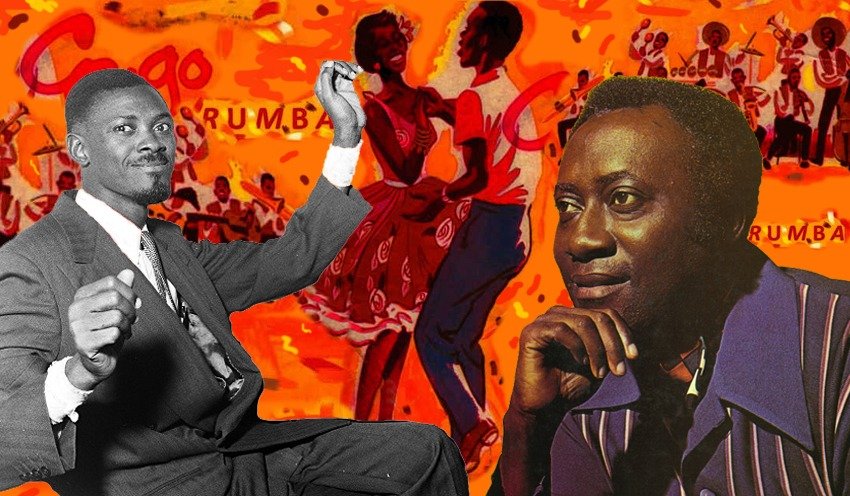
Reflections by Nora Hoppe
Today, a spirit of freedom – inspired by visions of a burgeoning multipolar world – is motivating a growing number of African nations to sever all ties with longstanding colonialist marauders. Such a spirit was always reflected in the arts, especially in music – all over the world… But, we ask, where is such music today? Here I provide an example from the past…
“Indépendance Cha Cha”
Written and composed by Joseph Kabasele (better known by his stage name “Le Grand Kallé”), one of the great Congolese singers of the 20th century, “Indépendance Cha Cha” was first performed with his group African Jazz in 1960 (the so-called “Year of Africa” during which seventeen African nations gained independence), to celebrate the imminent freedom of the “Belgian Congo” (now the Democratic Republic of Congo) from its Belgian colonial despots. Incorporating instruments and rhythms of music of the African diaspora, particularly Cuba, the song achieved considerable success and remains the best known example of Congolese rumba internationally.
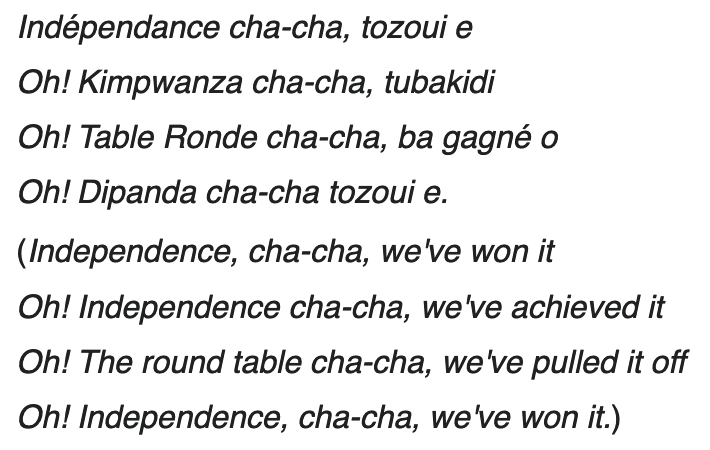
The lyrics appeal for unity amongst the various factions and leading figures of the Congo nationalist movement and praise several Congolese politicians by name. The refrain attributes the achievement of independence entirely to the Congolese people:
Joseph Kabasele Tshamala: pioneer of modern music on the African continent
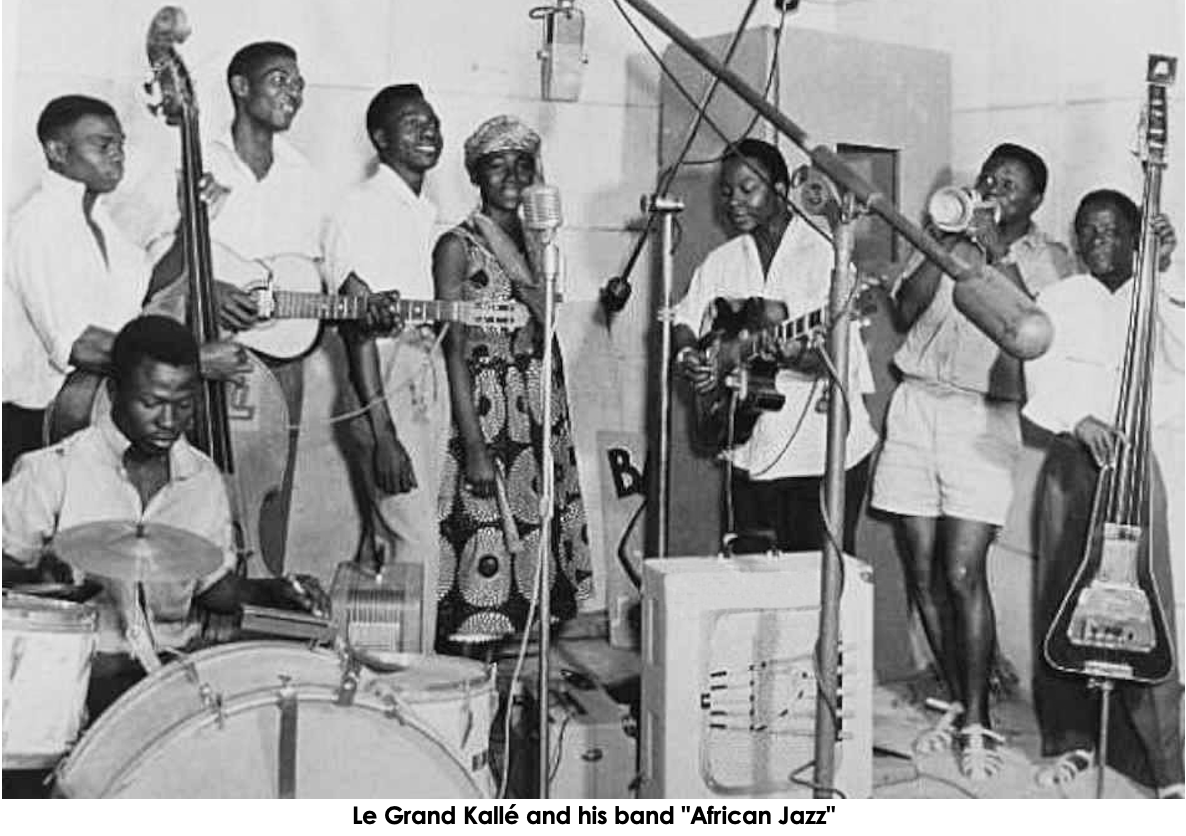
Joseph Kabasele Tshamala (1930-1983), was born in Matadi, in the Democratic Republic of Congo, then known as the Belgian Congo. In 1953, he founded the “African Jazz” orchestra with which he revolutionised Congolese music by electrifying the rumba and introducing brass music imported from Cuba and the West Indies by sailors.
The languages used in his music production were mainly Lingala (a Bantu language spoken in the north-west of the DRC), as well as Indubil (a Swahili hybrid language spoken by the youth), Afro-Cuban and French. With his group African Jazz, he was the herald of the new urban society of “Leopoldville” (Kinshasa) that sought to overcome an agonising past and aimed at a new, brighter future; his music reflected an urban mentality that, steeped in tradition, also embraced modernism. Recurring themes in Kallé’s songs are love and politics (the national union of today’s DRC and Pan-Africanism).
In January 1960, a round table brought together Congolese independence leaders, including Joseph Kasa-Vubu (the future president) and his rival Patrice Lumumba (the future prime minister), and the Belgian authorities in Brussels to negotiate the shape of the future Congo (today the Democratic Republic of Congo). At the end of the round table, the date of independence was set for 30 June 1960. It was for this occasion that Le Grand Kallé, who enjoyed a close friendship with Patrice Lumumba, composed “Indépendance cha cha”, which was broadcast to the Congo by Radio Congo Belge (and through which the Congolese learned of their country’s independence).
It immediately became the “anthem” of anti-colonial movements throughout most of Africa and the first pan-African musical hit.
On the occasion of the 30th anniversary of his death, AMAGEP (a pan-African non-profit organisation: “African Marketing Global Empowerment and Projects”) wrote the following about Joseph Kabasele:
“Songwriter, singer and band leader, he is doubtless the father of modern Congolese music. This title is justified for two reasons. First, on an artistic level, he revolutionised Congolese music by creating the group African Jazz in 1953 […] in which he opted for Afro-Cuban rumba and samba, paving the way for Congolese music to be acclaimed throughout Africa and the world. […] He is also the spiritual master of personalities who eventually became musical celebrities of Central Africa in the 1960s. […] Second, on the political level, Joseph Kabasele is the first African artist to use his musical genius to advance the pan-African cause, expressing through song the dream of an independent, united and prosperous Africa. […] Henceforth, he released the song ‘Indépendance Cha-Cha’, which will be danced to at the occasion of the Independence of each African nation and become one of the African hits of all time.”
* * * * *
On 30 June 1960, at the Congo Independence Proclamation Ceremony, attended by Congolese and Belgian dignitaries (including King Baudouin), Lumumba – who had not been scheduled to speak – gave an impromptu speech reminding the audience that the Congo’s independence had not been magnanimously granted by Belgium:
“[… ] Although this independence of the Congo is being proclaimed today by agreement with Belgium, an amicable country, with which we are on equal terms, no Congolese will ever forget that independence was won in struggle, a persevering and inspired struggle carried on from day to day, a struggle, in which we were undaunted by privation or suffering and stinted neither strength nor blood. It was filled with tears, fire and blood. We are deeply proud of our struggle, because it was just and noble and indispensable in putting an end to the humiliating bondage forced upon us.[…]”
* * * * *
Years have passed since that “independence day”… After Lumumba’s ignominious assassination – which heralded not the end of but only the transition to a new and much more insidious type of colonialism: one that shifted from Belgium to the USA, one that was to ensure “Forever Wars” (a trademark recipe, applied in Afghanistan, Iraq, Libya, amongst other places) – beginning with the CIA-backed dictatorship of Mobuto, the subsequent civil and continental wars (including the Rwandan civil war). Lumumba’s powerful speech was a prescient exhortation… that true and lasting independence can only be won by fighting a daily struggle, an ardent and idealistic struggle. And, because of the perpetual curse of colonialism, this is a struggle that must remain ongoing forever…
* * * * *
Years later, on 30 June 2020 – in honour of the Congo’s independence, which occurred on that day 60 years ago – “Independence Cha Cha” was performed by the group “Afro Fiesta” live in Cape Town, South Africa:
* * * * *
Again we must all ask ourselves: Where is the reflection of the spirit of rebellion against genocide, against the wars, against colonialism, against the insidious hegemonic powers… in music today? Where are the films? Where are the works of art? Where are our artists today?
* * * * *
Some references:
🔻JOSEPH KABASELE: Towards the 30th Anniversary of the death of a pioneer of modern African music.
🔻Joseph Kabasele “Grand Kallé ” : 39 ans après sa mort, ses oeuvres parlent à sa place!
🔻Congolese Independence Speech
🔻Discours de l’indépendance congolaise
🔻Patrice Lumumba Independence Day Speech (English Subtitles)
Related Posts
-

Venezuela Sit Rep: The view from Caracas
January 8, 2026 -

Venezuela Sit Rep: the reason for the struggle
November 20, 2025 -

All the World is a Stage across the Ancient Silk Road
October 22, 2025 -
Art, Trade and State power at the Heart of the Silk Road
October 14, 2025 -
Xiyouji: My Journey to the West
October 8, 2025 -

Last Chinese warning
August 31, 2025 -
“Africa – Orchestrated Dependency” – A Memory Revival
August 23, 2025 -

Trump received the War’s Victor
August 16, 2025 -

Tripoli: The Scent of History
August 5, 2025 -

George Galloway on MOATS with some hard truths
August 3, 2025