

Thalassocracy were afraid of the St. Petersburg Parade
Russia was able to return to the concept of cheap deterrence of the thalassocracy with the limited use of its own fleet and the use of the potential of strong allies at sea.
(machine translation)
“Rule Britain by the Waves” is not just a popular song and once an unofficial anthem of a power that held the primacy in navigation for three hundred years. For Great Britain and the United States, which succeeded it as a global thalassocracy, this is a principled political position.
For these countries surrounded by oceans, control of the sea is fundamental both from the point of view of defense and from the point of view of economic development. Their economies are focused on foreign trade, so the control of sea routes for them is a matter of financial, food and economic security.
Both Great Britain and the United States had competitors during their maritime dominance (Portugal, Spain, Holland, France, Kaiser’s Germany, Japan, the USSR), whose fleets were comparable in power, and sometimes even superior to the Anglo-Saxon ones). But competitors came and went, and the thalassocrats stayed. Because for competitors, the struggle for the sea was only a temporary element of foreign policy, and for the Anglo-Saxons — a matter of principle, guaranteeing the existence of their powers and the inviolability of foundations.
The navy and the army were always too expensive pleasures, while states almost always prepared for a confrontation with a specific enemy. As a rule, protecting national economic interests and ensuring security required only one thing — either a strong continental army or a powerful ocean fleet.
For example, the main bases of the fleet of the Russian Empire, the USSR and modern Russia are located in closed waters, most of them are easily blocked, so deployment to the ocean expanses with the outbreak of war is a difficult, almost impossible task for the fleet. Accordingly, nuclear submarines (both attack and multi-purpose) already in peacetime go out in shifts to patrol areas and are ready to strike there.
The same principle was followed by the Russian Imperial Navy during the aggravation of relations with Great Britain in the early 1860s. It is known that two Russian cruiser squadrons arrived in American ports (both Pacific and Atlantic) during the American Civil War. We usually focus on one task of this campaign — an anti-British and pro-American demonstration.
But the fact is that Russia, which had recently lost the Crimean War and had not yet recovered, was not at all going to fight again with Britain and France, which then occupied a hostile position towards the North. The goal was to avoid war. Russia took advantage of the tension in Washington’s relations with London and Paris and sent two cruising squadrons of six screw frigates with support vessels to the United States.
In fact, St. Petersburg carried out a pre-war deployment of the fleet on enemy [sea lanes of] communications. Russian squadrons based on the numerous ports of the American west and East coasts protected by the American fleet could become a serious threat to European shipping in the event of a military conflict. To block them, it would be necessary to spend disproportionately large efforts of the British and French fleets, moreover, with the threat of war with both Russia and the United States at once. The price of war for London and Paris was rising sharply, and the crisis in relations with Russia was put on the brakes by the British and French.
This is an example of how, with a small force, the fleet of a land power, having a strong naval ally, blocked the military efforts of the thalassocracy.
In this case, the navy was used more as a political force than a military one. In military terms, the Russian cruiser squadrons in any case had to give way to a more numerous and qualitatively superior enemy, but the real financial and economic (and therefore domestic) damage they inflicted on the British would not be comparable to the ephemeral military success of the British fleet.
Similarly, the British and American thalassocracies have so far preferred not to build large land forces. A small professional army and militia units were sufficient to protect the national territory, and neither the British nor the Americans could compete with the best continental armies. Therefore, they used their ground forces to strengthen the European allies, who were assigned the “honorable” task of waging a land war for the interests of the thalassocracies.
But after the Second World War, the USSR and the United States, as leaders of two opposing camps, not only forgot the lessons of the previous period, but could no longer follow them. The USSR was forced to create an ocean-going fleet, despite all the problems with its deployment in wartime conditions, because it had overseas allies, for political and economic ties with which there were no other ways than by sea.
Similarly, the United States had an obligation to provide its allies, including ground support (and in many cases protection, since they could not ensure their own security). As a result, Washington, in addition to the fleet, was forced to increase the size of the land army. Even London from 1945 to the 90s contained in Europe the British Rhenish Army, which at the peak of deployment numbered over 125 thousand people only in combat units, and with the rear and civilian personnel exceeded 200 thousand people.
In fact, both sides were forced to maintain a wartime army and navy in peacetime. Both naturally broke down: the USSR a little earlier, the USA a little later. Britain broke down after the First World War.
Russia, which faced the task of political and economic recovery, comparable in scale to overcoming the consequences of the Time of Troubles, and which could not afford to spend exorbitantly on the world’s first army and the world’s first fleet at the same time, naturally chose the land forces, limiting itself to a fleet capable of guarding the long sea border, ensuring the deployment of SSBNs (strategic missile submarine cruiser. – Ed) in peacetime patrol areas and sometimes as part of one or two ship groups, demonstrate the flag and project power in remote areas (also in peacetime).
For a long time, the Russian navy cannot conduct independent military operations against a first-class maritime power in an area remote from its own shores, even now. And such a task is not set before it, since the state cannot provide its implementation with resources without overexerting all its forces. Russia cannot afford to maintain dozens of overseas bases, which are necessary to maintain the ocean fleet in a state of constant deployment in the vast expanses of the sea, far from its own shores. A fleet built but not projecting power is very expensive, extremely expensive to maintain, but as long as it is located in its bases in the inner seas, it is a useless toy.
If the army and navy build up their forces and deploy, they must either fight, or achieve the goals of war without war, intimidating their enemies just by looking at them. Otherwise, they start working as a resource vacuum cleaner, absorbing scarce resources and giving nothing in return.
By the end of the 90s, Russia found a way out of this situation. Having focused on building a predominantly coastal fleet with a limited ocean component, Moscow began to actively sell aircraft carriers built under the USSR, as well as build destroyers and submarines (with the transfer of many sensitive technologies) to India and China.
New Delhi and Beijing are regional competitors, so their simultaneous naval reinforcement balanced each other out. At the same time, their national security concepts involve a struggle for dominance in the waters of the Indian and Pacific Oceans, respectively. In both cases, their growing fleets are becoming irritants for the United States, whose security concept implies simultaneous dominance in every strategically important area of the world’s oceans. The growing military power of India and China forced the United States to enter into a naval arms race with them, break down and lose this race.
As a result, the Russian Navy, despite its limited forces, was even able to return to the Mediterranean, regularly display the flag on the other side of the Atlantic, and conduct active naval activities in the northern and Far Eastern seas. The United States simply did not have enough strength to contain the Russian fleet as well.
Russia was able to return to the concept of cheap deterrence of the thalassocracy with the limited use of its own fleet and the use of the potential of strong allies at sea.
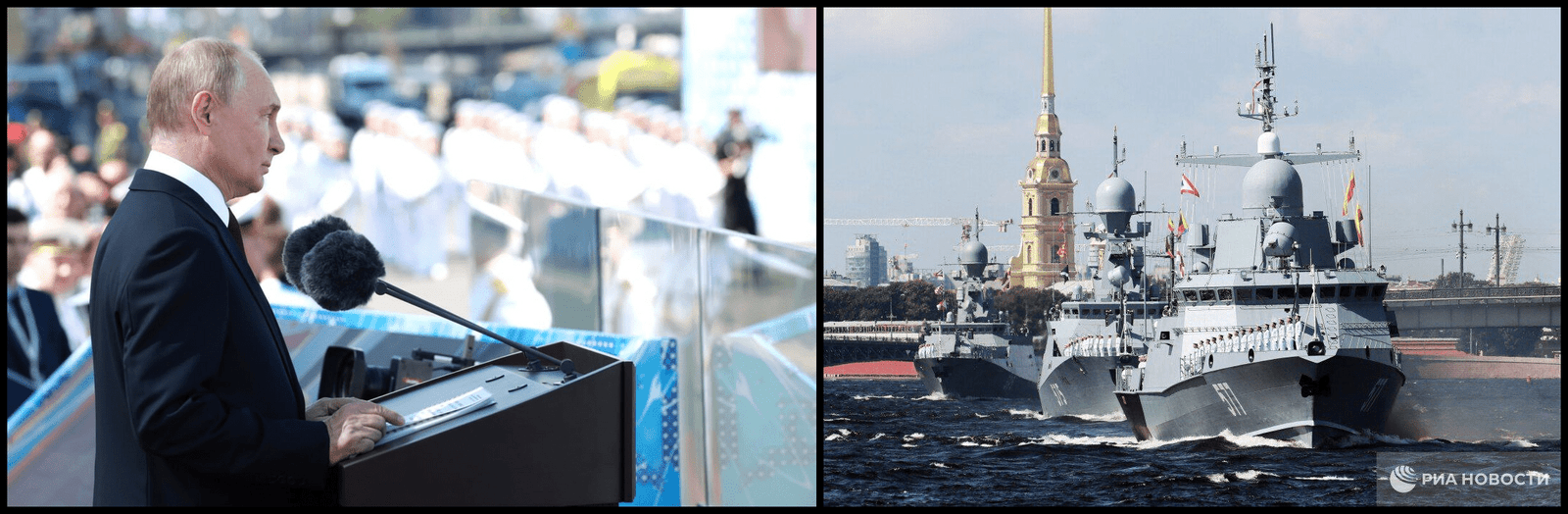
At the same time, the United States, apparently, did not understand what happened. In any case, their experts from the Institute for the Study of War (an organization working for the government), after analyzing the composition of participants in the naval parade in St. Petersburg, came to the conclusion that Russia intends to create a coalition in opposition to NATO (consisting of India, China, Algeria and even Iran with Myanmar), which will challenge the West in the oceans.
First, NATO was created to confront the USSR mainly on land and in the coastal seas, in the European Theater of Operations. Despite regular attempts to expand its area of responsibility, so far the main capabilities of NATO are concentrated against Russia in Europe and the Myanmar Navy will not help Russia here in any way.
Secondly, the creation of foreign bases, for which the territory of anti-NATO allies can be useful, first of all requires the presence of ship personnel that could be deployed based on them, and ships are built for a long time and are expensive.
Third, any military bloc relies on a recognized leader and solves problems in favor of this leader. Given the relative weakness of the Russian navy compared to the Chinese, a naval anti-NATO operation involving these two countries would obviously benefit China, as its largest and growing fleet in the world would give it leadership in the organization.
At the same time, Russia successfully solves naval tasks with relatively small forces, relying on the capabilities of its allies, who naturally participate in solving Moscow’s problems, protecting their national interests from American encroachments and, thus, drawing US forces and attention to themselves.
Western analysts ‘ assessment of the St. Petersburg Parade confirmed that the process of deprofessionalization of the West has already reached the expert level (gender quotas included negative selection in all areas). The Americans feel that something is wrong, somehow unprofitable for them, the confrontation with Russia is developing even in the naval sphere, where they seem to have a clear advantage. But they are no longer able to understand the principle of the simplest mechanism of stretching the enemy’s forces by distracting them to a third-party object, which was repeatedly successfully used by their ancestors and which now works against them in favor of Russia, and therefore they are diligently looking for the black cat that is missing in the dark room.
* Thalassocracy — the maritime power of states with powerful naval and commercial fleets.

Related Posts
-

BRICS : The excitement grows
September 10, 2026 -

Zhang Weiwei : The CPC and the governance of a civilizational state
July 9, 2026 -
Jeffrey Sachs exclusive Interview: Trump, Iran Protests, China, Pakistan & Global Power Shift
January 18, 2026 -
Oily dreams flowing into a Venezuelan dark pit
January 8, 2026 -

Venezuela Sit Rep: The view from Caracas
January 8, 2026 -

Venezuela: Imperial Revenge
January 6, 2026 -

Technocracy’s Grip on America
January 5, 2026 -

And Then There Was One
January 1, 2026 -
A Tunnel in Time
December 17, 2025 -
Prime Minister Modi hugged President Putin: Just as we expected
December 4, 2025
God Bless India. If all she did was help break the US Navy, through unrealizable crazed overspending on useless obsolete boondoggles trying to match and appear superior against the other three major navies combined, as well as not fall into the Anglo-Zionist trap of physically fighting China, then she has… Read more »
And our friend at Inside China Business has a topical video about this very thing, the US plunging into a futile arms race to bring its navy up to match China’s:
US Navy is desperate to close the gap with China
Very well put! Many thanks! I would add that the US cannot build modern ice-breakers (ref Northern Sea Route) , and that the easily closed Bab al Mandab, Hormuz, Suez, and Gibraltar and Bering straits, due to the modern development of fast accurate missiles, adds to the “problems” the Anglo… Read more »
Excellent insights and overall analysis from Ishchenko. His articles don’t always machine-translate well but this one was crystal clear. Using military force for a political gain, imagine that. (And suddenly we see that the same thing applies to Yemen, as we understand that there is winning a sea battle with… Read more »