

6. The Hezbollah Drone Family
The story continues:
1. Kings of the Sky! – The Story of the Air Force of Hezbollah
2. 30 Years… From Gliders to Drones, And From Syria to “Karish” to Al-Aqsa Flood
3. The enemy is haunted by the “Karar” drone: Hezbollah’s technical superiority has amazed our army and terrified us.
4. Intelligence and Military Confrontation and High-Tech Systems:
What Are The Details of the Electronic Warfare Between the Resistance and the Enemy?
5. Cost of Drones vs. Cost of Countering Them
6. The Hezbollah Drone Family
7. How did Hezbollah’s needle deflate the legendary balloon?
The diversity within Hezbollah’s drone capabilities is no longer a secret. While the enemy, Western intelligence, and even some Arab agencies talk about the data they have gathered, Hezbollah maintains a strategy of “constructive ambiguity,” revealing only what aligns with its plans.
In this context, the commander of the Islamic Resistance’s air force says, “We have a variety of drones. Each category is distinguished by its nature and function. In terms of missions, there are drones that collect battle-specific data. These drones previously operated in the ‘buffer zone,’ but their scope has expanded. They have reached Tiberias (Hassan drone 2022), as well as Ashdod (south of “Tel Aviv”), in addition to what was announced about the ‘Ayoub’ drone in 2012.
During the Syrian war, the leadership allowed us multiple entries into the Golan Heights. In peacetime, we conducted intelligence flights, but with a certain depth. After ‘Tsunami of Al-Aqsa,’ we adjusted our methods. When the Secretary-General asked us to expand our operational range, we did so, but to the extent that could be publicly declared, reaching beyond Haifa. We are talking about intelligence efforts, including day and night operations. There are both still images and videos.”
The commander adds that Hezbollah has drones dedicated to “distraction.” “They can be suddenly converted into diving or intelligence drones. The key is their presence in the air. We use them for various purposes related to other operations we are undertaking, especially as the enemy’s alertness is very high. The enemy is now aware that we send drones to trigger their defense systems.
However, due to their extreme tension, they do not know how to handle any drone they see. They struggle to justify their mistakes. For example, when we targeted a gathering of enemy forces near the “Elkosh” settlement, the enemy provided ridiculous and embarrassing excuses. They claimed that Hezbollah had breached the detection system at the “Meron” base and disabled it, giving us a significant achievement just to explain their failure. Nevertheless, the public no longer believes them. ‘Yedioth Ahronoth’ wrote that enough excuses have been given regarding the failure of air defenses.”
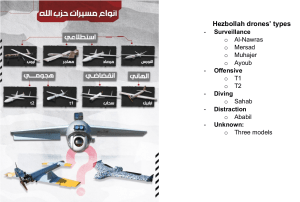
The commander in the air force points out that there are “distraction drones, diving drones, offensive drones, and also logistical drones (for transport, leaflet dropping, delivering supplies to ‘friends’). This is what we can disclose. Sometimes, we use more than one drone for a single mission. For example, we might have a diving drone performing a mission, and at the same time, a drone above it doing the filming.
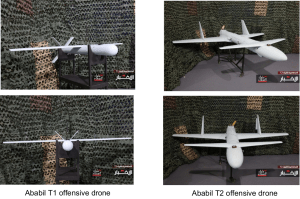
There are offensive drones that launch projectiles at specific targets. The enemy knows that there are smaller, lighter, smart, or precision missiles. There is also the offensive ‘Sijil’ drone, which has its unique features. As for the ranges, it’s extensive. Sayyed Hassan mentioned from “Kiryat Shmona” to “Eilat”, and we execute and tell him, ‘Wherever you want, to honor you.’ But, let’s consider what our brothers in Ansarallah are doing, having reached “Eilat”, “Tel Aviv”, and Haifa. We say that the enemy, compared to what Ansarallah is doing since they started in 2015, while we started before them, can only imagine what we have!”
The jihadist commander says there is a type of drone that falls under the title of “multi-copter,” which performs “hovering,” meaning it is essentially a drone, and we manufacture it with various types of engines. It can perform all tasks. However, the matter varies in terms of range and time; it can operate over tens of kilometers but is highly effective in direct engagement with ground forces. We haven’t used it yet. A fighter can control and manage it. Besides, its manufacturing cost is low. It can be produced very close to the battle site. It is considered a tactical weapon, and the enemy fears it in an open war situation because of its tremendous effectiveness against infantry forces.”
According to the jihadist commander, the enemy “has an army of the best people who study their adversary and learn lessons quickly. They are swift in implementation. Every time a site is targeted, they immediately take measures. At the beginning of the war, they withdrew their soldiers from the front positions. Some sites now have only a very few soldiers. They resorted to selecting new locations throughout the north to station the soldiers they brought in, using open areas like plains (with 20 or 30 personnel carriers and armored vehicles with soldiers deployed in a wide field). After the first operation we carried out, they then dispersed the soldiers under trees. Each time they choose a new location.
Sometimes, we conduct reconnaissance on a specific target, and when we return to strike it, we find that they have moved it due to sensing the danger. This process is exhausting for the soldiers, especially those coming from the reserves.”
The commander explains that each drone has “clear (Online) objectives, meaning we have assigned it a specific mission. There are also unresolved (Offline) targets, meaning the drone is on a specific mission, and during its operation, it discovers a target that can be added, updating our objectives. Even the idea of conducting an attack is possible during the mission. One can imagine whether we can or cannot do everything, including colliding with enemy aircraft.
The enemy classifies our drones as stealthy, meaning they can infiltrate and hide from radars, executing the mission without or before being detected. Even detection is not easy. The challenge here isn’t limited to radars. For example, we have drones with a low signature, high thermal signature, and loud sound, and their size makes them more visible. However, the enemy has not detected them due to the combination of optical, thermal, and physical efforts that hinder the enemy’s mission. Hence, the occupation army involves everyone in the mission. On the front line now, the army has given settlers phone numbers to call upon hearing any sound they suspect to be a drone. But we resorted to a specific tactic, and the operation was remarkably successful.”
Regarding the warhead weights, the air force commander says, “They vary. They start from a few kilograms and can be increased significantly. We are not talking about tons, but now our drones can carry warheads with significant weights. From the enemy’s experience over the past nine months, they know we have different weapons that have enabled us to reach the target. They understand what it means for our drones to be able to carry a missile. The enemy knows the issue is not related to weight, as we have conducted operations with small weights that achieved high results. As for control, the enemy says our drones are equipped with optical guidance heads allowing remote control. Fine, what’s new? The question for them is: what have you done to face this challenge?”
Excellent article !
Thank you for this drone series. I am not a military guy, so this has been a valuable lesson. Precision missiles and drones have revolutionized warfare, leveling the field.. and different mentalities, and the existential necessity for the defensive side, have forced innovation. There’s history and eschatology behind the hubris… Read more »
Tomorrow is the last one, plus a video. I was astounded, but what intrigued me all through these chapters was the ‘must do’ spirit. Its kinda, (if people remember some of the older zionist ‘haircuts’ where the Palestinians fought with rocks and trebouchets as they had nothing else), if we… Read more »