

Does man need to be governed?

By Nico Cost written for GlobalSouth
In a family with father, mother and children, no one is really in charge and yet things generally run smoothly. There are some household rules and the parents who are wiser have consulted on them and explain them during parenting. Bureaucracy is absent and pleasant coexistence unfolds in a practical sense. There is room for self-actualization and at some point the children fly out with their own set of norms and values.
The ingredients for a healthy, loving and meaningful family (in the sense of governance) are:
1. All family members can express themselves freely.
2. Wisdom guides rules and choices.
Both ingredients are important but collide at the same time. There is a significant chance that parents will differ in their opinions and that one or both will still want to be in charge. In addition, children, enterprising as they often are, sometimes want to be in charge. When opinions clash, sometimes nothing is decided and sometimes the wisest decision is not made. The strongest can win, but so can the one with the biggest mouth.
Then we still assume, that all family members are sincere and not necessarily selfish. When interests are high, then games can be played. Different family members may fuse together to get their way. Talk and manipulation may take place. There can be threats and lying.
So how do we organize this wisely in a family, in a village, in an area, a country, a continent and on the entire planet? In a family it can already go wrong and the more people involved the more impersonal it becomes. But first, let me look at an underlying theme:
“We” versus “I”.
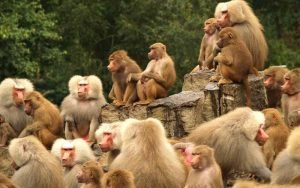
Man is a group being. We got this far as a species because we could survive as a group. We faced a challenging nature as well as other groups. Cooperation was necessary and therefore we had to live together.
Now that humans have taken their place on the planet, a new phase has begun. Evolution pushes us from ‘us’ to ‘me’. When a human being is thrown back on himself, then the space arises to make contact with ‘the source’ through ‘self’.
‘We’ stands in the way of self-realization, so to speak. Of course we need others to continually mirror life so that we can learn through real-life experiences, but at the same time those others are a continuous source of conditioning that keep us away from ‘being ourselves’.
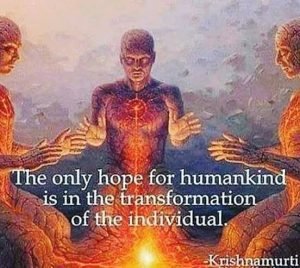 The reason man seeks the “I” is, in my view, simply dictated by God’s plan for the evolution of man and all life. It is the path of growth in consciousness. We are in the process of becoming substantially human and moving away from the unconscious tendency to be guided by our instincts and emotions. We may finally become more conscious. Becoming more consciously aware.
We need each other, to become more conscious. But the path we must take evolutionarily is “inward” to become self-aware, in order to make a more conscious contribution to the collective. Not because we have to, because the collective has to, but because we can ‘know’ that through a deep inner process.
I know that enough people will disagree with me and are convinced that this can also take place through the ‘we’. However, practice shows otherwise, for man has so far only been civilized through either prosperity or oppression. Where there seems to be civilization, it is wafer-thin. Take away prosperity, the beasts emerge. When oppression falls away, subcutaneous tensions return.
All prophets and sages in our past have traveled the ‘way inward’ to achieve enlightenment to some degree. Deep meditations lead to “the self” and “the source”. Our thinking is far from achieving the same. Our thinking is still primitive and disturbed by our unconscious instincts and emotions. ‘I am’ is the way forward.
Let me go back to ‘governance,’ the clashing ingredients.
Freedom
 Man thrives when he can be creative and for that he needs freedom. The freer the mind can be, the more it can be attuned to life itself. Life provides everything man needs and we may therefore surrender to that life. Our intuition is our most important attribute for making contact with nature, with our nature and with God.
Because of all the conditioning, man has become less intuitive. We have become more distant from nature. For example, because of specialization, most people in big cities no longer know how to take care of themselves should the supermarket not open. But more importantly, man needs his intuition to become and be spiritually free. To be able to shed the conditioning, the conditioning of the outside world as well as that of himself. To break free from fear and lust, instinct and emotion, the reptilian brain and the mammalian brain.
How do you manage a group in such a way that it offers maximum freedom? Maximum freedom for the individual, the “I,” but in such a way that it is not at the expense of the collective. Here we also have to deal with tension between the ‘we’ and the ‘I’. For where is the boundary. Yet the aim should be to give the ‘I’ as much space as possible. Because the ‘I’ must grow in consciousness so that that ‘I’ itself becomes conscious and chooses ‘we’ itself.
When all individuals have become wise, then the collective is conscious. We cannot accelerate that evolution and will have to bite through the sour apple. Growth comes with pains. We must dare to let go, dare to let go of the “we. That is, in essence, in intention. Because of course this doesn’t happen all at once, and with almost eight billion souls on this planet, the necessary time and energy will have to be spent. It is a process, it is evolution, of consciousness, God’s plan unfolding.
Please read through the lines and the words. I know believers will be bothered by my view of God and evolution. And I know non-believers will be bothered by the word God. Read it in your own way and see how my efforts can land in your own truth.
Wisdom
 What is wisdom? Who is wise and disinterested? There are smart people, but are they wise? Is it possible for people to be wise and make wise decisions? On the basis of what knowledge and experience can you say that such people are wise? Look at how many people run after propaganda and hypes, can you let those people make the really important decisions? The West is already completely lost, but so many non-Western countries have wanted to be like the West for so long that they have also lost their way quite a bit.
Look at how unhealthy many people live, how fat people are, how they treat nature, what they do to animals, the countless addictions, they can barely raise their own children, do you let them make choices for the collective? Because what do we see these people do when it comes to choosing their leaders? They appoint leaders through so-called democratic elections who ultimately never serve the interests of the collective, but the interests of those career politicians themselves and their real sponsors.
Those leaders are not wise, they are smart. They are not knowledgeable, but they know the right people. Even where not elected, you have to wait and see what kind of leaders emerge. Us knows us. Any organization that exists long enough almost always ends up being a corrupt institution. People are bad at handling power because they are smart and not wise.
And once you have a wise leader who does the right things for the collective, how long do you have them and what comes next? This shows, you can only get leadership through self-actualization. In fact, you can only lead yourself. Eventually, because it takes a path to get there. Individually and as a collective. It always comes down to the same thing, everything depends on how man himself evolves and gets on the path of God. Not to believe, but to know. Not to follow a religion, but to be able to be substantially self-responsible.
The question then is how to get there. How can we organize “our” governance, such that it supports our evolutionary process towards a conscious being as best as possible. What do we know about contemporary forms of governance, how are we organized and what ideologies do we adhere to?
Ideologies
In the spectrum of different ideologies, freedom seems to be the main criterion. On the left the collective prevails and on the right the individual, from communism to libertarianism.
Equality mangles everyone through the same funnel. Anarchy in an unconscious society leads to serious accidents.
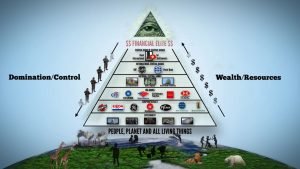
However, in our contemporary world we are all, from left to right, at the mercy of a global financial system that determines everything. It is that financial system that calls the shots. Indeed, money has become an end in itself because the system is and facilitates it. The unconscious human being does not realize this and goes completely along with it. Everyone ends up on the same ladder, the leaders as well as the followers.
Do you participate in a lottery? Then you hope to get richer, to win. You can only do that at the expense of others. It is that simple. That is how unconscious the masses are, who think and believe that a lottery is just a fun game. However, it is an expression of how we live as a species. Do not take this lightly, for it is essential to our breakthrough in consciousness.
The financial system that dominates globally is a pyramid scheme. Interest ensures that the system can only stay afloat if there is growth. More, more and more. It is all about profit. Profit for shareholders. The rich get richer, at the expense of the poor. Whether the country is communist or libertarian, it comes down to the same thing. Money determines everything. With money you can make money, it has become totally perverse. The banks are private institutions that create money “out of nothing”. Money is the ideology that dominates all other ideologies. Capitalism is now the cancer of the world.
 The good thing about communism is the ideal that resources belong to the collective and not to clever investors who want to get rich at the expense of poor workers. Are those resources then the property of the national collective or that of the whole world?
The good thing about libertarianism is the ideal that individual freedom leads to creativity and personal growth in consciousness. But how do smart people in especially Western countries now deal with such freedoms at the obvious expense of others?
Another variation is possible on the left, which is an ideology founded on religion. Without separation of church and state or even where the church is the state, religion is the vehicle for how things are organized. The form of government is then theocratic. Funnily enough, you can also view this as right-wing, because mostly religions are actually conservative in nature. I place it now only on the left because of its collective character.
Forms of government
They do say that democracy is the least bad form of government, because you have to choose between several evils. I believe that all forms of governance can work (temporarily), provided you have wise people in charge and not smart ones. Of course, the financial system that invariably encourages corruption doesn’t help either.
Current democracies, in my opinion, are sham democracies. Once every few years you get to elect leaders, who then forget their promises and chase the ideals of their real sponsors until the next election. Rarely are they representatives of the people, but representatives of themselves and other stakeholders. Once in a while you meet a wise leader, then you are lucky.
In this sense, a democracy is not much different from the other forms of government that you can broadly lump together. Indeed, the rest are a small group of leaders who determine everything for their people. From dictatorship to plutocracy and from aristocracy to oligarchy, even meritocracy, technocracy and theocracy can be called authoritarianism. All can work, but equally can be pure misery for the people.
You would say that a democracy most invites man to self-actualization, but given the current state of the morally and culturally bankrupt West, I seriously question whether that is so. I think it matters little, ultimately. I think the people themselves must move, making the leaders follow the people rather than the other way around.
Still.
What to do?
What is important now when it comes to that self-realization I propagate?
A government that is decentralized as much as possible so that the people can think and participate. A lean government without too many rules and thus bureaucracy. Decentralized areas divided by common culture and language.
 A society where we have as much individual freedom as possible, but where our norms and values also take into account the collective. A separation of church and state in order to be free in what the individual believes, because ultimately no man and no institution can stand between man and God.
A financial system where money is purely a medium of exchange and is part of the collective rather than private wealth. Resources such as commodities also belong to the collective. Primary necessities of life are not taxed and no profit is made on them.
The people have access to all information and can express their opinions and participate in all decision-making through direct democracy. Leaders are openly and transparently accountable and behave as true representatives of the people.
Fantasy
Well, this is my fantasy. There is obviously no solution, certainly no standard solution for everyone, not for all countries, probably not for any country. As if everyone is not doing their own thing and certainly the current leaders are just steering their own course. I am not a professor and this is not a dissertation. These are mere reflections, mainly to sort it out for myself. Where do I actually stand in this violence?
Will we still be governed by leaders ten thousand years from now, or will we be far enough along by then to cooperate and live together without leaders? Or, what will leaders be by then?
What can “I” do now? Become more conscious. Taking the path inward. It is not a mental exercise, but a spiritual experience that brings us to Earth. When will we really get on the road?
Kropotkin in his book “The State: It’s Historic Role” follows along similar reasoning. He focuses less on what the individual needs to do for such a collective conscious but he (and I would too) agrees that a better life is to be had in a high trust communal system. Some… Read more »
Thank you for the Kropotkin link.
I regard his “Mutual Aid” and “Ethics” as masterpieces, but somehow never got around to this one.