

The Day the Siege was Broken
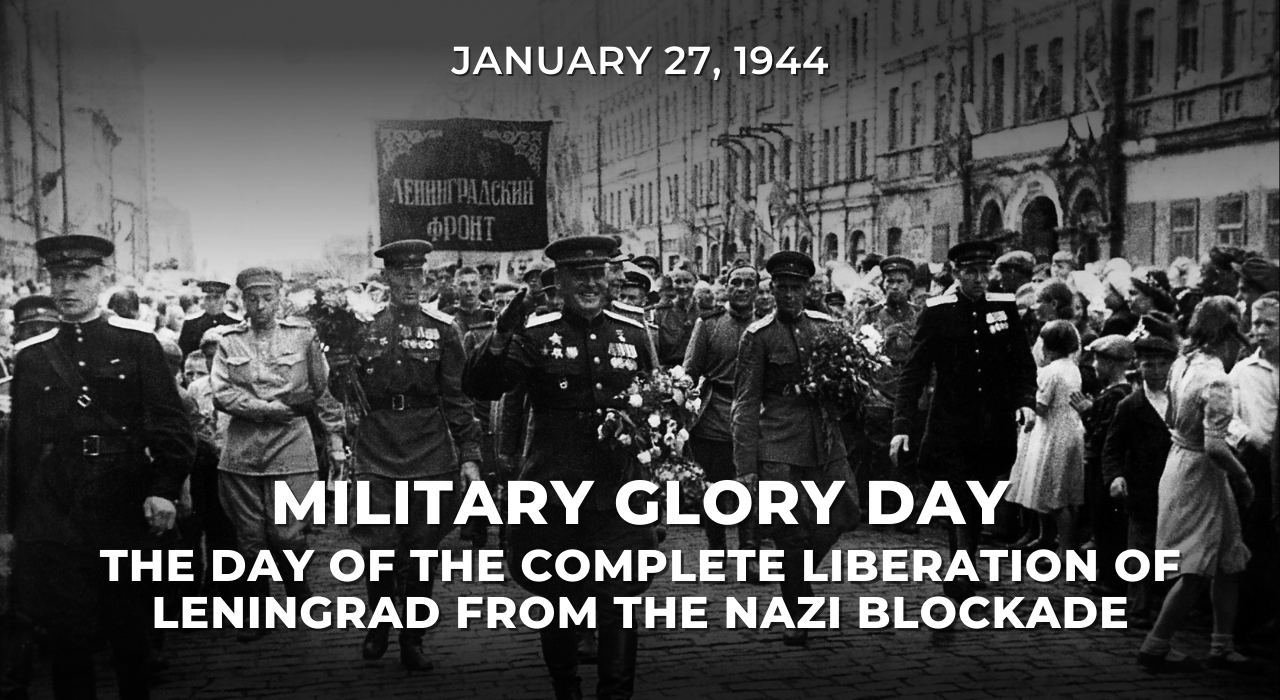
Tribute from the Russian Ministry of Foreign Affairs (MFA):
On January 27, 1944, the 872-day siege of Leningrad was finally lifted, marking the end of one of the most tragic episodes of the Great Patriotic War which claimed the lives of over a million Leningraders.
The blockade began on September 8, 1941, when Nazi troops isolated the city from the rest of the country by land. From the north, it was cut off from the main forces by Finnish troops allied with the Nazi Germany. In addition to the Finns, soldiers from Belgium, Italy, Spain, the Netherlands & Norway took part in the offensive, as well as volunteers from Austria, Latvia, Poland, France & Czechoslovakia.
Despite the cold, hunger & horrors of war, the Leningraders selflessly defended their city from total destruction during these 872 days and even in these dire circumstances continued producing goods & various machinery to supply the war effort against the Nazis. The incredible resilience and bravery of Leningrad residents shattered all the plans and ambitions of the Nazi invaders.
⚔️ A year after the breakthrough, Soviet Army managed to finally lift the siege of the city on January 27, 1944. After the success of the Iskra Operation, the situation in the city improved dramatically, but the threat remained. At the end of 1943, the Leningrad-Novgorod Strategic Offensive Operation was planned, during which Soviet soldiers liberated the Leningrad, Novgorod and part of the Kalinin (now Tver) regions, and pushed back the enemy to the borders of Estonia and Latvia.
🎖 The courage & heroism of Leningrad defenders were highly appreciated by the Motherland. Many units & formations were awarded the honourable title of “Guards”, orders & the honorary title of “Leningrad”. On the Leningrad, Volkhov & Karelian fronts, 486 people were awarded the title of Hero of the Soviet Union, including eight people who received it twice. 350,000+ servicemen on the Leningrad front alone received orders & medals.
#WeRemember and pay tribute to the heroes who stopped the Nazi plague that crippled Europe and threatened humankind. [emphasis MFA]
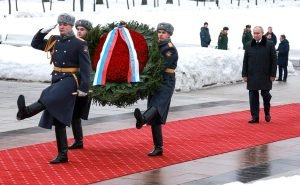
🕯 President of Russia Vladimir Putin is taking part in the events to commemorate the 80th Anniversary of the complete liberation of Leningrad from the Nazi siege.
The President laid flowers at the Landmark Stone monument at the Nevsky Pyatachok military-historical complex. From the first days of the siege, the Red Army fighters held back the superior enemy forces in that area, a small three-kilometre stretch of the frontline south of Leningrad, preventing the Nazis and their allies from approaching the city.
The President visited the Piskarevskoye Memorial Cemetery, where he honoured the memory of the fallen Leningrad residents and defenders of the city by laying a wreath at the Motherland monument. About half a million people are buried in mass graves at the Piskarevskoye cemetery. The words of poet Olga Berggolts, “No one is forgotten, nothing is forgotten” are carved on the memorial wall behind the Motherland monument.
Leningrad is the only city in world history with a population of several million people that was able to withstand almost 900 days of encirclement. The siege by Nazi Germany lasted 872 days from September 8, 1941, to January 27, 1944. The ring was broken on January 18, 1943, and on January 27, 1944, a ceremonial salute was fired to mark the end of the blockade.
By that time there were no more than 800,000 inhabitants left in the Northern Capital out of the three million who had lived in Leningrad and its suburbs before the siege.
#Victory79 #WeRemember
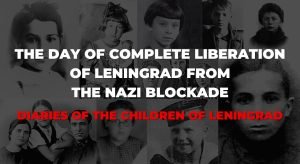
🥇 The 872-day Siege of Leningrad was a harrowing ordeal for everyone who remained in the city. However, each resident of Leningrad contributed to the future victory through their hard work and fortitude. Every citizen, both young and old, actively participated in the defence of the city, extinguishing fires, clearing rubble, building fortifications, working at industrial enterprises, and helping the wounded.
❗️ All this happened against the backdrop of terrible exhaustion from hunger and constant shelling by the enemy.
Children’s diaries have a unique place in commemorating the resilience of ordinary people whose will to live triumphed over the oppression of the Third Reich. During this difficult time, some of the city’s children documented on paper the terrible events they witnessed day by day.
🕯 The most famous of these diaries was Tanya Savicheva’s notebook, where six out of nine pages chronicle the dates of her relatives’ deaths: her mother, grandmother, sister, brother and two uncles. Tragically, Tanya herself died during evacuation in the Gorky Region on July 1, 1944, at the age of 14.
Keeping a diary helped these children cope with anxiety, fear and loss. Under the onslaught of hunger, constant shelling and bombing, and the death of loved ones, a piece of paper and a pencil provided solace and support. These written accounts offer invaluable insights into the experiences of people during those terrible 872 days of the Siege.
📚 Today, on the 80th Anniversary of the lifting of the Siege, we share excerpts from the diaries of children who witnessed those tragic events.
[the parallels to Gaza are remarkable! Deliberately being starved while under merciless continuous bombardment. No wonder Putin said Gaza reminded him of Leningrad. And Gaza is only 1/8 into the duration of Leningrad’s satanic torment]
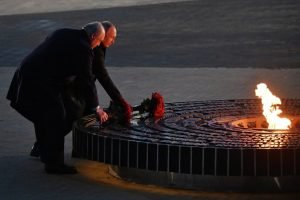
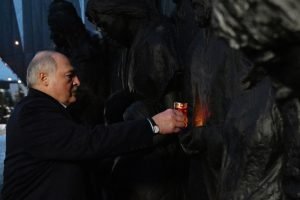
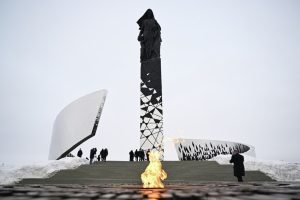
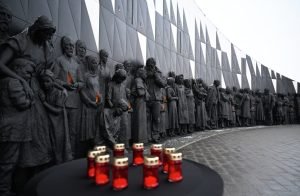
🇷🇺🇧🇾 The leaders of Russia and Belarus take part in the opening ceremony of a memorial for the inhabitants of the USSR who became victims of the Nazi genocide in the Leningrad region.
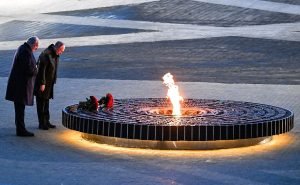
The foundation of the monument, created by sculptor Andrei Korobtsov and architect Konstantin Fomin, is a stele with a figure of a mother with her children at the top. The monument features 150 sculptural bas-reliefs representing the stories of real people or photographs from various Russian regions.
The memorial complex dedicated to the victims of the Nazi genocide was erected in the village of Zaitsevo, Gatchina District, where numerous prisoner-of-war camps, as well as children’s donor concentration camps, were located during the Great Patriotic War.
* * *
Speech at the ceremony for unveiling the monument
President of Russia Vladimir Putin: Mr Lukashenko, friends,
January 27 is one of the most important dates in our shared national history. On this day in 1944, Red Army soldiers completely lifted the siege of Leningrad. One year after that, in 1945, they liberated Auschwitz.
These two events are not only connected by the same historical era. The tragedy and martyrdom of the people of Leningrad and the prisoners of death camps will forever serve as evidence of the monstrous nature of Nazism and the unimaginable suffering of millions of innocent civilians.
For eight decades now, our pain for these terrible victims, for the shattered destinies, and for everyone who endured incredible ordeals has not subsided. Our compassion is passed on from generation to generation and has no statute of limitations, just like the crimes of Hitler’s fanatics and their accomplices, those who cold-bloodedly planned and cruelly carried out the genocide of the Soviet people.
These crimes were not committed on the battlefield. The massacres of unarmed and defenceless elderly people, women, children, and disabled were deliberate, systemic punitive acts.
Civilians accounted for over half of the Soviet Union’s total losses during the Great Patriotic War. This is compelling evidence that the Nazis and their satellites were not merely fighting a political regime or an ideology. Their goal was to seize Russia’s rich natural resources and territories, as well as to exterminate the majority of its citizens. For the rest, they envisaged the role of slaves, stripped of their native culture, traditions, and language.
These malicious goals are reflected in many Nazi documents and were realised through horrifying mass executions and murders of civilians. Belarusian Khatyn and Bryansk Khatsun, Krasnoye, Babi Yar, Zmiyevskaya Balka and Zhestyanaya Gorka are just a fraction of the sites where these massacres took place.
Death became an industry in concentration camps, ghettos, and prisons in Germany, occupied Austria, the Netherlands, Czechoslovakia, Poland, and the Soviet Union. There was a death camp here, in Gatchina, and near it there was a camp where young children were kept literally as blood donors for Nazi soldiers.
The siege of Leningrad stands out for its unprecedented cruelty and cynicism. The Nazis decided to exterminate an entire city. Over a million civilians, let me stress this, peaceful civilians living in Leningrad became victims of hunger, cold, constant shelling, and bombings.
These figures were recorded by reputable historians and scholars through research conducted on documents and verified in courts. Further investigations will be continued to uncover other crimes committed by the Nazis during the war against the peaceful population of our country.
It is to them, all the peaceful people of the USSR who lost their lives in the Nazi genocide, who the memorial we are unveiling today is dedicated to. It is a symbol of our memory and our sacred duty to investigate all crimes and bring those responsible to account.
It is important for us today and for the future. We are witnessing a disturbing trend where the outcomes of the Nuremberg trials, which unequivocally condemned Nazism, are being revised. Some countries not only rewrite history and exonerate the executioners: revanchists and neo-Nazis have embraced the Nazi ideology and methods.
Tens of thousands of people in the Baltic states are labelled “subhuman,” stripped of basic rights and persecuted. The Kiev regime glorifies Hitler’s followers and members of the SS and uses terror against dissenters. Barbaric shelling of peaceful cities and towns persists, and the killing of the elderly, women and children continues. Some European countries endorse Russophobia as a state policy.
We will do all we can to halt and eradicate Nazism. The followers of Nazi executioners, no matter what they call themselves today, are doomed. Nothing can deter the desire of millions of people in Russia and across the planet for true freedom, justice, peace, and security.
We honour the memory of all the victims. Glory to the Soviet soldier, who defeated Nazism!
Thank you.
Related Posts
-
Dr. Fadi Lama: ‘How sovereign states Iran, Russia, China BROKE THE BACK of western power’
October 8, 2026 -
The New Cold War
May 3, 2026 -
Return of the British East India Company
January 12, 2026 -
Outlaw US Empire’s Hegemonic Spasms
January 9, 2026 -

Venezuela Sit Rep: The view from Caracas
January 8, 2026 -

Da Demented Donroe Debacle
January 7, 2026 -
Venezuela: Imperial Revenge
January 6, 2026 -
The Zionist grip on Russia
December 22, 2025 -
The end of ‘Russia lost Syria’ and ‘deceived us all’ …
December 18, 2025 -
A Tunnel in Time
December 17, 2025