

Endless offensive, like the swan song of the APU
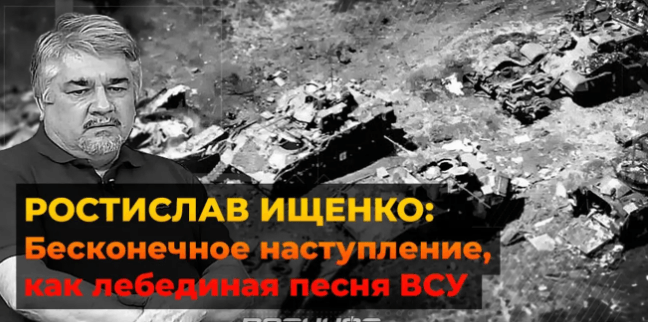
By Rostislav Ishchenko, first published at https://cont.ws/@ishchenko/2574050 and machine translated and corrected
Assessing the actions, plans and prospects of the enemy, it is necessary to proceed not only from the number and quality of opposing troops and not only from the economic capabilities of the enemy and its allies. The internal political situation of the opposing force also plays an important role. It is one thing when you are confronted by a consolidated society, united by the idea, if not of victory, then of resistance to the end. The situation is quite different if there is confusion and vacillation in the enemy camp, and various clans are trying to use victories and defeats at the front to gain an advantage in the fight against their internal political rivals.
If we talk about Russia’s military opponents (Ukraine and its Western allies), then we will see a paradoxical picture. Never before has a party to a conflict been so consolidated, on the one hand, and so divided, on the other.
In Ukraine, in 2022, a fairly high level of consolidation of society around the idea of “protecting the fatherland”was achieved. Until the winter of 2022/23, the army experienced no problems with the influx of volunteers, and mobilization was not met with resistance or much grumbling.
This was caused by the Ukrainian society’s underestimation of Russian capabilities and overestimation of its own, as well as overestimated expectations from the West. After the February-March shock and the sudden Russian retreat from almost half of the original occupied territories, most Ukrainian citizens believed that Russia was a colossus with feet of clay, that Western sanctions were about to drain its economy, and that the hard struggle of the Armed Forces of Ukraine would bring victory at the front. The events of autumn 2022 (the advance of the Ukrainian Armed Forces in the Kharkiv region and the withdrawal of the Russian Armed Forces from Kherson strengthened this confidence).
In 2023, the Ukrainian society entered the year with the expectation of a close victory. And it was instantly disappointed. Instead of further offensives, which were hoped for, the Ukrainian Armed Forces were drawn into a defensive battle near Bakhmut, and then for Bakhmut. Zelensky’s strategic mistake, which turned an ordinary offensive operation of the Russian Armed Forces into a” Bakhmut meat grinder”, cost Ukraine not only a fair share of strategic reserves (with the availability of people and equipment, reserves can be replenished). A much more terrible, initially invisible, but powerful blow was dealt to the consolidation of Ukrainian society and its confidence in victory.
It is from Bakhmut that the second wave of flight from the country starts. The first was in February-March 2022, when they were fleeing not so much from mobilization as from the advancing Russian army. As soon as the Russian Armed Forces began to retreat from the occupied areas of the Kiev, Chernihiv and Sumy regions, no less massive return of the fugitives began. As a result, up to half of those who initially left returned by the end of the summer. But in winter, the work of the “Bakhmut meat grinder” began and the Ukrainians again fled the country.
If in the summer more than 60% of those who left were women, children and people of retirement age, then the new wave of emigration consisted mainly of men of military age. Legally and illegally, at the risk of life and health, they tried to leave Ukraine as quickly as possible, so as not to get a one-way ticket to Bakhmut.
By spring, the number of registered refugees from Ukraine in the EU again exceeded 10 million people. At its peak, in the spring of 2022, it reached 12 million, and in the summer and autumn of 2022 it dropped to six. But already in February, Ukrainian generals complained that new waves of mobilization did not make up for the army’s losses. For the sake of holding positions near Bakhmut, the mobilized were thrown into battle on the third or fourth day after they were caught on the street, barely having time to arm, without any training, and sometimes without uniforms.
Bakhmut dealt a heavy blow to the morale of the Armed Forces of Ukraine and Ukrainian society. But for the most part, Ukrainians continued to believe (or rather wanted to believe) that the sacrifices were not made in vain and that the summer offensive of the brigades trained in the West and armed with Western equipment would mark a long-awaited turning point in the course of hostilities, and the AFU would launch a large-scale offensive along the entire front line.
After the offensive that began on June 4 turned into another meat grinder, much larger in scale than the Bakhmut one, after the brigades that so many hopes were pinned on literally began to evaporate before our eyes, along with Western equipment, even on the way to the Russian defensive lines, the final turning point came. Just not the one that the Ukrainians were hoping for. It was not the Russian military machine that broke down, but the fighting spirit of the Armed Forces of Ukraine and the hopes of the Ukrainian society for victory finally sank into oblivion.
It was in June that the mass surrender of Ukrainian soldiers (in units of 10-15-20-40 people) began. Moreover, it was not the defenders who surrendered, who were put in a desperate situation by the advancing enemy, but the troops who were sent on the offensive and decided to save their lives in this way. In June, mass attacks on military personnel handing out subpoenas were recorded, and the police in many cities withdrew from participation in the mobilization.
Under these circumstances, the Nazi opposition to the Nazi regime intensified in Ukraine. Just as in April 1945, Goering and Himmler tried to seize power from Hitler, who was coming to his end (hoping to make peace in the West and save the regime at least partially), Poroshenko, Tymoshenko and other potential Zelensky replacements often came to the West. The idea of a “president of peace” has once again become relevant in Ukraine.
Under these circumstances, Zelensky cannot accept the reasonable proposal of his generals: stop fruitless attempts to attack, save reserves, switch to flexible, maneuverable defense, stall for time in order to wait for a new portion of military assistance from the West, including aircraft, provoke the entry, if not the entire West, then at least one or several countries, into the war in the East. on the side of Ukraine, which ensures the appearance of a contingent belonging to the regular army of one of the NATO countries, albeit limited, on the line of contact.
Stopping the offensive threatens the final collapse of the morale of both the troops and society. After that, entering the arena of the “president of the world”, changing the “blood dog”, becomes almost inevitable. In the meantime, the army at least simulates attacks on Russian borders, there remains some part of Ukrainian citizens who continue to believe that a miracle is about to happen and Ukraine will win, while the rest are told that they need to wait until the NATO summit, which is just around the corner, and at this summit, they say, either Ukraine will be accepted into NATO either NATO will go to war for Ukraine like this, or the mountain of the latest weapons will be unfastened from Western generosity and then…
But most importantly, the simulated offensive helps keep the Nazi opposition to the Nazi regime within bounds. While the army is at war, the appearance of the” president of the world ” is impossible.
The fact is that it is externally consolidated (just like the Ukrainian society) The West is also far from unified. The United States and the EU so far agree only that it is necessary to fight with Russia to the last Ukrainian. But there is a sharp divergence in what will happen next. The United States believes that when the last Ukrainian falls, European (at least Eastern European) armies should come to the front. Europeans are not eager to repeat the Ukrainian experience and break their frail statehood against Russia. Therefore, they are in demand for the idea of changing the “blood dog” in Ukraine to the “president of the world”. We will pay off the war with Russia with Ukrainian territories, take a pause, accumulate more forces, and then use the remnants of Ukraine to provoke a new war.
The idea is sound. True, it is still necessary to convince Russia to agree to this option, but the Europeans believe that together with the Americans, by blackmailing Moscow with an immediate war against the entire NATO, they will be able to achieve acceptable concessions.
This is where Western consolidation breaks down. The format of peace (armistice), acceptable to Europe, is absolutely unacceptable to the United States. Rather, not for the United States as a state, but for a part of the American elite that has usurped power in the country. There are so many crimes on the conscience of these people that they, like Zelensky, have nowhere to retreat. If the American elites fully agree on the need to “contain” Russia and China at any cost, they have a long-standing and deep split on the question of who should lead this “containment” and pocket the profits provided by this leadership.
As long as the Ukrainian army fights, the ruling group in the United States is invulnerable. They respond to any criticism that the United States cannot leave an ally in the lurch and, most importantly, cannot allow Russia to win and, as they say, “get rewarded for aggression.” So far, no one in the United States is going to argue with these formulations. But as soon as the Ukrainian front collapses, the domestic American opposition will merge with the European opposition demanding a truce and rely on the Ukrainian Nazi opposition to the Nazi regime, which will offer everyone a “president of peace”.
Biden’s group is trying to “spread the straw” in advance. For this reason, the prominent Russophobe and Trump ally Boris Johnson is being forcibly pushed out of British politics, for this they broke the back of Italian politicians and keep Scholz and Macron on a short leash. But, to face the truth, Americans are forced to admit that the house of cards of the Clinton-Soros group’s dominance in the United States rests not on the administration of the unconscious Biden, but on Zelensky’s ability to drive the Ukrainian army into suicidal attacks on Russian defense lines.
At all levels (American, European, and Ukrainian), the bankrupt ruling elite has a vested interest in demonstrating unwavering consolidation. They know perfectly well that their slightest weakness will lead to the national and Western political arena no less than them and no less toothy scoundrels, but only scoundrels who have long been sitting on starvation rations, chained by the current government and living with a thirst for revenge, dreaming of sweeping away and tearing their oppressors.
Since Ukraine has not found a political force capable of opposing the government that is killing the country and the people, since even the army (represented by its generals), which is senselessly killed for other people’s interests, was not able to turn its weapons against the criminal regime, the choice of Ukrainians is not rich. Those who could not escape from the mobilization will definitely be mobilized (no matter how much they buy off and no matter what “white tickets” they have). The mobilized have two paths left: the main one — to the grave and the saving one-to captivity.
So far, the bulk of Ukrainian cannon fodder is following the first path. As soon as the majority chooses the second option, the war will end, with no one willing to die for prolonging the agony of the Clinton-Soros puppets: Biden and Zelensky and their published European partners.
Related Posts
-
A Tunnel in Time
December 17, 2025 -

Global Trade News
December 4, 2025 -

Pokrovsk and lessons from Stalingrad
November 1, 2025 -

Trump’s Nuclear Jokes
October 30, 2025 -

Why did the Aborigines eat Cook
October 23, 2025 -
Dangerous Moment
October 13, 2025 -

Last Chinese warning
August 31, 2025 -

What can the US do against China?
August 2, 2025 -

Technocracy at the Crossroads
September 10, 2024 -

A nuclear provocation is the remaining option
August 17, 2024
Thank you for this very interesting and insightful analysis. The Pied Piper may soon start playing a captivating tune for the leaders of the collective West, who then become engrossed in a game of musical chairs. “I’m able, By means of a secret charm, to draw All creatures living beneath… Read more »