

Lineaments of Multipolar World Rising: Africa and Russia harmonize (Part 3)
By AHH
Please first read in order:
Part 1
Part 2
SURVIVAL
“One falsehood spoils
a thousand truths.”
— African Proverb
The ongoing massive harmonization of Africa and Russia is the underappreciated yet so consequential turning point for humanity’s free and equitable future. It strengthens both sides and bolsters multipolarity worldwide. If the first Cold War could have been said to be the Liberal Capitalist bloc in bitter confrontation with the diverse Socialist bloc, this is a new yet recast paradigm. It is the revanchist and messianic Liberal dregs of the West against the Global North, East and South. The ‘Exceptional’ 10% against the 90% Rest of Mankind (RoM).
After the loss of the Russian, Chinese, and Iranian civilizations from the Washington Consensus and post-World War II “Rules-based International Order,” the loss of Africa strips most of the remaining fig leaves from a dying Hegemon. It exposes the essential irrational hollowness of the stridently proclaimed “The International Community.”
The Valdai Club summarized the African determination, and the opportunity Russia provides as a goodwill partner with the umbrella of its potent global military and the provision of its plentiful breadbasket.
“Although Africa possesses all the requirements needed for development and economic breakthroughs, it still suffers from hunger, poverty, poor living standards, and political instability. Over long decades of colonialism, Western countries exploited Africa and drained its wealth without investing in any development.
African countries deeply trust Russia as a reliable partner. This reliance is rooted in the Soviet era, when Moscow was the only supporter of the African national liberation movements. Russia provided the newly independent African countries with economic, military and technical assistance. At a time when Washington considered Nelson Mandela a “terrorist”, Moscow supported him as a fighter against apartheid.
Africa needs fair and balanced partnerships in order to help it face its problems and move toward the future. Unlike Western countries, which view Africa as an arena for international competition, Moscow seeks development partnerships based on a win-win principle… Russia bases its cooperation on mutual respect of interests, non-interference in internal affairs, and consolidating peace and stability.
The Russian-African partnership is the core for a new multipolar world order that would be more fair and just for all. Africa expects a lot from Russia. Historical cooperation between the two and the huge capabilities that Russia possesses confirm its ability to meet these expectations and move forward together to the future…”
The deep freeze in Russia – Africa relations were self-inflicted in the first 10 years of the post-Soviet collapse. Much work remains to repair old networks and to forge new connections between the two eager sides. Urgent de-dollarization is needed to circumvent hostile weaponization of the dollar system. The Institute for African Studies of the Russian Academy of Sciences, Irina Abramova admitted,
“We need to be more proactive in amending our legislation, introducing new tools to ensure that our businesses can safely operate on the African continent, starting with the issue of payment systems, switching to payments in national currencies, but also clearing and barter trade.”
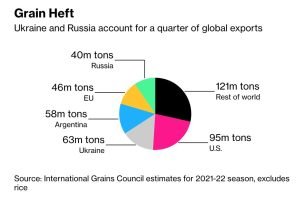
Global Grain Exports
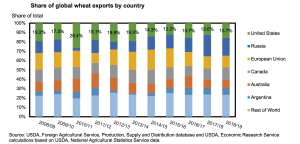
Global Wheat Share
Decoupling from the West gathered pace on the Africans’ side too. At the heart of the reorientation is anxiety about food and energy insecurity, as immediate as putting a stop to endless externally contrived hybrid-wars. Africans began to reorient their resources and preferential trade and security relations towards other principled partners, chiefly China, Russia, and Turkey. Africa agreed with Russia and openly came to blame the West for the Ukrainian grain, fertilizer, and fuels fiascos; China and the rest of the Global South came to blame the West for provoking and stoking the Ukrainian war. The shamelessness of sending UN-underwritten Ukrainian grain earmarked for Africa to pigs in Spain did not help the western cause in Africa. What some saw as the bottomless greed and cynicism of disaster capitalism, others interpreted as devils that could not divert a day’s focus from the depopulation agenda of depriving foodstuff and energy from Africa.
Africans urgently sought short-term provision of Russian grain and fertilizer. They also pursued long-term Russian help in modernizing and developing their own agriculture and self-sufficiency, thus overcoming chronic overdependence on food imports. Strident diktat such as, “Neutrality is not an option” in the West’s proxy war against Russia could not be accepted. Russia is Africa’s top grocery store and neighborhood farm – and increasingly friendly fuel station… Through the medium duration, their teeming populations require constant reliable food and energy imports. The United States, the main global grain exporter since World War, had seen a decline in its exports to Africa in the last decades. Ever a geopolitical weapon, it sent its foodstuffs to influence regional powers such as Mexico and Nigeria, and to traditional vassal Columbia; 6 of the top 10 destinations were to Obama’s East and Southeast Asian pivot direction, in preparation for gathering allies on the war on China. (Chart 03: 2022 United States Wheat Markets)
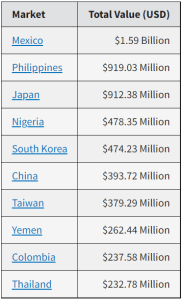
2022 US Wheat Markets
In 2016, Russia became the world leader in wheat exports.
“Now, the Russian Federation [of the 1990s] has shifted from being a net importer of [US!] wheat to become the largest single wheat exporting country in the world… Russia has managed to capture more than half of the wheat market in recent years, becoming the world’s biggest exporter of grain, thanks to bumper harvests and attractive pricing… Since the early 2000s, its share of the world wheat market has quadrupled.”
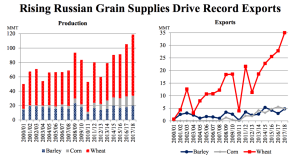
Russian Record Exports
Why wheat? Wheat is a staple food cultivated to some degree in every land. Its flour is ubiquitous in the diet of every culture, used in countless ways and relied on excessively in unresilient developing countries. “Wheat is the second-most-produced cereal grain behind maize, and the global trade of wheat is greater than all other crops combined.”
“Wheat is cultivated as a cash crop, as it produces a good yield per unit area, grows well in a temperate climate with a moderately short growing season, and yields a versatile, high-quality flour. The majority of wheat flour is used to make products including bread, pasta, cereal, pastries, cookies, crackers, muffins, tortillas, and pitas.”
“Wheat also accounts for 19% of global calory supply. 17% of total wheat production is used for livestock animal feed. Wheat is the most extensively stockpiled food crop as a barrier against production deficits,” thus essential to food security. The 48 wheat silos which shielded Beirut during the infamous explosion also held most of the 90% imported share of wheat; with only 10% wheat produced within Lebanon, this was a single massive blow to food security. Wheat, and its trade, insurance, and shipping control, and dispensation, presents a hegemonic bottleneck sine qua non…
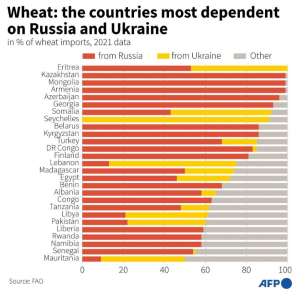
Countries Reliant on Black Sea Ports
How did the Russian SMO in the Ukraine affect global wheat supply? First, note 15 of 27 (56%) of those reliant on grain traditionally shipped from Black Sea coasts are African. (Chart 05: Countries Reliant on Black Sea Ports) It is above all Africa, West Asia and CIS states. affected by war in the Ukraine. The manufactured war in the Ukraine had many handmaidens and objectives. For Africans and most developing countries on this list, they were first forced by IMF/WB Economic Hitmen to abandon the self-sufficiency and food-security of countless generations into growing single export cash crops, and to trust to the mercies of the “free and fair market.” Then that market withdrew food through war and sanctions policies…
Additionally, blocked sea ports and Russian shippers impounded in European ports prevented the delivery of fertilizer (and diesel) essential for modern farming. The cumulative resulted in sky-rocketing prices for what wheat could be sent, and harmed yields in upcoming planting season. Russia still persisted in the face of western intransigence; it pledged free grain if the ships could be released, as well as free fertilizer.
Fortunately, the Lord provides in myriad ways. Workarounds were found around contrived famines to be blamed on Russians. Russia found redundancy in the fortunes of war. They achieved a significant victory in April 2022 with the conquest of Mariupol. It led to the capture of the entire Azov Sea. This small inland sea has valuable connections to the Don-Volga canals corridor leading to the Baltic northwards or to the Indian Ocean southwards via the Caspian and the turbo-charging INSTC. These provide essential outlets circumventing potential blockades at the outlet of the Black Sea, which are surrounded by NATO members.
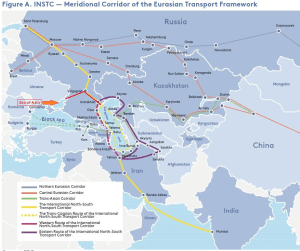
Sea of Azov – INSTC Corridor
Even if NATO were to miraculously maintain long-term control of Odessa and the Bosporus strait, there are now other avenues to bring southern Russian grain to market. The planned massive infrastructure investment in rail and roads, announced in the February 21, 2023, Presidential Address to the Federal Assembly, will help. However, sealift provides the most economic method. And the maintenance of Crimea is essential to permit access to the Azov Sea. A good part of the western obsession of regaining Crimea is to assume control of these diverse global food sources and logistics networks. It also informs their need for war to burn the Ukrainian and southern Russian breadbaskets of mankind.

Russia had the expertise, technology and will to impart African agricultural needs. In addition, it had the existing productive farmlands to provide in the here and now. Since the 2014 European sanctions, it lifted itself into not mere self-sufficiency but became a global leader in grain and other agricultural foodstuff. Indeed, trends show Russia achieved self-sufficiency in grain and became a net exporter within a year of President Putin’s first term and expanded production and export with the launch of the Global War of Terrorism in 2001. (Chart 06: Russia Enters the Market)
Today, Russia is the number 1 grain supplier to Africa. This factor alone accrues it incalculable goodwill in its main markets of Africa, West Asia, and CIS States. Russia is a bulwark against contrived sudden withdrawals of grain from the market. Russia stands to gain an ever increasing already huge market in Africa, with 60% of the continent’s people younger than 25 years of age. In every way, the breadth of the Russian breadbasket, determination and will to bring its food to market and Africa’s acute and long-term needs are highly complementary.
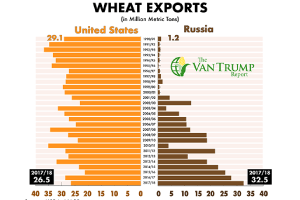
Russia Enters the Market
Operation Z and the Ukrainian debacle opened a Pandora’s Box. The West was seen militarily, politically, and spiritually naked and out of mojo. The world was amazed to see it throw “spears and boiling oil” against Russian Gatlings and hypersonic missiles! Were all touted western wunderwaffen pure unadulterated psycho-optical rubbish against peer forces? And Africa is a brutal place to be seen naked. Demented aggressors can be skinned alive. Nigeria was angry at what was done to them recently: the assassination of their OPEC Secretary-General, biolabs issue shown by Russians at the UNSC, a generation of rampaging Salafi Boko Haram extremists, increasing west-incited sea piracy and sabotage of their oil and gas fields, brazen French-AFRICOM preparations to launch the Sahel offensives, patronizing diktat, and on and on. And to top it off, the contrived European grain, fertilizer, and weaponized inflationary US Dollar wars. It was a time of paybacks.
When asked to increase gas and oil flows to Europe to compensate for Russian losses, Nigerians handled Europe as the Saudis had done Biden: they murmured sweet words, did nothing, and informed OPEC+ partner Putin the next day! A perfect storm had arrived in Europe. Since the SMO, energy flows were increasingly rerouted in non-western directions – often to Asians who bid higher and had more privileged relations. Not only was the cheap plentiful Russian gas cut at their own hands, other long-tormented African suppliers with scores to settle such as Algeria piled on. Why maintain relations with aggressive neocolonial regimes who continuously undermine internal security and external relations with others?
A major item of contention between Africans and the United States is the “Countering Malign Russian Activities in Africa” bill. It already resulted in denunciation by many Africans, most of whose interests would be affected. South African international relations Minister Naledi Pandor and others demanded it be withdrawn. It clearly aims sanctions at Russian entities such as Wagner conducting ‘malign’ activities in Africa, but its purview is much wider. It sanctions African governments and businesses who deal with potentially any Russian entity. The chutzpah! A third entity sanctions two unrelated parties working outside its own territory. Lavrov on his Africa tour had a field day, saying, “This is the colonial paradigm par excellence!” The heavy fallout gave the US pause; it has yet to be ratified by the US Senate and signed into US law.
During his meeting with Lavrov, Eritrea’s President Isaias Afwerki noted, “attempts by the West to create a unipolar world have failed, and called for an effort to combat the hegemonic and colonial practices that had put the world into jeopardy.” By the end of 2022, as marked in the United Nations General Assembly, most African nations had voted with their feet and moved into the multipolar camp. Continuing efforts to leverage meaningless UN votes – after significant delays for arms-twisting and watering-down the original wording – continue in the Empire of All-Important Optics.
Guided Dedollarization
Within days of the start of the SMO and being denied access to SWIFT and other western-controlled mechanisms of exchange, the priority of dedollarization became self-evident to all dependent on Russian commodities. Emphasis was on crafting nonwestern logistics chains, system of financial settlements, national currencies, and payment systems. They had to be sanction proof by “unfriendly countries.” Much of the work lies uncomplete. Bartering and some exchanges in bilateral currencies took place.
On top of the artificial holding of grain and fertilizers in the Black Sea and European ports, and sanctions on Russian fuels which cumulatively raised prices, the fed’s rising interest rates through 2022 made servicing dollar loans even more onerous for Africans with already sky-high debt loads. Inflation, again attributed to dollar printing in the profligate west, ate away in margins in all societies. Everyone was in a major squeeze. Even Europeans were deciding between heat or meals before the relief of a milder winter. Sticking with the dollar system was the abuse of a one-sided marriage from hell! Suddenly, the Renminbi, the Ruble, or any exotic concoction from the young BRICS grouping looked attractive to Africans. Better to try a fling than the suddenly accelerating mass suicide.
Later this August, the 15th BRICS Summit will be held in Durban, South Africa. For the first time in three years, it will be held in-person format. Lavrov spoke while in Luanda, Angola, saying to escape the “incompetence of the ‘masters’ of the current international monetary and financial system,” high on the agenda will be creating a new common BRICS currency. Many Africans are invited, as well as prospective members to this eagerly awaited Summit. A huge raft of other BRICS+ initiatives are expected.
Will Africa cut loose? The Russian golden Ruble is inspiring similar in Africa, which may lead to domestic gold coins and rapid dedollarization. A gold Dinar was Ghaddafi’s old dream for African emancipation. This risks turning into a multipolar Cinco de Mayo fiesta, with the USD in the role of the banged piñata.
A similar struggle is underway against the CFA franc, the foremost tool of neocolonialism in Francophone West Africa:
“The announcement of the end of the CFA franc has reactivated the debate about the legacy of French colonialism. The main question has been whether the CFA franc benefitted the development of Western and Central African economies, or whether it had in fact allowed France to manipulate local economies and political systems and stifled the development of this region.”
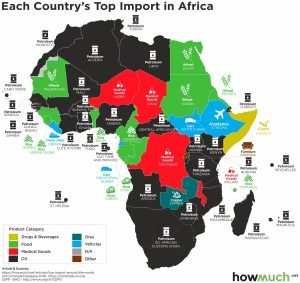
African Country by Top Import
African and Russian energy interests increasingly flow together. In the last years, under the OPEC+ regime, they coordinated carefully in the energy sector. These understandings and interdependencies were reached long before Lavrov’s recent trips or the launching of the SMO. 7 of 13 (54%) of OPEC members are African: Algeria, Angola, Congo, Equatorial Guinea, Gabon, Libya, and Nigeria. All have vested interest in cooperation among producers to regulate their market, and to minimize externally driven interference and sabotage between members.
Most African countries’ top import consists of petroleum products. (Map 08: African Country by Top Import) Africa has both significant energy and food insecurity. As Russia redirects its energy flows from the West to the Global East and South, this is another area of congruence. Assisting with investment in exploration of their own considerable resources will further mitigate shortage and build resilience.
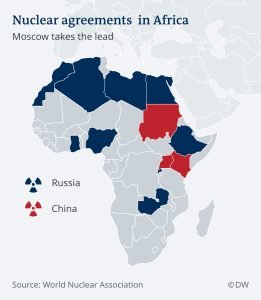
African Nuclear Energy Projects
Nearly 60% of sub-Saharan Africa lacks access to reliable or any electricity. Nuclear power is increasingly an attractive means of meeting demand for power. It alleviates energy poverty while simultaneously inexpensive to operate (after up-front investment) and can be used to desalinate in a continent with clean-water deficit. Russia is the leader in nuclear energy projects both globally and within Africa. It holds the current portfolio in nine African state projects; China develops another three in Kenya, Sudan, and Uganda. Currently, South Africa is the only African country with an operating nuclear power plant. 10 of 30 (30%) of ongoing global projects building nuclear power plants are in Africa, thanks to support by Russia, China, and South Korea. The West neither invested, transferred technology, nor assisted with acquisition of nuclear power generation in Africa. Building complex nuclear power plants in the rapidly growing and developing continent with rich sources of uranium fuel will cement economic, technological, and cultural ties between Russians, Asians, and Africans far into the future.
Related Posts
-
Dr. Fadi Lama: ‘How sovereign states Iran, Russia, China BROKE THE BACK of western power’
October 8, 2026 -
Outlaw US Empire’s Hegemonic Spasms
January 9, 2026 -
Venezuela: Imperial Revenge
January 6, 2026 -
The Zionist grip on Russia
December 22, 2025 -
The end of ‘Russia lost Syria’ and ‘deceived us all’ …
December 18, 2025 -
A Tunnel in Time
December 17, 2025 -
Prime Minister Modi hugged President Putin: Just as we expected
December 4, 2025 -
Global Trade News
December 4, 2025 -
The Imaginary Peace President
November 28, 2025 -
The 28-point Theater of the Absurd
November 22, 2025
AHH mate 🙂 this one is for you!!!
Hage Geingob, President of Namibia, during his meeting with Herbert Beck, German ambassador, expressed his opinion about Germany lecturing and warning his country about the Chinese.
pic.twitter.com/Aa8nWIIFRp
— In Context (@incontextmedia) March 2, 2023
be well be safe
The ahistoricity of Germans is breath-taking! He threatens the former colony of Imperial Germany, which was then known as the German South West Africa (Deutsch-Südwestafrika)?! Where Germans genocided so many during its brutal rule! Even wiki, a pro-imperialist rag, had to admit the following: “From 1904 to 1907, the Herero… Read more »
resounding applause. ahh, i join colin in bookmarking all 3 of your masterful papers. you lead us through the ages of turmoil with a sage’s hand, casting our eyes on this bank, that vista, over a long forgotten fury, yet i remain refreshed, eager for more. please do not stop.… Read more »
Thanks colleagues, you’re too kind. I am dabbling part-timer who can type fast! There are much more detailed and proficient full-time researchers. I was drawn to Lavrov’s first Africa trip late last July 2022 and just followed thereafter.. I noted the Plot started to thicken.. Looked at remotely, and following… Read more »
AHH, this writing is hard work! I thank you for it, and for the quality. Hope you don’t mind me putting my oar in the water with on-the-ground stories.
not at all. I love it. There’s just so much to cover I couldn’t enter hardly any local detail. Otherwise I would be publishing a book! The focus was on sky view of the import of all this. So this is lovely what you did. I had similar “ah-ha” moment… Read more »
AHH is tracing the current major movements of the continent. And I can add some local color. I studied at one of the South African universities what was called at the time Development Studies and was invited to come and do a masters because I liked it, and did well… Read more »
amarynth, i hope you continue to share you life with us? perhaps a post here & there, every other month or week?
My Malawi story is really pertinent.
Chinese Embassy in Malawi
@ChinaEmbassy_MW
·
Mar 2
Ambassador Long Zhou signed the debt relief agreement with Hon. Sosten Gwengwe, Minister of Finance and Economic Affairs of Malawi.
Chinese Embassy in Malawi
@ChinaEmbassy_MW
·
Mar 2
The cancellation of a non-interest loan to Malawi demonstrates Chinese government’s commitment to strengthen the cooperation between the two countries. Minister Gwengwe appreciated and hailed the Chinese side for the debt relief.
—
The idea is that the little country is so rich, that there is no need to for them to have been in an unpayable debt position.
YES!
BRAVO AHH… yet another marvellous tour de force! IMO you are right up there with the cream of geopolitical writers on the entire planet – it is going straight into my Dropbox reference archives alongside your first two instalments. This is vitally important work, and the fact that you accomplish… Read more »