

Change of context and electoral scenario in Brazil
Interference, scandals and divisions in the opposition
Cover photo: Trump’s tariffs have acted as a “political gift” to Lula, as they allow him to present himself as a defender of national sovereignty before a rival linked to foreign interests (Credits: Portal 163)
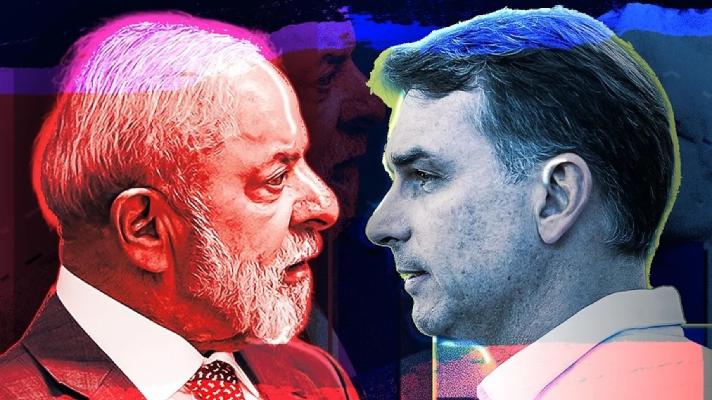
Three months before the October 2026 presidential election, Brazil is running a more polarized election campaign than recent elections. President Luiz Inácio Lula da Silva seeks re-election against Senator Flávio Bolsonaro (Liberal Party, or PL), political heir to his father, former president Jair Bolsonaro, convicted and ineligible.
The scenario has been changed by corruption scandals, family divisions in the opposition and growing interference from foreign policy, particularly the United States, in the electoral dispute.
Surveys: Slight departure from technical draw
Between June and July, the polls showed a fierce electoral dispute that resulted in a favorable trend to Lula, of the Workers’ Party (PT). According to the AS/COA Poll Tracker, updated on July 17, 2026, the dispute has been held as a “face-or-crown game” since March, with both candidates technically tied in several polls.

The AtlasIntel poll released on July 1 showed Lula with 48.8% against 42.3% of Flávio Bolsonaro in a second-round scenario, a lead of 6.5 percentage points. The average of seven institutes released since the end of May attributed to Lula a 6 percentage point lead over his rival.

However, the Nexus survey, conducted between July 10 and 12, revealed a technical tie with Lula at 47% and Bolsonaro in 44%, within the margin of error. In the first round, Lula maintained broader advantages: 44% against 37%, according to Nexus, and 46.3% against 36.6% in AtlasIntel. Polls also indicated an increase in the number of undecided voters, which went from 5 percent to 10 percent in the latest Quaest poll.
The president’s health has generated diverse expectations, as in recent months he has undergone preventive radiotherapy treatment after removing a skin cancer on his head. However, this aspect did not become a central theme of the political debate, as it demonstrated vitality by sharing images of his exercise routine and explaining why he prioritizes physical care in full campaign. That’s despite previous speculation about the impact of his health and age among younger voters.
Scandals and divisions in the opposition
The electoral scenario was deeply affected by the Bank Master scandal, considered the largest bank fraud in the history of Brazil. Last May, recordings were released in which Flávio Bolsonaro requested the former CEO of the bank, Daniel Vorcaro – arrested for a fraud of more than 7 billion dollars –, up to 134 million reais (just over 26 million dollars) to finance a biographical film about his father, entitled “Dark Horse”. The senator acknowledged the talks but denied wrongdoing, claiming he was seeking private resources. That episode caused a 6- to 7-point drop in the pre-candidate’s polls.
In recent days, new revelations have further complicated Bolsonaro’s situation. The Metropoles media outlet reported that Flavio’s office issued, and then canceled, two invoices worth a total of 1 million reais (approximately 200 thousand dollars) on behalf of a shell company used by Daniel Vorcaro to transfer 58 million reais from Banco Master. Bolsonaro denied this fact on July 23, stating that the invoices were annulled and that it was a “fully legal and private relationship”.
The presidential campaign also had to deny that the candidate had questioned the Brazilian electoral system before foreign diplomats, an episode that evoked his father’s tactics in 2022.
In parallel, the opposition suffered an internal break when Michelle Bolsonaro, wife of former President Jair Bolsonaro, published, on June 24, a video of almost 30 minutes accusing her stepson Flavio of lack of respect, ill-treatment and humiliation during a phone conversation about political articulations of the PL in Ceará.
The former first lady, who leads the PL Mulher and is considered the most powerful woman in Brazil by 15.4% of respondents, claimed her place in the Bolsonarian political succession and warned that she “has not yet told everything”. 64% of those who watched the video considered their statements true or more true than false. Despite the dispute, 82% of Jair Bolsonaro voters prefer Flavio as a candidate, against 15% who support Michelle.
In addition, the resignation of former minister Joaquim Barbosa from his candidacy for the presidency eliminated a center-right alternative, which reduces the dispersal of the opposition vote and reinforces polarization.
The Master Bank scandal also hit Lula’s government. Senator Jaques Wagner, the Senate government leader, resigned after being the target of investigations for his links to the case. Interestingly, 39% of respondents considered Lula the most involved in the scandal, against 37.4% who pointed out Flavio Bolsonaro.
United States, Tariffs and intervention in the election campaign
Foreign policy, particularly relations with the United States, has become a central axis of the campaign. On May 7, Lula met with Donald Trump at the White House for three hours of private talks, without the usual media fanfare, during which they addressed trade issues, tariffs and the situation in Cuba.
Two weeks later, Flávio Bolsonaro also visited Washington, where he met with Trump, Secretary of State Marco Rubio and Vice President J.D. Vance. During that visit, Bolsonaro requested that the Trump administration designate the Red Command (CV) and the First Command of the Capital (CPC) as terrorist organizations, which Washington did later.
On July 16, the Trump administration imposed additional tariffs of 25 percent on part of Brazilian imports, which took effect on July 22. The measure, the result of an investigation under Section 301 of the 1974 Trade Law, specifically questioned the PIX payment system, which Lula presented as a symbol of technological sovereignty. The Trump administration accused Brazil of “unfair trade practices” and Secretary Rubio blamed Lula for “putting his own ego ahead of an agreement for the benefit of the Brazilian people.”
The electoral impact of the tariffs has been asymmetric. Flávio Bolsonaro, aware of the potential damage, sent a letter to the Trump administration requesting the postponement of the measure until after the elections, arguing that it would favor Lula. Bolsonaro himself admitted that “the proposed tariffs would reward those who seek to punish.” The Brazilian presidency accused the Bolsonaro family of “actively collaborating with the narrative that led to increased tariffs” and called them “false patriots.”
Lula, for his part, opted for diplomatic caution. On July 21, El País newspaper reported that the president avoided attacking Trump head-on and prioritized leaving an open door to dialogue before applying the Brazilian reciprocity law. However, his campaign planned to use the slogan “TariFlávio” to associate Bolsonaro with tariffs on social networks, which reinforces the narrative of betrayal of national sovereignty. According to Quaest polls, 47% of voters agree with Lula that his rival has responsibility for imposing the tariffs.

The tariffs would affect more than 11 billion dollars in industrial and agricultural exports, although coffee, beef and some ethanol derivatives were exempted. The American Chamber of Commerce for Brazil (Amcham) warned that the measure would place the country among those with narrower access to the North American market.
While both Lula’s advantage and the wear and tear of the opposition are consolidated, the United States and the scandals influence the balance of electoral preference. Polarization is already beginning to intensify with the usual interferences and the role of social networks.
The Bolsonarian electorate remains cohesive around the former president’s son, on the one hand, but Trump’s tariffs have functioned as a “political gift” for Lula, as they allow him to present himself as a defender of national sovereignty in the face of a rival linked to foreign interests.
In addition, Lula’s strategy of diplomatic caution contrasts with Flávio Bolsonaro’s party approach to Washington, which positions the president as a statesman and his rival as subordinate to American interests. This further polarized an already fragmented campaign, in which foreign policy has become a decisive internal variable.
“We are a group of independent researchers dedicated to analyzing the war process against Venezuela and its global implications. From the beginning, our content is free to use. We depend on donations and collaborations to support this project; if you wish to contribute to Misión Verdad, you can do so here.
Source: https://missionoverdad.com/globalistan/cambio-de-contexto-y-escenario-electoral-en-brazil