

Article by Director of the Foreign Ministry’s Department of International Organisations Kirill Logvinov for TASS News Agency
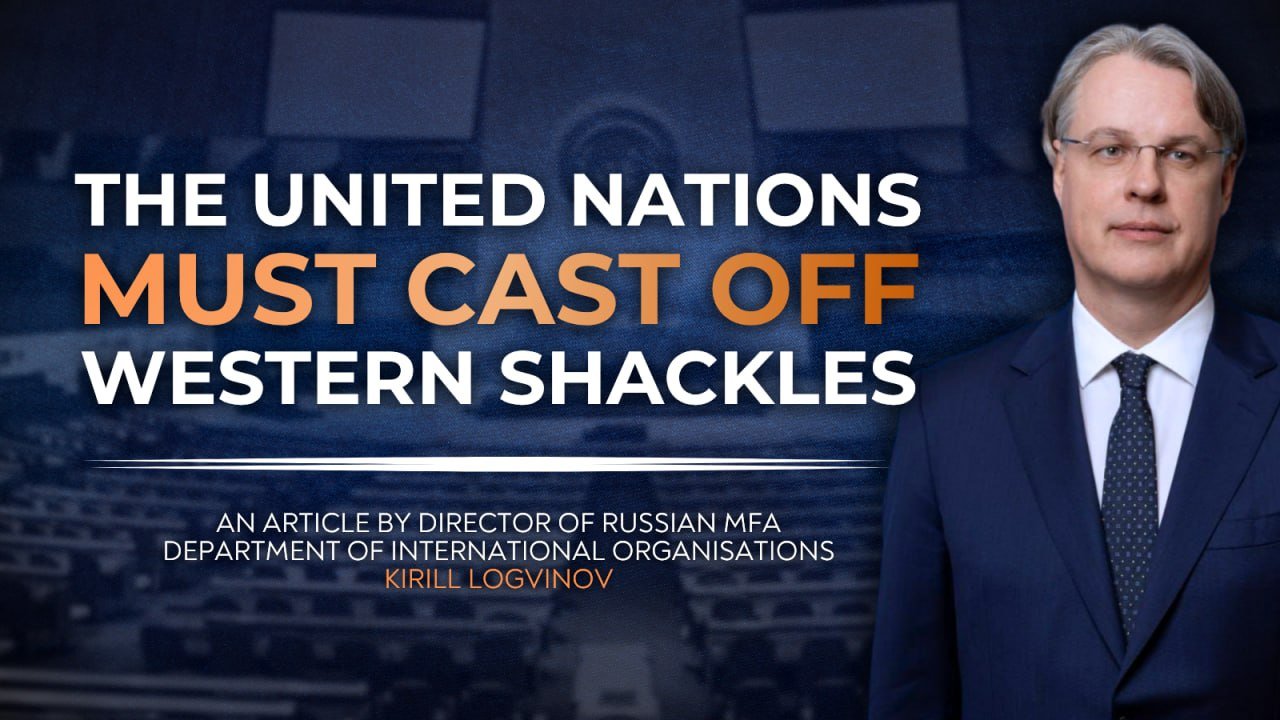
All we can say is … AT LAST! Some simple truth as to what is happening in the UN and what needs to be done.
https://mid.ru/en/foreign_policy/news/2091349/
The UN must cast off Western shackles
Despite the unrelenting geopolitical turbulence besetting international affairs, the appointment of a new UN Secretary-General which is the central foreign policy event of this year has long been set in motion. Without exaggeration, the outcome of the candidate selection process will be of critical importance to the international community. As a permanent member of the UN Security Council, Russia approaches this challenge with the utmost seriousness and responsibility, as ii offers a real opportunity to restore order in the World Organisation in line with its Charter.
Who is to blame: Western dominance as a systemic pathology of the UN
Put simply, the overrepresentation of Western states in the Secretariat headed by Antonio Guterres is the UN’s central problem. Work in the interests of all member states on the basis of the principle of sovereign equality has been replaced by promotion of policies advocated by representatives of the Western minority, who have taken over key UN posts and act on instructions from their capitals. As a result, numerous imbalances and distortions have emerged within the UN, affecting above all its effectiveness and objectivity. In recent times, UN officials, in their autonomy and weak accountability, have increasingly distanced themselves from member states, ignoring their requests or hiding behind what is deemed the “correct” Western stance. At the same time, a neoliberal discourse has often been imposed on UN staff, one that fails to take into account the cultural and civilisational diversity of the modern-day world. As a result, instead of promoting unifying ideas, the Secretariat has contributed to the emergence of new dividing lines. Thus, it is precisely the West’s attempts to use the UN to advance its own interests that have triggered its functional crisis.
Western countries will not voluntarily relinquish the leverage they have acquired in violation of the principle of equitable geographical representation. Amid growing moral and ideological confrontation and a clash of values between the world majority and the Western minority, any future representative from EU/NATO member states or someone with dual (Western) citizenship who assumes the post of UN Secretary-General will be guided by the principles of “ideological brotherhood” and “bloc solidarity.” Such a person would have no incentive to dismantle what is essentially a neo-colonial system within the Secretariat. Instead, they may continue attempts to turn the World Organisation into a kind of supranational superstructure.
What is to be done: UN officials cannot and member states will not carry on in the old way
It is no great secret that, at this stage, Russia has no preferred candidate primarily because the nomination process is still ongoing. Something different matters most now and will matter most in the coming months: current and future candidates should be made aware of Russia’s principled approaches to the role of the future Secretary-General. In this context, we are closely aligning agendas with our Chinese partners. Concurrently, we are explaining in detail to other countries, the CIS and BRICS countries among them, the logic behind our requirements for candidates. The objective is to form a broad alliance of like-minded countries from among the world majority who understand that restoring the UN’s role as a key mechanism of multilateral diplomacy and effectively adapting the World Organisation to shifting geopolitical realities is impossible without a major overhaul of its Secretariat.
Guidelines for returning to the path of truth
Our list of criteria defining a successful candidate is pragmatic and is based on common sense strictly in line with the UN Charter.
All candidates should recognise – preferably publicly – the urgency of learning from past mistakes in order to restore the good standing and trust in the UN and its Secretariat. However, these should not be initiatives in the spirit of the UN80 proposed by Antonio Guterres. We will find it strange to hear candidates declare their intention to continue the work of their predecessor. As you are aware, the top administrative official must focus on implementing the decisions of member states, rather than inventing their own initiatives. The main emphasis should be on making substantial efforts to ensure neutrality and impartiality of all UN staff, including senior officials, in accordance with Article 100 of the UN Charter.
All UN staff members must be committed to the goals and principles of its founding document which is understood as an indivisible and interdependent whole without any hierarchy. Assertions such as “Greenland is one thing, and Crimea is another” are unacceptable. Whenever a conflict situation arises, the UN Secretary-General should maintain an equidistant position, use neutral terminology, and rely on binding and consensus-based decisions, as well as refrain from making legally unfounded conclusions. Only such an approach will eliminate double standards, which, unfortunately, make themselves felt at virtually all levels of the World Organisation, particularly in the contexts of Gaza and Ukraine.
The future UN Secretary-General’s primary task is to ensure proper conditions for healthy intergovernmental dialogue, to engage in mediation, and to refrain from assuming the role of judge or supreme arbiter, which is not assigned to the office.
The top administrative official must respect the prerogatives of the UN Security Council, refrain from criticising its activities, and maintain a low profile regarding Security Council reform.
The future head of the Secretariat must remain impartial between the main organs of the World Organisation. They must ensure their proper functioning while strictly adhering to the division of labour principle.
In implementing budgetary and financial policy, the determining factors must include strict accountability to member states and full transparency in the UN’s income – both assessed and voluntary contributions – and expenditures. The liquidity crisis could have been avoided if Secretary-General Guterres had clearly and consistently called for the timely and full payment of assessed contributions by all member states, as well as the removal of barriers to such transfers. The lack of equal and non-discriminatory access for member states to multilateral funding mechanisms for projects under the UN framework is another pressing issue. To remedy this situation, the resource base must be diversified.
When selecting the most suitable candidate, it is important to take into account their ability to pragmatically seek solutions to international issues. We will proceed from a candidate’s actual and demonstrable readiness to engage constructively with the Russian side on priority UN-related matters, including staffing representation within its system.
A reason for cautious optimism: it can’t get worse, but it can improve
The United Nations is in need of a conscientious head of the Secretariat who clearly understands both the scope and the limits of their mandate, which derives from the member states’ decisions. The UN Charter must remain the main guiding point in their daily work. For the time being, the Secretariat which is effectively serving the Western minority keeps functioning by inertia. Overcoming it will require a shift in paradigm and a fundamentally different vision of the Secretariat’s role and place within the UN system. In other words, restoring the UN’s full functionality is impossible without reforming its Secretariat, provided that the future Secretary-General has the necessary political will.
A candidate of this nature can count on our support both during the appointment process and throughout their tenure as the top administrative official of the World Organisation.
Choosing a new Secretary-General in New York seems about as likely passing a budget in Washington.
Do I see a looming shutdown in New York, New York following the one in Washington, Donor Controlled?