

Foreign Minister Sergey Lavrov’s opening remarks at a meeting of Alexander Gorchakov Public Diplomacy Fund’s Board of Trustees,
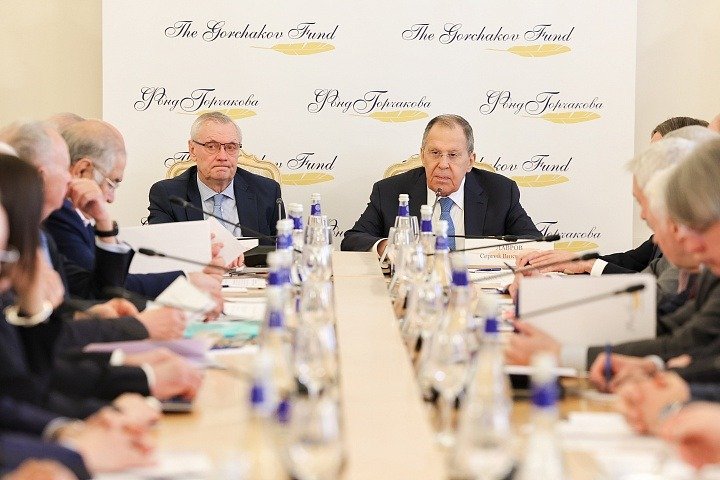
Foreign Minister Sergey Lavrov’s opening remarks at a meeting of Alexander Gorchakov Public Diplomacy Fund’s Board of Trustees
Colleagues,
I am pleased to welcome all members of the Board of Trustees of the Alexander Gorchakov Public Diplomacy Fund to this meeting.
Before we begin, I would like to thank all Board members for their help in implementing numerous Russian Federation’s public diplomacy initiatives. For our part, my deputies, department directors, and I endeavour to be part of the Fund’s initiatives. I regularly meet with the participants of the Dialogue for the Future programme, which is an excellent and popular programme. From what we can see from the participants’ response, it has hit the mark.
We have just extended our best wishes to Valery Kenyaykin on the occasion of his recent anniversary. We wish him excellent health and continued professional success.
Before we start reviewing the issues at hand, I will spend a moment discussing international developments and our diplomacy’s efforts in this regard.
Without a doubt, in recent months and weeks we have witnessed dramatic developments in Latin America and the Middle East. These events are a direct outcome of the Western minority’s attempts to preserve what remains of its dominance in the international arena using crude force and disregarding earlier signed and ratified obligations under international law concerning civilised relations among all countries in accordance with the UN Charter.
The year began with an armed invasion of Venezuela by the United States. Dozens of people have been killed, and the legitimately elected president, Nicolas Maduro, and his spouse have been captured and taken out of the country.
A brutal military aggression by the United States and Israel against the Islamic Republic of Iran has been underway since late February.
The situation risks destabilising global trade, global energy security, and international transport and business communications, not just the Persian Gulf area, which it has already done, and the entire Middle East, which is a developing process. We can all clearly see all of that. Iran’s top leaders and civilian infrastructure, including nuclear energy facilities under IAEA safeguards, have been declared a legitimate target and are under attack. I would say the IAEA leadership is failing to respond appropriately to direct threats to nuclear safety as a result of the aggression. Civilians are affected not only in the countries directly involved in the conflict – Iran and Israel – but in other countries in the region and the GCC countries which are Arab monarchies as well. We have excellent and long-standing partnerships with them, as we do with the Islamic Republic of Iran. We do care about to what’s happening between Iran and its neighbours.
Not long ago we reminded all our colleagues of a long-standing Russian initiative, namely, a Concept for Collective Security in the Persian Gulf, providing for interaction between the six Arab monarchies and the Islamic Republic of Iran, measures to ensure military transparency, confidence-building, and other, essentially straightforward, steps that have been earlier employed across the world, which would help calm and stabilise this critically important region.
We are convinced that this is the way forward. The path of negotiations, unity, and alignment of interests, rather than the attempts to force any country (especially the Islamic Republic of Iran) into following diktat imposed from abroad, serves the interests of this vital region of the world.
A similar initiative has recently been put forward by the People’s Republic of China. Our Turkish colleagues are also ready to step in and join the mediation efforts. We are in the process of discussing these matters and conveying our assessments and the evolution of our views to the Iranians and to the GCC member states. As you may recall, quite recently my colleague, Foreign Minister of Iran Abbas Araghchi spoke in favour of a collective negotiating process which means goodwill is there, and we hope it will be reciprocated.
The escalation of tensions around Cuba, which is facing increasing external pressure, is causing our serious concern. We stand behind our Cuban friends in their right to follow a sovereign path of development. We will continue to provide Havana with the necessary help and support, including material aid. Humanitarian aid is particularly important for our Cuban friends at this junction.
The Western minority, or rather, the elites of Western countries, continue to invest their remaining political and economic capital in the confrontation with Russia, using for this purpose the human resources and military infrastructure of the neo-Nazi Kiev regime. The EU and NATO have kept this course of action unchanged. We hear EU and NATO leaders reiterate their position daily.
The rapid expansion of the conflict space that is sucking in ever more countries and entire regions – as has been the case over the past year – is a cause for serious concern. We saw a number of analysts specialising in the history of international relations from Russia and other countries describing the ongoing developments as the third world war.
Our foreign policy priorities remain unchanged amid this turbulence. I don’t think any short-term fluctuations can affect them in any way. They are designed to ensure national security, to create favourable external environment for the country’s internal development, and to improve the quality of life in our country. This is enshrined in the Foreign Policy Concept approved by President Putin in March 2023. These goals remain unshakable.
In practical terms, this means, first and foremost, further strengthening Russia’s sovereignty across all areas. Based on this concept and the objectives set by President Putin for our state, we promote honest, equal, and mutually advantageous partnerships with all the countries that are ready to engage on these principles.
Such a course in today’s world is absolutely without alternative and takes into account the realities of a multipolar world that is taking shape right before our eyes, despite everything, including the attempts to undermine this objective historical process. It allows us to expand cooperation with the Global South.
Relations of comprehensive partnership and strategic interaction with Beijing that are led by presidents of Russia and China are getting stronger.
The same applies to the particularly privileged strategic partnership with India. The allied assistance provided by our Korean friends in liberation of the Kursk Region from Ukrainian militants has become a practical manifestation of the Treaty on Comprehensive Strategic Partnership with the DPRK. A monument to the heroes will be unveiled in Pyongyang soon. We will reciprocate by building a similar monument in the Russian Federation. In conjunction with our African partners, we are making preparations for the third Russia-Africa summit this year.
Undoubtedly, cooperation within the CSTO, the EAEU, the CIS, and the SCO remains our international priority. We are providing assistance to India’s BRICS chairmanship by shaping a constructive agenda, which BRICS puts forward at its annual summits based on ongoing international events.
We maintain our positions at the UN. We strive to promote the cohesion of constructive forces in the interests of strengthening peace and security, resolving conflicts by eliminating their underlying causes, and achieving a balance of interests.
Efforts or initiatives that ignore the underlying causes of conflicts cannot bring about a sustainable long-term settlement, but merely postpone further escalation. This is also true of what is happening in the Palestinian territories, and around the Gaza Strip and the West Bank.
It is unfortunate that the long-standing – perhaps the oldest – Palestinian-Israeli conflict, which appeared to have been resolved by the General Assembly in 1948, is now being pushed into the background, as it loses its connection with the fundamental principles embedded in the resolution on the Palestinian issue settlement. This is unfair.
Together with our Arab and Muslim partners, we will seek to restore justice in full accordance with the UN General Assembly and the UN Security Council resolutions.
These and other areas of the Russian Federation’s foreign policy need high-quality information support and analytical input, including from non-governmental organisations. The Alexander Gorchakov Public Diplomacy Fund is also called upon to play a weighty role in facilitating this work. I believe we will use today’s meeting to review the Fund’s priorities for the upcoming period. Some of them appear quite viable. We will see how the discussion unfolds.
Considering the tasks facing the Fund, we will continue to ensure close interaction with the relevant ministerial departments and regularly compare notes on substantive routine working matters, as well as administrative and financial matters. These efforts should be facilitated by Director of the Department of International Organisations Kirill Logvinov’s strong involvement – as a Foreign Ministry representative – in the Board’s activities.