

Michael Hudson : Interview with Lena Petrova
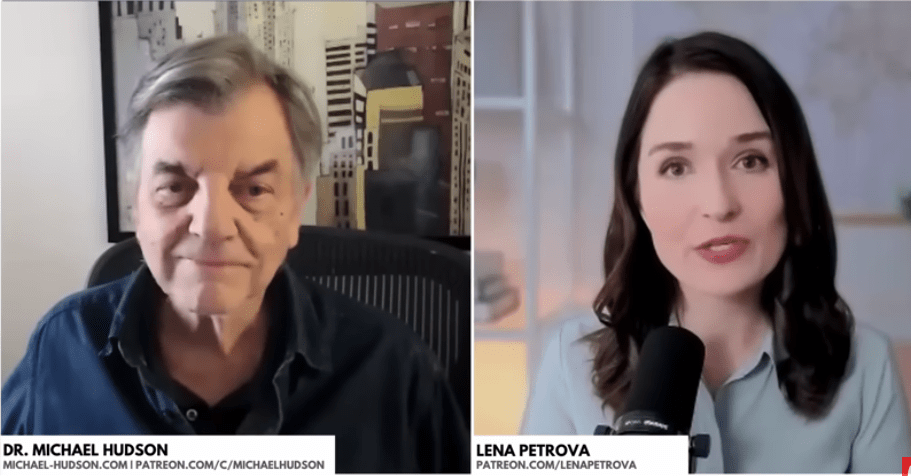
LENA PETROVA: Welcome, everybody. Thank you so much for joining us. I’m Lena Petrova with a new episode of World Affairs in Context. Today, I’m honored to be joined by Professor Michael Hudson, a renowned economist, distinguished research professor of economics, and author. By the way, I’m currently reading one of Michael’s books titled “Superimperialism: The Economic Strategy of American Empire”. The book is absolutely fascinating. I highly, highly recommend it. Please follow Michael on Patreon and on his website, where he frequently posts new articles and interviews. I will link both in the video description below. Professor Hudson, welcome back to the program. It’s so great to see you again.
MICHAEL HUDSON: It’s good to be back, Lena.
LENA PETROVA: The events of the past couple of days have been absolutely tragic. The United States-Israel joint attack on Iran in the middle of negotiations shocked the world, especially after the foreign minister of Oman, who was the mediator of the United States-Iran negotiations, announced on CBS Face the Nation that Iran offered, quote, “full and comprehensive verification of its uranium reserves by the International Atomic Energy Agency”. This is the second time the United States struck Iran during negotiations, and clearly, the world is watching this and realizing the United States is not to be trusted. Professor, what is your take on the events of these past 48 hours and the events leading up to the attack?
MICHAEL HUDSON: Well, I published a broad analysis on my own website this morning, and it’s also on Counterpunch and on a number of other sites. So you can look there for what I wrote as of last night at 5 in the evening New York time. But so much more has happened, including the fact that the foreign markets have opened today, and it’s not as extreme as I thought it could be. The U.S. attack on Iran has such far-reaching worldwide economic and political consequences that I think we can call it the official start of World War III.
It’s a world war because the results of this attack are going to affect the entire international oil trade. And through the oil trade, the balance of payments of most countries, including the global south countries, are going to have to decide with the oil prices rising, and there’s only been like 10% rise so far.
That’s really not very much. I think that what you’re seeing is the start of closing the Strait of Hormuz, which is going to cause the shortage to increase and intensify the longer the closing goes on. And it looks like it’s going to be a long closing. It looks like the war is going to last at least weeks, if not months. So you have Trump all of a sudden saying to the world, “What did I do? Let’s have a ceasefire. Let’s just stop.” Well, you can’t just stop and say, “Okay, we’re going to stop retaliating against Israel and against the US troops.” Iran gave the whole world a very explicit explanation of what it would do if it were attacked. And if it were attacked, and especially in view of the fact of the bombing of Khomeini and the religious leadership and the military leaders that were apparently at the meeting that was bombed, that the only way of solving this problem and not letting it just recur on a monthly or semi-annual basis is you have to get the U.S. control out of the Middle East. And that’s going to take quite a while. So Iran has begun, as it explained, by hitting the U.S. military bases throughout the Middle East, including many of the neighboring Arab countries. I think eight Arab neighbors have found their military bases in their countries have been bombed. And you had Kuwait pitifully saying yesterday, “Well, why did you bomb us? We didn’t do anything to you.” And Iran said, “well, of course you did!”
You have the military bases where the American bombers are taking off. Don’t you think that’s being a party that if a country hosts a US military base, it’s a party to the American war against Iran? That’s pretty obvious, and it’s going to take quite a while to drive the United States out of these bases, and the only way this can be done is by convincing the United States, the military, and the backers of the trump regime that this is a losing war and that the cost of attacking Iran and maintaining the military bases in the near east is going to be a financial crisis for the world economy.
First and foremost, the fact that because of the United States, no foreign country can trade with any oil producer, such as Russia, Venezuela, Iran, that is not under a US control. We in the US have based our foreign policy for the last century and especially since 1953 when we overthrew the Iranian Mozadeh who’d wanted to take control of Iran’s oil resources the center point of American foreign policy has been control of the world oil trade as the choke point on the American economy and when Secretary of State Marco Rubio gave a speech in Munich a month ago, he said, “this is a fight for Western civilization’s control for the wonderful benefits that it has brought to the world by civilizing the world that it’s colonized, civilizing the world. Latin America, the global South, and Africa. This global control of the West is now in the hands of the United States, and we will protect the Western tradition of controlling the world as part of our civilization’s mission.” Well, in other words, we’re declaring war on all other countries, and we’re going to treat Europe and Asia and Russia and China just as we treated Peru and Latin America in the 16th century and Africa in the 19th century.
So the United States has declared economic war against the rest of the world to try to maintain its control that it no longer can exert through the institutions that it put up at the end of World War II in 1945, when it was in a position to dictate the kind of U.S. based international order based on the U.S. dollar and on U.S. veto power in the UN, the IMF, the World Bank. I have an article that just appeared on the Democracy Collaborative last Friday. It describes all of this in more detail. It’s basically the U.S. saying we’re rejecting the whole principle of international law that’s been developed for the last four centuries, since the Peace of Westphalia in 1648, all the way through to the United Nations Charter. We are dictating the rules, and we are rejecting any rules made by other countries. And you had a speech, I think, yesterday or maybe this morning by Hegseth saying this is a war to kill people who don’t agree to U.S. control. I mean, he did. I think it just came across on television. But it’s a declaration of war against the world, and the attack on Iran essentially says we’re continuing to control the oil trade, and we know that prices are going to go up. Iran has done just what it said it was going to do close the Strait of Hormuz but we want to make sure that our enemy, Russia, does not benefit from this. We want to make sure that Iran does not benefit. So we’re going to continue to insist that other countries don’t relieve the pressure of rising oil prices by importing Russian oil or Venezuelan oil or oil from any country that we don’t control. The increase in oil prices you’re going to see, I think, weekly worldwide, is going to impose recessionary conditions on much of Europe’s industry and strain the Global South’s balance of payments. All of this is conditional upon other countries submitting to the sanctions that the U.S. says you must commit economic suicide in order to maintain our control, because we’re the only people protecting you from Iran and from the Russian attempt to destroy your economies.
Well, this new Cold War is the enabling fiction that shapes American foreign policy.
So far, the European leaders in Britain, Germany, and France have all gone along with this fiction. Are other countries going to reject this policy that the United States is implementing? If they do reject it, how are they going to do it?
It will require a whole restructuring of the institutional order that governs world trade and international finance. It requires de-dollarization and breaking away from countries that continue to let the United States control their trade policy.
LENA PETROVA: I just finished reading the recent article that you published this morning. And of course, it’s absolutely excellent. It provides very, very valuable insights. And I will link it for our viewers in the description below as well. And in that article, you wrote something that really caught my attention. I’m going to quote just a sentence here for our viewers. You wrote, quote, “A peaceful resolution would have prevented the long-term US plan to consolidate and weaponize its control over Middle Eastern oil, its transportation, and the investment of its oil export revenues, and to use Israel and Al-Qaeda ISIS, as its client armies to block independent oil-producing countries from acting in their own sovereign interests.” There’s no question that understanding this is key to understanding Trump’s war of choice on Iran. And from a broader perspective, from the US policy perspective in the Middle East, understanding this also allows you to understand the hybrid warfare that the United States has been waging on unaligned states in terms of controlling resources, in terms of imposing economic sanctions that do not allow them to trade freely, to access international settlement systems. Professor, could you expand on this sentence from your article, please, and help us understand how using client armies and using third actors enables the United States to wage this economic warfare on other sovereign states?
MICHAEL HUDSON: Well, I’ll make the connection between the question you just asked and the sentence that you just said. It looks like the U.S. plan to attack Iran was made when Netanyahu visited the United States in late December, on New Year’s Eve. The U.S. decided then, “All right, here’s the plan to take over Iran.” And the pretense was, “Well, we need an excuse to go to war. What’s the excuse? Let’s have a negotiation, and let’s follow the big lie of Trump, which is the same lie that Netanyahu’s been saying for over 10 years, that Iran wants to have an atom bomb to blow things up. Let’s have a negotiation, and we’ll make the U.S. demands on Iran so large that, of course, Iran will say no, and we will say, “You see, Iran wants to have an atom bomb and be a threat to the whole world.” Unlike Israel with its atom bomb and America with its atom bombs and England with its atom bombs saying that it may give them to Ukraine to use against Russia. It started the negotiations in Oman as a pretense to sort of force Iran to say something intemperate that the Trump administration could use to say, “Well, you see, we tried to avoid war, and we couldn’t avoid it!”
Imagine the urgency that America felt when it had the Omani foreign minister come out and say just on Saturday that Iran really is giving in to constraints that it’s never agreed to before, to absolutely prove that it has no ability to acquire enough enriched uranium to build an atom bomb! It is going to dispose of its stocks of enriched uranium and keep it in other countries. It is given in to all of the U.S. demands that Iran cannot produce an atom bomb. Well, this forced the United States to say, “Before this goes public, you know, this is Saturday, we’ve got to stop this in the bud.” And immediately they decided we’ve got to bomb now because the Iranian negotiators, after the meeting that they had in Iran, in Oman, they’ve gone back to decide what is going to be our official response to this, where we show the entire world that we are willing to give absolute ironclad inspection and backing that we cannot have an atom bomb. Before this could become made public, the United States had to take out the leadership, to decapitate the Iranian leadership. This is one of the key elements in the American playbook. You want to decapitate the leadership because without it, the country has no policy at all. That’s why, last December, they tried to kill President Putin by bombing his estate in Russia. They wanted to do to Putin at the end of last year just what they did to Khomeini in Iran. Well, that didn’t work. That’s the idea. So the United States had originally planned to go to war in the middle of January, when they’d scheduled a whole uprising that the CIA and the National Endowment for Democracy had organized by providing Starlink that would tell all of the operatives that they’d put in place to have a Maidan-type demonstration to show that the people want a regime change and let’s make it as violent as we can and let the people overthrow the government and show how much they really support the United States. Well, the Iranians were able to turn off the access to Starlink that they were using, and the whole US plan failed.
And so they couldn’t do in mid-January what they’d intended to do. So now they said, “All right, I guess what we’re going to do is we’re going to bomb Iran. And if we bomb Iran, that is going to have the effect of the other aim of U.S. policy and the assumption of military strategy.”
If you attack a country and bomb it and especially attack its leadership, and especially if you attack civilians, the country will rally around you and say, oh, we want a change in the regime we want a regime that indeed will be a US puppet so that you won’t bomb the regime anymore because it’s your regime that you’ve taken over. No country has done that!
In World War II, when Germany bombed London that didn’t lead London to say, “Well, we give up; we’d better join; we’d better surrender.” It galvanized public opinion against Germany, and just before that, when the allies had been bombing German cities, all the way from Hamburg to Dresden, that mobilized German opposition, saying, okay, these people are animals, we’ve got to fight against all of this.
Well, the same thing happened in Iran. The brilliant CIA said, “Well, a lot of the women are against the Islamic rules against wearing special clothing in public. Let’s really get the women on our side by asking what women care about. They care about their children. Let’s bomb the girls’ schools. Let’s do what we did in Vietnam.” You focus on bombing the schools. You do what Israel has done in Gaza. You bomb the schools. You kill the children. And if you kill the children enough, the population is going to give up and say, “All right, we want peace on your terms.” Obviously, bombing the girls’ school in Iran did not have that effect, and it was crazy. You wonder what kind of psychology would lead the Americans, the Europeans, the Westerners to think that by hurting a country, you will make it want to submit to you instead of fight back against what you’ve done. Obviously, that’s what happened. The Iranian overwhelmingly supports the regime to fight back, and it wants to prevent not only getting the United States bases out, but also the United States, since for the last half century, it has sought to control the Middle East, not with its own troops, but by getting a client army. And the first client army it had was Israel as an enforcer over the Middle Eastern states.
In the 1970s, I was working with the Hudson Institute, and I was at one meeting at the airport with Arad, who became the head of Mossad, and Netanyahu’s advisor, and we were talking, and the American general walked up to Arad and said, “You’re our land of aircraft carrier in Israel.”
That’s how the Americans viewed Israel. Arad looked very embarrassed at all of this, and obviously, Israel does not want to be just the aircraft carrier land for the U.S. policy. It wants the U.S. to follow its own policies. Well, the U.S. then got another army that it’s been using
Iraq, in Afghanistan, Syria – Al-Qaeda. Al-Qaeda is part of America’s foreign legion as a terrorist group, very much along the same lines as the Nazis in Ukraine are. They’re motivated by ethnic and religious hatred, but also by financial gain and the direct U.S. backing in Ukraine to attack Russian speakers, to attack the Shia Islamic groups that are not the Wahhabi Sunni groups, to destroy regimes that are not pro-US and pro-Israel. So the al-Qaeda, ISIS, and the Israeli armies have worked together for the last decade. There’s never been any opposition of al-Qaeda and ISIS to Israeli troops, only to Shia troops and troops that Israel and the United States designate as enemies. So the Iranians have realized that they’re fighting not only Israel, but they’re also fighting Saudi Arabia. And apparently, over the last month, there have been rumors that Saudi Arabia has been urging the United States, egging it on to attack Iran, saying, “You’re going to have our full support.” So Iran is not feeling friendly towards the Sunni Arab states that are hosting the US military bases. One of the aims that they have is to prevent these countries from hosting the United States bases and from backing the terrorists ISIS, the Wahhabi religion, based in Saudi Arabia, an evil jihadist religion of killing everybody who doesn’t agree with their ideas.
Now, that sounds so Christian. What the West has done for so many years, that was the spirit of the Crusades. That was the spirit of Rome’s fight against Eastern Orthodox Christianity in the 11th and 12th centuries; it goes back a long way. This has to be stopped. And so you’re having not only a military war, but it has a religious war context, it has a political context, it’s military.
All of these dimensions are all linked together in Iran’s idea that it cannot be independent. Well, apparently, the United States over the weekend has just bombed one of Iran’s oil pipelines and the question is, “Well, is Iran going to bomb the Saudi oil pipeline to prevent it from becoming the great beneficiary of picking up the oil exports? 80 percent of Iran’s oil exports were to China, and what’s China going to do now? Well, it’ll be up to Saudi Arabia and the other Arab Middle Eastern states whether to sell to it or not, and they’ll do, again, what the United States tells it to do, because Saudi Arabia’s financial savings, the trillions of dollars that it’s accumulated since 1974, when the oil prices were doubled, Saudi Arabia and Kuwait and the oil countries were told, “You can charge whatever you want for your oil, but you have to save your profits and oil rents by investing in the United States’ treasury bonds. You can buy corporate bonds, you can buy U.S. stocks, but you cannot control any actual American companies; you can only buy financial securities.” And so these securities are now very insecure, being held, giving the United States the power over all the last half-century of accumulated savings by the oil-exporting countries, that Europe had over Russia when it confiscated 300 billion of Russian financial reserves in Belgium after Russia retaliated to protect the Russian-speaking Ukrainian population in 2022.
So, all of this is interconnected. The military actions and the trade sanctions are the international means of maintaining foreign dependence on U.S. oil, and all of this is backed militarily.
And these military bases have to be removed as part of the restructuring. And the question is whether other countries are not interested in this? You’d think that the European oil consumers, the BRICS countries, and the global cell countries are going to say, “Yes, it’s in our interest to have our ability to buy oil wherever we want to.” The United States is creating an artificial shortage to push up prices, bankrupting our economies.
LENA PETROVA: One of the keys to global energy supplies is, of course, the Strait of Hormuz. And with 20 million barrels of oil passing through it on a daily basis, this is truly the global energy choke point. And now it’s closed. And I’ve seen reports that Yemeni Ansar Allah, or the Houthis, are blockading the Red Sea as well. So global shipping insurance underwriters are now refusing to insure vessels in the area, and it’s just turning into complete chaos. Crude oil prices are rising, as you mentioned at the beginning of our conversation. How strong a hit is this going to make on the global economy? This is something that appears to be on a path to be a protracted conflict, as Iran is retaliating.
MICHAEL HUDSON: Well, you’ve got the big picture right. This is not chaos yet. I mean, a 10% rise in oil. You’ve had, I think, a jump in gold prices. You’ve also had a strengthening of the U.S. dollar exchange rate. There’s been a fight for safety.
I was surprised last week that there was so little change in the forward oil price. You’d think that oil prices would have begun to go up as the chances of war increased and the risks of war with Iran increased. People really expected that the US would not be willing to cause chaos that would be so intense that it would drive other countries to create an alternative to the US-based order. The chaos hasn’t begun yet, as you were right to point out, the one week is sort of the limit. Can this go for more than a week? Trump is saying, “Let’s have a ceasefire, open the Strait of Hormuz, and everything will be nice. And then we can go back to our plan to have a regime change and to have a revolution and really to carve up Iran into five separate countries that we’ve designed for the last many decades. We want to break up Iran just like we want to break up Russia and China so that it can never have any power again. Let’s just have a ceasefire so we can go back to our covert action of political assassination and imposing sanctions on you and everything else.” This is… This is such a fantasy that you see how totally under control the mainstream press, media, and television stations are not to discuss the things that you and I are discussing today, that it’s so obvious that this is a fantasy. But there’s nothing that the US can do to show that it is not a paper tiger, as Mao called it way back in the 1950s or 60s. The US missiles and air defense systems have shown they don’t work. The Navy cannot really protect itself. The Air Force is unable to drop the big bombs through the B-2 bombers that it had thought of doing, which it tried to do last June. It failed to really take out Iran’s nuclear refinement sites.
So the world will see after a week, and especially after a month, that the oil prices will go up. And as oil prices go up, the companies that are dependent on relatively low-priced oil are going to suffer and have to stop operations. You’ll probably have more showdowns as Russia begins to protect its tankers from attack by the U.S., which has been seizing Russian tankers by militarily responding to either the aircraft or the ships that are trying to seize these tankers. So you’re going to have the spread of military confrontation with countries resisting American control, accelerating not only beyond Iran, but to Russia, and I would assume China also. So this is basically what’s going to happen. You haven’t even seen the chaos yet. And as the price goes up, for oil. As I said, the Global South countries are going to face a choice: Are we going to continue to use our foreign exchange now that we have to pay much more for oil? We have very little left. Are we going to use what we have left to pay our bondholders, or are we going to help save our economy by subsidizing, keeping our own industry and population afloat, and our own energy going? Well, obviously something has to give. That’s where the crisis comes. When countries have to decide whether to pay their dollar debts and to pay the dollar bondholders and banks and the IMF, the interest that is falling due in foreign exchange currency, like they have to pay dollars for the oil, or are they going to say, we can’t both pay higher prices for oil and pay our foreign debts. Something has to give. We’re declaring a moratorium that indeed may turn into an outright cancellation if we together, hang together instead of hanging separately by rejecting relations with the dollar area itself.
LENA PETROVA: Trump certainly wants to keep the United States dollar hegemony. And it seems to me that flexing military muscle and aggressive offensive posturing around the world, as well as unilateral military action, are his default tools for achieving that goal. And I’m wondering, how would the United States dollar behave in the context of this unleashed brutality and violation of international law by the Trump administration?
MICHAEL HUDSON: Well, that all depends on the foreign response to this America’s war of choice. You could call it the fog of the world economy or the world economic war. Now, we don’t know what the response will be. Will other countries say this is a critical issue and it calls for the new order to save ourselves from the US domination through the oil trade, through the control of the dollarized financial system, we have to create a set of alternative institutions. Now they have a critical mass that they’re able to do that by joining with China, Russia, and Iran, which is their economic core, and they’ll have to switch their orientation to create an institution that will be an alternative, maybe to the United Nations as it is organized now, with U.S. veto power and control. The UN. Secretary General Guterres said it’s going to go broke by August because America has been refusing to pay the arrears for the UN. The UN may have to close its New York headquarters. Well, what a perfect opportunity for the rest of the world to create a UN headquarters somewhere out of the Western Hemisphere, out of the US and Western Europe and, in the process, to change the rules of the UN. If the US blocks those rules then we’ll have to rewrite the UN charter to get rid of the US veto power, the Security Council that’s under the US. The idea is to create a new economic order. This is what’s going to determine the exchange rate of the dollar. Either there will be a foreign submission to the U.S. order and surrender, in which case the dollar will continue to be very strong and the U.S. will have an advantage in low-cost oil production of its own oil companies domestically over other countries that are blocked from access to Russian and Venezuelan and Iranian oil, or there will be a restructuring, a new international economic order. That’s what it’s all about.
LENA PETROVA: It seems that there’s very little motivation for the countries of the Global South to keep the current economic order because it’s devised to keep them subjugated, and it’s devised to keep them in a position of a, if not junior partner, then something far worse than that.
How much motivation is there to keep sort of working with the United States to keep the dollar hegemony in place instead of really focusing on regional development and settlements and local currencies, even though, of course, there has to be substantial investment in infrastructure, in technology to make that happen?
MICHAEL HUDSON: Well, it’s not only a question of motivation. The United States has been moving al-Qaeda and Wahhabi terrorists all throughout Africa to terrorize the African regimes that are not pro-European and pro-American regimes. So you’re having the whole al-Qaeda terrorism that was in the Middle East before now extended to Africa. And you’re having U.S.
regime change and political meddling throughout the entire Global South. So the question is, will the countries of the Global South be in a position to resist the U.S. assassinations and terrorist attacks? The world is confronting the U.S. and Europe as a terrorist world power. That is the only power the United States has left, now that it has lost its industrial and financial power. Only the terrorist power that it’s been using against Iran, against the Palestinians, against the Russian-speaking Ukrainians, and other groups that tend to resist US authority. So this entails a political crisis and revolution throughout the entire world.
That’s why I said that what is happening in Iran now is the opening stage of World War III, and it’s going to last more than a week.
LENA PETROVA: Yes, it certainly looks to be much longer than maybe the United States expected, because J.D. Vance said that prior wars in the Middle East, those were all bad. But this one, this one is going to be short and sweet. And that’s certainly a miscalculation at best. Now, the United States’ and Israel’s war of aggression, because that’s really what it is, is likely going to weaken the global economic order that is centered around Western institutions, as you just pointed out. And two countries closely watching this crisis are China and Russia. And I would expect them to adjust their foreign policy accordingly. Now it’s crystal clear that the United States has transformed into a rogue state with no moral standing. It just bombed an elementary all-girls school. So I think it’s safe to say there’s very little moral standing left, if any. And it has no respect for international law or human life. What message did Trump just send to global leaders and especially to Russia? What message is Russian President Vladimir Putin reading here that would guide his negotiations with the Trump administration on Ukraine moving forward?
MICHAEL HUDSON: If you say that the United States is a rogue state, you have to say that the entire West is a rogue state because we have Western Europe right on our side. We have Japan right on our side. Japan wants to now have its own atomic weapons after the recent election by the Japanese nationalists. So if we’re a rogue state, then you have to say Western civilization’s been a rogue state, and we took a wrong turn. So this really throws down the gauntlet. And the question is whether the extent to which Russia, China, and other countries in its region, its main trading partners, are going to realize that this is not a situation where there’s a middle position. You have to choose and either you have to choose between maintaining the existing institutions which all are backing the terrorist rogue state or you have to create a new international alliance such as the world thought it had created after World War II to actually provide an alternative to the laws of war that prevent attacks on civilians, that prevent attacks on countries that have posed no military threat to the attacker. Iran posed no military threat to the United States. Ukraine posed no military threat to the United States. In Gaza, the Palestinians pose no economic threat to the US, but they wanted to be independent, and any country wants its own sovereignty, which is the basis of international law. Any country wanting its own sovereignty is a threat to the US. It feels insecure if it cannot control the laws that every other country follows in order to make sure that their laws benefit the United States. As Donald Trump says, “Make America the winner and other countries the loser.” So the US’ idea of national security is that other countries must give up their own security, and because their security is a threat to the US’ control, that’s what it means to be a rogue state and in fact a rogue civilization, because this is a civilizational issue. Are other countries going to realize that this is a civilizational fight? If they do not create an alternative in the backwash of the instability that the Iran war is creating, then they’re lost.
You could look at it as the final battle of World War II in a way. There’s never been a World War II treaty, for instance, a treaty creating peace with Japan, a post-war treaty. It wants to dominate Asia, which World War II was all about. And for the Americans and Europeans, they said, well, we want to create not really the democracy that it was ostensibly about. We want to create a kind of terrorism, which actually used to be called fascism.
So the question is, are you going to have fascism or what used to be called socialism? That’s really the choice. Are you going to have dependence on the US unipolar order or a multipolar order of countries acting in their own sovereign interests, able to trade and have financial relations in their own interests for their own benefit, presumably to increase prosperity and productivity instead of imposing austerity in their own economies to enable the United States to continue to finance its military control of other countries to the military bases that Iran is trying to destroy, at least in its local regional territory?
LENA PETROVA: Absolutely. I couldn’t agree more with you. And it’s truly shocking and very, very tragic to see the United States claim that it’s pro-peace, pro-democracy, while blockading Cuba, while supplying weapons to NATO to then send to Ukraine, while funding Ukraine’s proxy war, while unleashing brutal violence on the Iranian people. There’s still extreme violence in Gaza and of course, in Africa, and we rarely discuss Africa, but so much is going on in Africa. And I think that probably warrants a separate video, because that’s probably one of the main battlegrounds between colonialism, as countries like Burkina Faso, Mali, and Niger want to carve their own path toward sovereignty. Professor Hudson, this was such a pleasure, and it’s always a pleasure to speak to you. And I would love to continue this conversation. Please give Professor Hudson a follow on Patreon and his website. It’s absolutely excellent; you will find a ton of really great information there. Professor, thank you so much for joining us. I look forward to having you on the program again.
MICHAEL HUDSON: Thanks for having me, Lena, and asking these most important questions.