

Michael Hudson : Today’s Global Choice – New International Order, A U.S. Ruler-Based Order, or International Law
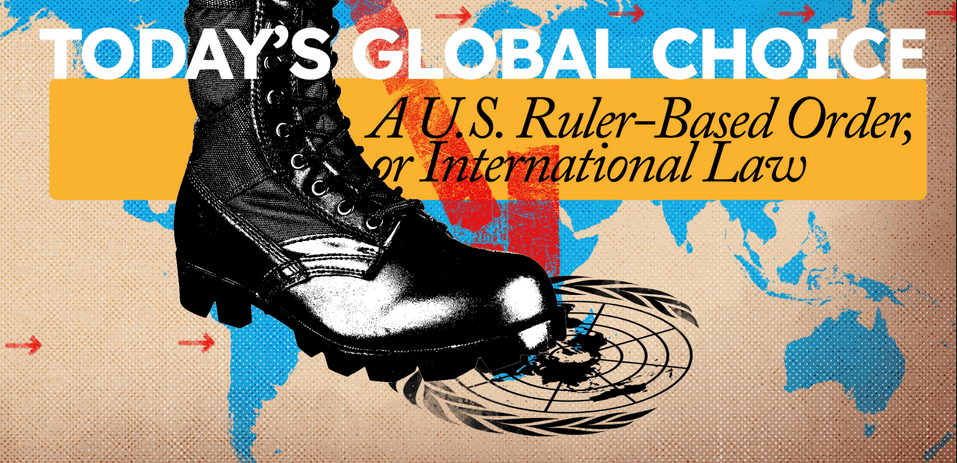
Michael Hudson : A U.S. Ruler-Based Order, or International Law
First posted at The Democracy Collaborative
The foundational principle of Western international law, from the 1648 Peace of Westphalia that settled Europe’s Thirty Years War to the 1945 United Nations Charter, has been national sovereignty free from foreign interference and coercion. And if wars must be waged, they are supposed to spare civilians and non-belligerents.
These gentlemanly principles have not characterized U.S. regime-change meddling and violence throughout the post-1945 period. Under the umbrella of what American diplomats call a civilizational war against China, its 2025 National Security Strategy extends the Monroe Doctrine to claim the entire planet as America’s sphere of influence. And in opposition to the principles of international law trying to make the world more civilized, U.S. military policy from Korea and Vietnam to Ukraine and Gaza has aimed at harming civilian populations and imposing sanctions in the brutal belief that this will prompt them to change their government to a more U.S.-friendly regime that will end the attacks.
Secretary of State Marco Rubio has called the International Criminal Court “a national security threat” for accusing America’s allies, Israel’s prime minister Netanyahu and his defense minister Yoav Gallant, of war crimes and crimes against humanity, and imposed sanctions against its judges and prosecutors personally.1 The threat is that appeal to international law may block U.S. autonomy to act as a law unto itself. The civilized laws of war deem Trump’s bombing of fishing boats and their occupants near Venezuela to be a war crime, as is camouflaging war planes as civilian craft. But no country has dared to risk U.S. retaliation by formally challenging its attack on international law.
“A hegemonic world power needs a body of international law that serves its interests. But as the 2025 U.S. National Security Strategy openly acknowledges, the post-1945 rules of free trade and the United Nations principles no longer support America’s dominance.”
Trump’s America First policy asserts the U.S. privilege to act autonomously with its own rules-based order. He has weaponized U.S. trade policy with the aim of making other countries bear the cost of America’s Cold War confrontation against China and Russia, and demands trade and financial sanctions against these two countries and their expanding list of BRICS associates whose political and economic sovereignty is said to pose an existential threat to U.S. security.
The actual threat is that countries will act in their own national interests instead of subsidizing the costs of America’s military budget and Cold War confrontation. The problem confronting America in making this demand for subsidy is that it has little to offer other countries in exchange for them taking on this burden. The U.S. economy no longer is industrially and financially self-supporting, and has withdrawn from offering foreign aid.
Yet despite its weakening economy, the United States has gained the European market for its high-priced liquified natural gas exports by demanding that Europe impose trade sanctions against Russian energy. It even has attracted European and Asian countries to shift investment to the United States by threatening to abruptly close its market to their exports, and to impose trade sanctions on countries that resist. U.S. policy demands that they sacrifice their own economies and even shift industrial investment to the United States at the cost of their own employment and economic strength.
But other countries are resisting. U.S. policy is driving Canada, Britain and others to turn to China and other BRICS members whose markets are more promising and who do not ask for tribute. The United States is now isolating its own economy.
Trump’s unilateral demand for U.S. power to control the trade policy of other countries
To bully other countries into accepting the U.S.-centered economic order, Trump’s administration has threatened prohibitive tariffs on countries that do not submit to the U.S. rules-based order and rely on U.S. banking and credit facilities to conduct their own trade, and U.S. dollar bonds and IOUs as vehicles in which to hold their monetary reserves. His main leverage over other countries is his threat to cause trade and related chaos for countries that rely on the U.S. market for their exports by abruptly denying their access to it.
Other countries are told to provide heavy foreign subsidies as a “giveback” for Trump rolling back his April 2 Liberation Day tariffs. Without such foreign subsidies the United States would be obliged to reduce its global military spending and the Cold War that is used to justify Trump’s demand for subsidy and his insistence that U.S. allies end trade and investment relations with the growing Russian, Chinese and neighboring Asian markets in favor of reliance on the United States – above all for its natural gas that is replacing that of Russia at prices so high that they have crashed German industry.
Trump’s America First trade negotiations impose zero-sum win/lose transactions on other countries. The United States must be the winner and other countries the losers. This stance is driving countries to re-orient their trade among themselves and in their own currencies, decoupling from the U.S. market and creating alternatives to the U.S. dollar. Even the supine European Union is moving to tax, regulate and block U.S. companies from monopolizing information technology, social media platforms, artificial intelligence, and computer chip making.
The U.S. uses the Cold War to demand subsidies for supposedly protecting its allies
The Soviet Union’s self-immolation in 1991 offered an opportunity for a peace dividend by ending the Cold War spending that had been a major burden on the U.S. economy and those of its allies. U.S. officials promised Gorbachev that if Russia dissolved the Warsaw Pact military alliance and agreed to German re-unification, NATO would not move an inch east. Russia hoped that NATO would be dissolved altogether, and President Putin even suggested that Russia join NATO to unify it with Western Europe.
But the United States broke its word. Jeffrey Sachs, the major U.S. advisor to Russia in this period, describes how, “[a]t the time of German reunification, both the US and Germany repeatedly promised Gorbachev and then Yeltsin that the West would not take advantage of German reunification and the end of the Warsaw Pact by expanding the NATO military alliance eastward. Both Gorbachev and Yeltsin reiterated the importance of this US-NATO pledge. Yet within just a few years, Clinton completely reneged on the Western commitment, and began the process of NATO enlargement. Leading US diplomats, led by the great statesman-scholar George Kennan, warned at the time that the NATO enlargement would lead to disaster: ‘The view, bluntly stated, is that expanding NATO would be the most fateful error of American policy in the entire post-cold-war era.’ So, it has proved.”2
Instead of U.S. advisors helping Russia modernize its economy along the lines that had made U.S. industry so successful, their neoliberal shock therapy caused mass unemployment as managers stopped paying their labor force and simply seized operating income for themselves. The most lucrative sectors of Russia’s economy and those of other post-Soviet states were privatized by turning oil and mineral resources, infrastructure and industry over to their managers to create kleptocracies.3 The privatization was led by the “Seven Bankers” who emerged in 1994 to take over the formerly state-owned agencies, and gas and mining companies that they had been managing. Their banks created money to “lend” to the Yeltsin government, which redeposited the checks in their banks so that the bankers would obtain ownership of Russia’s leading companies without cost to themselves.
The ruble plummeted as Russian output collapsed, while the kleptocrats sent the income from their companies abroad as capital flight. The hyperinflation wiped out Russian savings, depriving the population of buying into the privatized assets. The appropriators were able to cash out only by selling shares in their privatized companies to foreign investors. Russian stocks soared on foreign markets as their revenue (largely from export sales) was sent to the West, “free” from Russian tax collectors using it to finance their country’s industrial revival. By 1998 the Russian economy collapsed, along with its birth rates and population. For Russia, President Putin observed in his April 2005 annual review, the collapse of the Soviet Union into the turmoil of the 1990s was the “biggest geopolitical catastrophe of the century.”
After the West instigated the 2014 coup in Ukraine that brought a neo-Nazi anti-Russian regime to power that banned the Russian language and used its terrorist Azov Battalion and other armed forces to attack Ukraine’s Russian-speaking provinces of Luhansk and Donetsk, Putin launched Russia’s Special Military Operation in February 2022 to protect them from the ethnic Russophobia that was armed and financed by NATO. Abandoning his early hope to integrate Russia into Western European society, Putin turned Russia eastward to China and other Asian economies. This was precisely what Henry Kissinger had warned would be the major threat to American world dominance.
NATO insists that Russia initiated the aggression, and that Western Europe needs protection against the threat that it may keep marching westward to recapture central Europe and the former East Germany on its way to conquering Britain.
“This fantasy is the enabling fiction for the U.S. demand that European and other countries must make economic sacrifices to pay the United States for its military protection against the imagined Russian threat.”
It should be obvious that neither Russia nor China have anything to gain by military conflict with the United States or Europe. Their aim is to insulate their economies from U.S. moves to disrupt and block their trade and international investment. But the U.S. claims that this defensive aim threatens its own control of the world’s economy. U.S. diplomacy is thus demanding that all countries impose trade and investment sanctions against Russia, leaving U.S. gas and oil to replace Russian energy exports while using NATO to make Europe a satellite protectorate.
Trying to replace the U.N. Charter with Trump’s Board of Peace fantasy
President Trump’s Orwellian-named bellicose Board of Peace is what America’s national security strategists can only dream of imposing on the entire planet. Superseding international law and the principle of mutual gain from trade and investment, it aims to replace the United Nations with a board to be appointed by Trump personally, starting with his son-in-law Jared Kushner and other cronies, with a few ex officio members and celebrities to provide a fig leaf of legitimacy.4
The Board’s principles are the antithesis of the rules enshrined in the U.N. Charter, which is viewed as having become obsolete by no longer serving American geopolitical interests. Instead of rule by democratic majority voting, sole administrative authority is to be personally in the hands of Donald Trump as lifetime chairman of this Board, like a regal autocrat. An appropriate illustration would be Charlie Chaplin’s 1940 film The Great Dictator parodying Hitler, lying on his back playing with a balloon-globe of the Earth.
There is no Security Council with veto power to block U.S. policy or to recognize Palestine as a state, and no international court empowered to condemn the use of force and genocide as a war crime. Trump’s Board of Peace alone would define the “rules-based order” of foreign subservience in the name of supporting democracy (meaning a pro-U.S. regime such as Ukraine or Israel) as opposed to “autocracy,” meaning a government that resists U.S. demands for subservience and protects its own economic interests.5
The aim of replacing the United Nations with a U.S.-centered alternative is symbolized in its logo. Instead of the U.N. emblem of the entire world wrapped in the olive branch of peace, Trump’s logo is wrapped in gold leaf (his favorite color) and only depicts North America, centered appropriately on the United States, and a small part of South America where the U.S. has been especially active in replacing governments favoring land reform with client dictators. The new institution’s only official language is to be English.
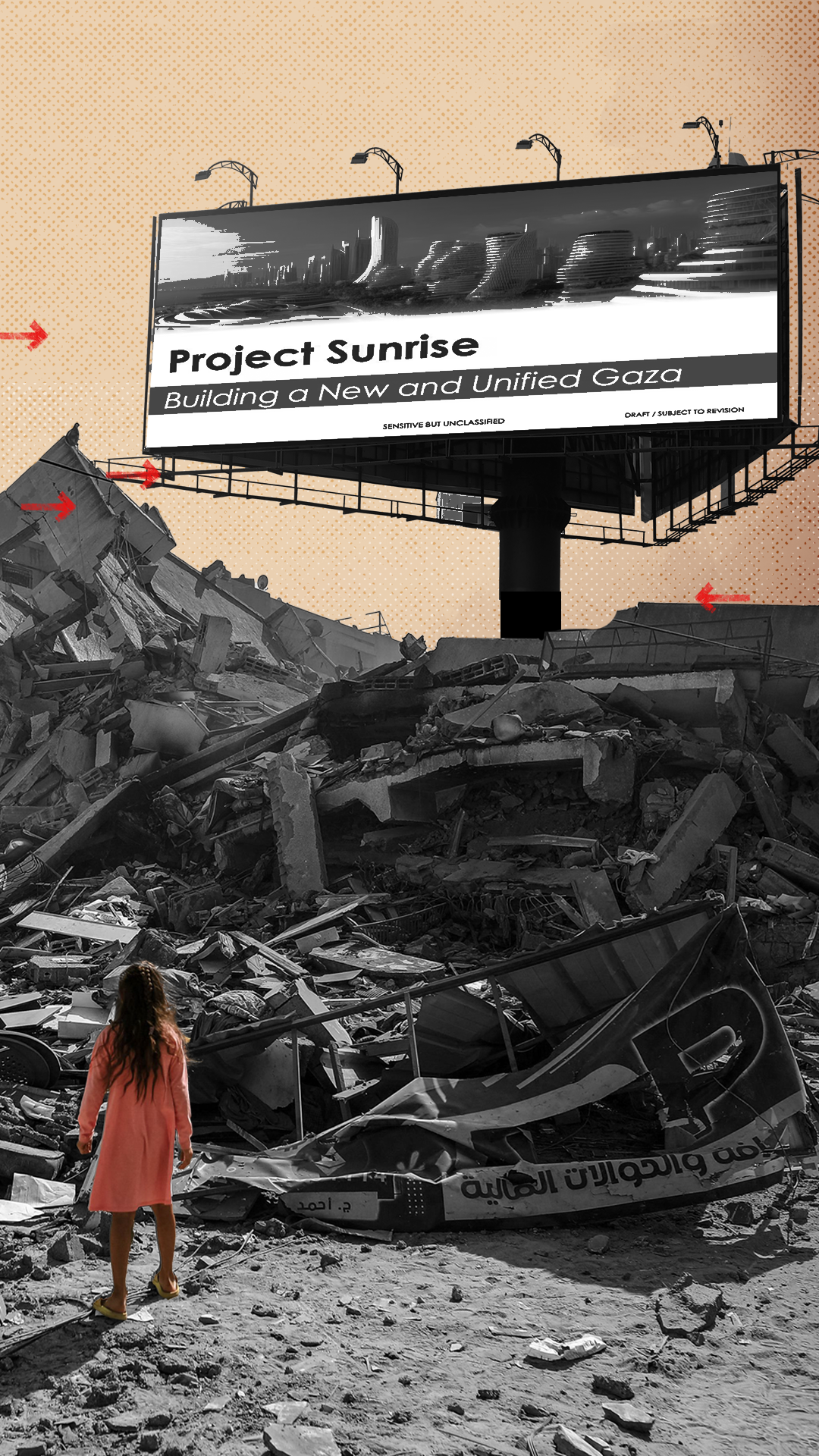
The Board of Peace was formally presented on September 29 as part of a Gaza ceasefire plan to oversee its reconstruction (with no Palestinian property ownership). Kushner provided an image of what would replace the devastation of bombed-out buildings: a futuristic fantasy city reminiscent of science fiction magazine covers of the 1950s.
Having obtained the fig leaf of U.N. approval (Security Council Resolution 2803), the draft Charter announced on November 17 invited 62 countries to join, but only 19 attended the signing ceremony at the World Economic Forum in Davos. Most were Middle Eastern monarchies, and there was Belarus and some post-Soviet Central Asian countries, and Argentina and Paraguay from Latin America. The only Western European nation represented was Hungary. Even Germany and France did not join, nor did Britain. Its Prime Minister Keir Starmer objected to the invitation extended to Russia.
The $1 billion fee for joining Trump’s alternative to the United Nations would not have to be paid for three years, and only by members buying lifetime membership. All funding would be deposited in U.S. banks or invested in bonds (or even in cryptocurrency, perhaps Trump’s own $Trump or $Melania to stem their plunging valuations). But Russia insisted that the payments must go to the Palestinians directly, or be used to repair war damage in the Donbas that NATO has caused the Russian-speaking civilians, who also were attacked in violation of the laws of war.6
Brazilian President Lula da Silva, the 2025 head of BRICS, asked governments “to come together and prevent multilateralism from being trampled on” by replacing the United Nations with an institution that Trump “alone would own.” Jeffrey Sachs and a co-writer argued that: “Refusal to join will be an act of national self-respect. The UN-based international order, however flawed, should be repaired through law and cooperation, not replaced by a gilded caricature. … The so-called ‘Board of Peace’ … is profoundly degrading to the pursuit of peace and to any nation that would lend it legitimacy. This is a trojan horse to dismantle the United Nations. It should be refused outright by every nation invited to join … It is to accept, in advance, that peace is no longer governed by the UN Charter, but by Trump.”7 Acknowledging that “some nations, desperate to get on the right side of the US, may take the bait,” they proposed that: “If the US doesn’t want to abide by the Charter, the UN General Assembly should suspend the US credentials, as it once did with Apartheid South Africa.”
The United States already is disengaging from the United Nations and has pulled the United States out of UNESCO, the World Health Organization (owing $250 million in arrears), the Population Fund and U.N. Human Rights Council, not paying any of the arrears that it has run up to them. Trump is especially antagonistic toward the U.N.’s peacekeeping mediation and tribunals such as the International Criminal Court, despite the fact that with the exception of what the ICC has recently ruled on Gaza, it has mostly been a tool used against U.S. enemies while ignoring infringements by the United States and its allies.
As of the start of 2026 the overall U.S. arrears owed to the United Nations have grown to $4.5 billion. This debt includes $2.19 billion for its 2025 and 2026 annual membership dues (levied in proportion to the member country’s GDP) and the regular U.N. operating budget, another $2.4 billion for U.N. peacekeeping operations, and $43.6 million for U.N. tribunals. Altogether this represented some 95 percent of total U.N. arrears. On January 28, Secretary General António Guterres warned that these non-payments threatened to push the United Nations into “imminent financial collapse” and force it to close down its headquarters in New York City by August if Trump continued to boycott it.8 But the looming crisis was partly resolved on February 3, when Trump signed the new U.S. spending bill allocating $3.1 billion for the United Nations.
Rising U.S. opposition to the United Nations and the post-1945 world order in general
The United States no longer is the world’s largest creditor, nor is the dollar as good as gold at a stable price. America has become the largest international debtor, with its official debts to foreigners looking unpayably high. And instead of remaining the preeminent industrial economy, the United States has been de-industrializing since the 1980s, celebrating this as inaugurating a financialized post-industrial society free from blue-collar factory labor.
America’s deepening industrial and financial dependency on China, Western Europe, Japan and South Korea has left it with little to gain by free trade and peaceful relations. Trump has demanded that countries offer “givebacks” in the form of special trade concessions, while pursuing trade and financial sanctions against Russia, China, Iran and other countries resisting his bellicose diplomacy. He has warned Canada and Britain that “it’s very dangerous for them” to travel to China to negotiate an increase in their trade relations with it.9 And he has threatened military force against Greenland, Venezuela, Iran, Russia’s periphery and China (indeed already using it against Iran and Venezuela). Manipulating these pressure points would be the main role for his Board of Peace, euphemized as a new “coalition of the willing.”
“U.S. policy vis-à-vis the United Nations opposes above all the U.N.’s role in mediating international conflicts.”
Cutting its budget prevents it from being able to pay its staff in war zones or on peacekeeping operations, especially in conflicts where the United States is backing one side, as in Gaza and Africa. Such U.S. policy goes back to 1961, when U.N. Secretary General Dag Hammarskjold was killed to stop his efforts to negotiate a ceasefire in Congo. Pressure by his successor U Thant (1961-1971) on the Johnson Administration to negotiate an end to the U.S. war in Vietnam further alienated the United States. And most recently, the United Nations has been accused of being anti-Semitic for urging Israel to withdraw to its original territory prior to its 1967 war.
Most U.N. members have not supported U.S. war policies in general. That is why, as U Thant’s grandson has observed, “the U.N. started to become unfashionable in Washington – not because it was ineffective, but because it began to take opposing positions on what were seen to be American interests.”10 U.S. strategy to block meaningful U.N. action led it to insist on having veto power in the Security Council (and indeed, in any international organization that it joins) from the very beginning, and to oppose the U.N.’s role as mediator in general. “State Department spokesperson Tommy Pigott said the U.S. rejects ‘an outdated model of multilateralism’ and will no longer participate in or fund international organizations that it deemed contrary to U.S. national interests.”11
Of course the United States supports international institutions, including the U.N., when they further its interests. One such institution is the Organization for Security and Cooperation in Europe with its blatant anti-Russian bias in favor of the NATO-backed war in Ukraine. Russian Foreign Minister Sergei Lavrov has accused the OSCE of degenerating “into a political appendage of NATO and the EU,”12 remarking that “I don’t know how possible resuscitation is in this case. The OSCE has ‘fallen’ so low that there is nowhere else to go.”13
Russia has been subjected to Western trade and financial sanctions in violation of international law. President Putin has described his 2022 Special Military Operation as being motivated by Russia’s responsibility to protect Ukraine’s Russian-speaking provinces from terror attacks in violation of international law banning governments from waging war against their own civilian population. As noted above, the root of this war in Ukraine was the U.S.-instigated 2014 coup against Ukraine’s elected government, bringing a neo-Nazi regime to power. But only Russian fighting is condemned, despite its focus on military targets, in contrast to the Ukrainian and Western-backed bombing of civilians.
Lavrov has complained about an equally anti-Russian double-standard bias of U.N. head António Guterres.14 On the one hand, Guterres “and his senior executives at the U.N. recognize the right of the people of Greenland to self-determination and … to decide on their own destiny instead of leaving it to someone else.” By contrast, he asks: “Does the United Nations recognize that people in Donbass, Novorossiya and, of course, Crimea, enjoy the same rights?”15 The West has blocked the U.N. from recognizing the referendums in which these provinces voted to join Russia to free themselves from the neo-Nazi ethnic cleansing supported by the Western-backed regime.
On Saturday, February 14, Secretary of State Marco Rubio addressed the Munich Security Conference with the most direct attack on UN rules yet. It rejected the entire 20th century’s progressive agenda, setting U.S. Trumpian values of America First and its One Percent against the entire world’s hopes to increase social welfare in principle. He complains that: “We increasingly outsourced our sovereignty to international institutions while many nations invested in massive welfare states at the cost of maintaining the ability to defend themselves.” But the United States is now ending that situation in order to prepare for the coming war with Eurasia: “We can no longer place the so-called global order above the vital interests of our people and our nations.”
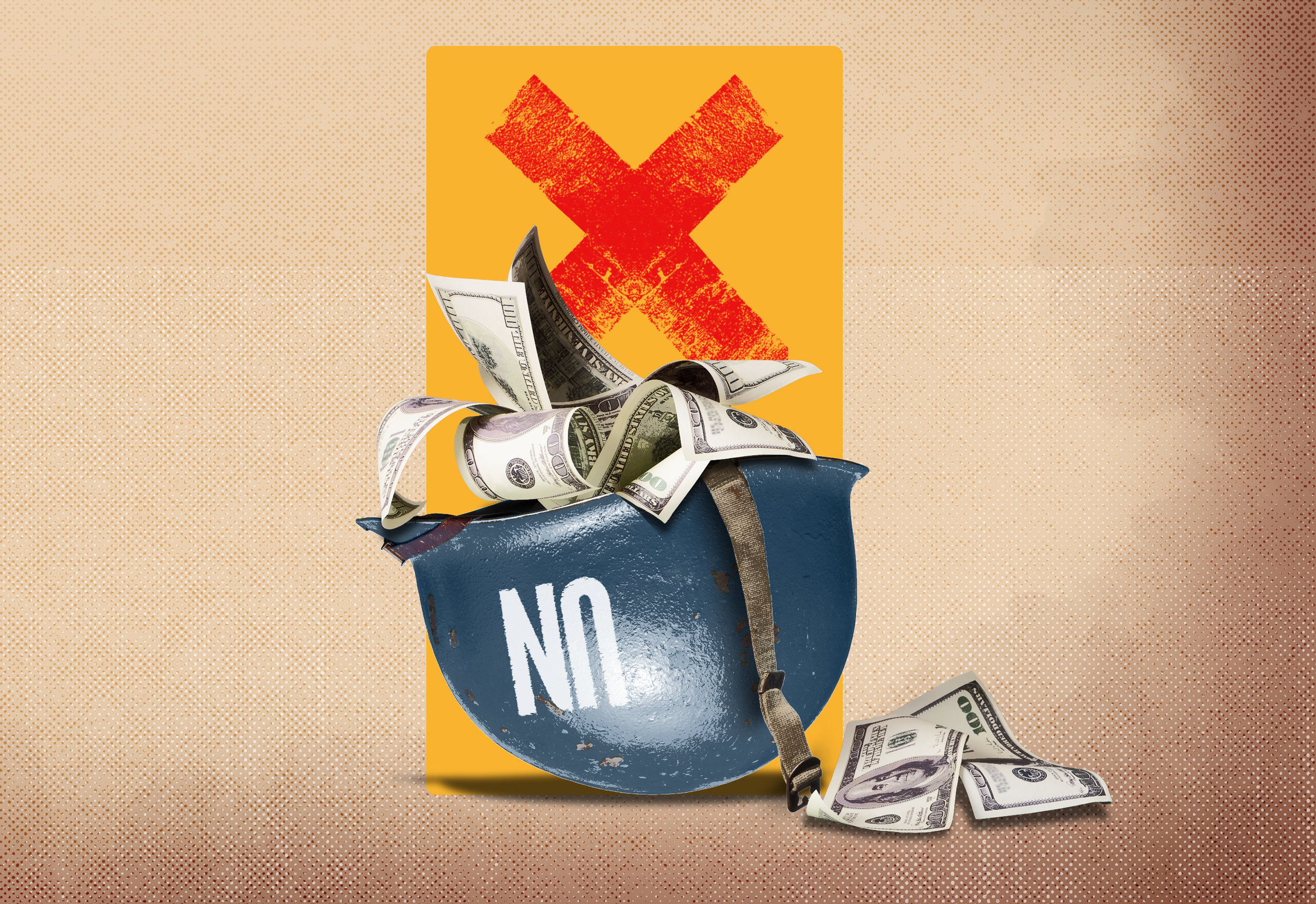
The United Nations would still exist, but its role is to be radically changed:
We don’t need to dismantle the global institutions of the old order that together we built. But these must be reformed. These must be rebuilt. … We cannot continue to allow those who blatantly and openly threaten our citizens and endanger our global stability to shield themselves behind abstractions of international law which they themselves routinely violate. … we in America have no interest in being polite and orderly caretakers of the West’s managed decline. … the alliance that we want is one that is not paralyzed into inaction by fear – fear of climate change, fear of war, fear of technology. …
An alliance ready to defend our people, to safeguard our interests, and to preserve the freedom of action that allows us to shape our own destiny – not one that exists to operate a global welfare state and atone for the purported sins of past generations. An alliance that does not allow its power to be outsourced, constrained, or subordinated to systems beyond its control; one that does not depend on others for the critical necessities of its national life; and one that does not maintain the polite pretense that our way of life is just one among many and that asks for permission before it acts.16
The U.S. Government, supported by Israel, has directed the most extreme political attack on U.N. peacekeeping functions in its actions against Francesca Albanese, the special rapporteur for Palestine. She was the author of the report Anatomy of a Genocide on March 24, 2024 for the 55th U.N. session, and followed this up on October 25, 2025 with Gaza Genocide: a collective crime. Especially threatening to the Americans were the letters that Albanese wrote in spring of 2025 to Alphabet, Amazon, Caterpillar, Chevron, Hewlett Packard, IBM, Lockheed Martin, Microsoft and Palantir (and two charities) to warn them that she might soon accuse them in a U.N. report of “contributing to gross violations of human rights” in Gaza and the West Bank.
These reports infuriated U.S. officials, and just as they made personal attacks on ICC. judges who indicted Benjamin Netanyahu and his defense minister Yoav Gallant in November 2024 for Israel’s war crimes in attacking Gaza’s civilian population and using starvation of the civilian population as a tactic of war, they have brought similar vicious personal pressure against Ms. Albanese, as they have against senior ICC staff. Their bank accounts were closed and credit cards cancelled. Albanese told Reuters that she has had to borrow credit cards from her friends in order to travel. As the Reuters report explains:
U.S. sanctions have deprived Albanese of basic financial services that most people take for granted. The U.S. bank account she had is now closed, and sanctions have prevented her from opening one in another country, including Italy, she said. Her U.S. assets are frozen. That includes a condo in Washington, D.C., valued at about $700,000, that Albanese and Cali own. Under U.S. law, the property cannot be sold or rented while frozen.
U.S. sanctions are powerful: They not only freeze assets in the U.S. but also effectively cut off individuals from the U.S. financial system – a global network that can block access to banking in most countries. U.S. citizens, corporations and foreigners legally residing in the U.S. face steep fines or prison sentences for funding or aiding sanctioned individuals. European banks can be barred from operating in U.S. dollars or excluded from international payment systems, devastating their business. …
Albanese and the sanctioned ICC staff now sit on the U.S. Treasury Department’s Specially Designated Nationals list, alongside suspected al Qaeda terrorists, Mexican drug traffickers and North Korean arms dealers.
The willingness of U.S. officials to take such extremely punitive personal measures to prevent international legal findings against America and its Western allies illustrates how fundamentally the position of the United States and its Western allies toward the rule of law differs from that of the Global Majority. Given America’s position, it is not possible for mediation, reconciliation or peacemaking to be effective within the existing U.N. and ICC framework.
The world is being polarized between the attempt of supporters of the UN Charter to preserve over four centuries of Western international law on the one hand, and America’s attempt to replace that body of law with a monolithic U.S. autocracy of its own uniquely self-serving ruler-based order, as most recently illustrated by Trump’s autocratic Board of Peace.
I think that the term “ruler-based order” is more accurate than “rules-based order,” because rulership is the key to unilaterally changing the rules to be imposed on other countries quickly and easily when needed to achieve America’s geopolitical and economic aims.
Notes
-
“International Criminal Court: New US sanctions ‘a flagrant attack’ on judicial independence,” UN News, August 20, 2025. ICC judges and prosecutors have been banned from travelling to the United States or holding assets there, and the sanctions “make it virtually impossible for them to hold credit cards, making everyday financial transactions and online purchases difficult.” See also “Trump administration proposed sanctions on two more ICC judges,” Reuters, December 18, 2025.
-
Jeffrey Sachs, “How the Neocons Chose Hegemony Over Peace Beginning in the Early 1990s,” September 4, 2024.
-
The 1990 G7 Houston Summit’s plans by the IMF and World Bank to neoliberalize the Russian economy were published in January 1991 as The Economy of the USSR: Summary and Recommendations. Russia’s Academy of Sciences has published my analysis of how these plans helped destroy Russia’s economy in “How Neoliberal Tax and Financial Policy Impoverishes Russia – Needlessly,” Mir Peremen (The World of Transformations), 2012 (3):49-64 (in Russian).
-
In addition to Kushner, Trump’s real-estate associate Steve Witkoff, his speechwriter and former Fox TV producer Robert Gabriel Jr., Zionist investment banker and activist Mark Rohan, and Secretary of State Mark Rubio are proposed members. The eight-member U.S.-centered board announced on January 17 is rounded out by World Bank president Ajay Banga, High Representative for Gaza, Nicolai Mladanov, and Tony Blair, who previously showed his subordination to the United States by shepherding British support for America’s false claim that Iraq had weapons of mass destruction, justifying the 2003 invasion and occupation of that country and its oilfields.
-
Article 3 of the Board’s Charter states that “Donald J. Trump shall serve as inaugural Chairman of the Board of Peace,” with “exclusive authority to create, modify, or dissolve subsidiary entities.” Article 7 provides that “the Chairman is the final authority regarding the meaning, interpretation, and application of this Charter.” Trump is personally empowered to nominate his successor, just as he has named the Executive Board in his role as Chairman.
-
Russia introduced a poison pill by proposing to pay its $1 billion membership fee from the $300 billion of its foreign-exchange reserves that the European Union has confiscated.
-
Jeffrey D. Sachs and Sybil Fares, “Every Nation in the World Should Reject Trump’s Absurd and Dangerous ‘Board of Peace,’” Common Dreams, January 22, 2026. The authors describe the Board as “a pledge of allegiance to Trump, who seeks the role of world chairman and the world’s ultimate arbiter.”
-
Farnaz Fassihi, “U.N. Says It’s in Danger of Financial Collapse Because of Unpaid Dues,” The New York Times, February 1, 2026, and Emma Farge and David Brunnstrom, “Explainer: Why is UN warning of ‘imminent financial collapse’?” Reuters, February 4, 2026. Andrew R.C. Marshall, Humeyra Pamuk, John Shiffman and Stephanie van den Berg in “Trump’s war on global justice, court staff and U.N. face terrorist-grade sanctions,” Reuters, February 6, 2026, report that: “Trump’s opposition to international organizations dates to his first term in office, when he withdrew from the Paris Agreement, an international climate treaty, and slashed discretionary funding to some U.N. agencies.” The discussion below describing U.S. punitive pressures against the U.N. special rapporteur for Palestine, Francisca Albanese, relies largely on this article.
-
Emma Bussey, “Trump warns UK it’s ‘very dangerous’ to do business with China after Starmer’s Beijing meeting,” Fox News, January 29, 2026.
-
Thant Myint-U, “Trump’s Board of Peace Won’t Help World Conflicts,” The New York Times, February 1, 2026.
-
Reuters, “Trump’s war on global justice, court staff and U.N. face terrorist-grade sanctions” (above, fn 9).
-
Foreign Minister Sergey Lavrov’s remarks at Eurasian international public political hearings on the formation of a contour of equal and indivisible security and cooperation in Eurasia, Perm, May 29, 2025.
-
Lavrov’s 2025 Review Press Conference, Karl Sanchez Substack, January 21, 2026.
-
In his remarks to Russia’s State Duma on February 11, Lavrov complained that within the World Trade Organization “the Americans are blocking the dispute settlement body to which China and many others are complaining.” This makes it impossible to enforce the rules that the Americans put in place as the foundation for their system of globalization after World War II, along with the Bretton Woods Institutions. “The West is trying to sabotage these principles in every possible way, maintaining its policy of usurping key posts in the UN system and privatizing the Secretariat of this structure. … The current UN Secretary-General Antonio Guterres is fulfilling not the UN Charter’s requirement of impartiality and equidistance, but the political order of the ‘collective West.’”
The driving aim, Lavrov concluded, was “NATO’s frank and proclaimed intention to establish its instruments of influence throughout the Eurasian continent under the pretext that threats to the territory of the members of the North Atlantic Alliance (it was for their protection that this bloc was created) now come from the Taiwan Strait, the South China Sea and Southeast Asia.” Lavrov’s Q&A session. Karl Sanchez, February 11, 2026.
-
Foreign Minister Sergey Lavrov’s interview with Turkish media (state television channel TRT and newspaper Türkiye), Moscow, January 29, 2026.
-
Secretary of State Marco Rubio, remarks at the Munich Security Conference, February 14, 2026.
This article was first published by The Democracy Collaborative at democracycollaborative.org
Michael Hudson is a financial analyst and president of the Institute for the Study of Long-Term Economic Trends. He is distinguished research professor of economics at the University of Missouri– Kansas City.
Hudson has served as an economic adviser to the U.S., Canadian, Mexican, and Latvian governments, and as a consultant to UNITAR, the Institute for Research on Public Policy, and the Canadian Science Council, among other organizations. Hudson has written or edited more than ten books on the politics of international finance, economic history, and the history of economic thought.
He sits on the editorial board of Lapham’s Quarterly and has written for the Journal of International Affairs, Commonweal, International Economy, Financial Times, and Harper’s, and is a regular contributor to CounterPunch and Naked Capitalism. He is co-host with Radhika Desai of the ‘The Geopolitical Economy Hour’ podcast, and a weekly commentator with Richard Wolff on ‘Dialogue Works’ with Nima Alkhorshid.
He blogs at Michael-Hudson.com.
The views expressed are his own.
Artwork by Clem Bradley