

Keynote: Chinese FM Wang Yi at the 62nd Munich Security Conference Conversation with China
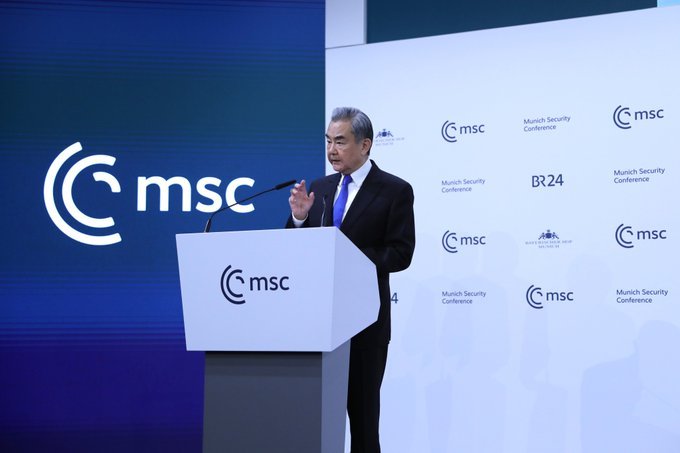
First a selection of extracts of the most important quotes. Wang Yi called out the trouble spots by name and the message is clear: “Baby, you gotta get it! We now live in a multipolar world!”.
This is vastly different from the Marco Rubio speech, that carried across a very old message and it looks like this. “We made a few mistakes but we can do colonialism better if Europe works with us and rebuild our bloodsucking regime.” In other words, a continuation of worthless dogma, jingoist, self-congratulatory exceptionalism that depends on the other guy, (you are the other guy, and I am the other guy) being fleeced.
Wang Yi worked with actuals and with solutions.
💠In #Gaza, the realization of ceasefire and reconstruction still require unremitting efforts. To implement the two-State solution and restore fairness and justice to the Palestinian people is the unshirkable responsibility of the international community.
The situation in #Iran has a direct impact on peace in the Middle East. Relevant parties should act with prudence and avoid creating new conflicts.
On the #Ukraine crisis, the door to dialogue is finally open. All parties concerned should seize this opportunity to reach a comprehensive, durable and binding peace agreement, remove the root causes of the conflict, and bring about lasting peace and stability in Europe.
On #Venezuela, the red line of international rule of law must not be crossed, and the principle of state sovereignty must be upheld.
💠We live in a multipolar world and need to practice true multilateralism. There needs to be greater democracy in international relations, global affairs should be discussed by all and the future of the world should be decided by all.
💠The reason why the international system is not functioning well enough lies not with the U.N. itself, but rather with certain country seeking to magnify differences and disagreements, put itself above everyone else, stoke bloc confrontation and even revive the Cold War mentality. All these have eroded the foundation of trust, worsened the atmosphere for cooperation, and impeded the functioning of international institutions.
To safeguard international collaboration and cooperation, it is important to seek common ground while shelving differences and pursue win-win cooperation.
Transcript of full speech
Joining Hands to Set the Ship of History on the Right Course
Keynote Speech by H.E. Wang Yi
At the 62nd Munich Security Conference
Conversation with China
Munich, February 14, 2026
Your Excellency Chairman Wolfgang Ischinger,
Friends and Colleagues,
It gives me great pleasure to join you again at the Munich Security Conference for the conversation with China.
Over the past year, the international landscape was marked by growing transformations and turbulence, and the law of the jungle and unilateralism went rampant. Humanity has come to a new crossroads for the cause of peace and development. At such a juncture, President Xi Jinping proposed the Global Governance Initiative (GGI), and called for following the five principles of sovereign equality, international rule of law, multilateralism, the people-centered approach, and real actions, with a view to jointly building a more just and equitable global governance system. The GGI aligns with the progressive trend of the times, represents the biggest common ground of the world’s nations, and has thus received widespread response from the international community shortly after its announcement. It injects new impetus into the endeavor to build a community with a shared future for humanity, and offers a compass for the giant ship of history to navigate through storms toward a brighter future. Now that humanity has weathered wind and rain to come this far, pulling together should be the imperative choice. We should reform and improve global governance to set the ship of history on the right course.
In reforming and improving global governance, the priority is to revitalize the United Nations system.
The founding of the U.N. was an important outcome of the victory of the World Anti-Fascist War, a historic choice made by previous generations after painful reflection on past agonies, and the peace endeavor that nations have invested their greatest efforts in thus far. This edifice was jointly built by the people of the world. We have every responsibility to reinforce and renovate it, and no right to destroy it or tear it down.
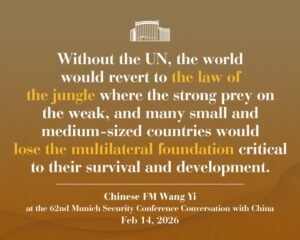
The U.N. is not perfect, but it remains the most universal and authoritative intergovernmental organization in the world. On the U.N. platform, each country, regardless of its size or wealth, has a voice and a sacred vote as well as its due obligations and equal rights. Without the U.N., the world would revert to the law of the jungle where the strong prey on the weak, and many small and medium-sized countries would lose the multilateral foundation critical to their survival and development.
Therefore, what is imperative for us today is to recommit to the founding mission of the U.N., revitalize the leading role of the U.N., abide by the purposes of the U.N. Charter, and enhance the efficiency and efficacy of the U.N. system, so that the organization will be able to better adapt to the needs of the 21st century and unleash renewed vitality.
In reforming and improving global governance, the key lies in the collaboration and cooperation of all countries.
The reason why the international system is not functioning well enough lies not with the U.N. itself, but rather with certain country seeking to magnify differences and disagreements, put itself above everyone else, stoke bloc confrontation and even revive the Cold War mentality. All these have eroded the foundation of trust, worsened the atmosphere for cooperation, and impeded the functioning of international institutions.
To safeguard international collaboration and cooperation, it is important to seek common ground while shelving differences and pursue win-win cooperation. The world is a diverse place. It is only natural that countries differ in social system, history, culture, interests and demand. And it is precisely the differences that necessitate dialogue and cooperation. There is no reason why countries cannot respect each other and contribute to each other’s success. Just like the way gentlemen engage with one another, there could be harmony without uniformity.
A review of history shows, from the victory of the World Anti-Fascist War, to overcoming the global financial crisis, from the climate response to fighting terrorism, none of such progress would have been possible without countries coming together for sincere cooperation despite their differences. Let us always bear in mind that unity brings strength, and only in unity can we find hope.
In reforming and improving global governance, multilateralism should be always upheld.
The monopolization of global power by a small number of countries is unpopular. We live in a multipolar world and need to practice true multilateralism. There needs to be greater democracy in international relations, global affairs should be discussed by all and the future of the world should be decided by all.
We need to make sure that all countries abide by the same set of rules, i.e., the basic norms governing international relations underpinned by the purposes and principles of the U.N. Charter. All countries should be equal in terms of rights, opportunities and rules, and all countries, in particular small and medium-sized ones, should be able to find their places and play their roles in international relations.
To practice multilateralism, major countries in particular should lead by example. They should take the lead in pursuing cooperation, instead of conflict or confrontation. They should take the lead in observing rules, instead of applying double standards. They should take the lead in promoting equality, instead of imposing their will onto others. They should take the lead in encouraging openness, instead of resorting to self-serving unilateralism.
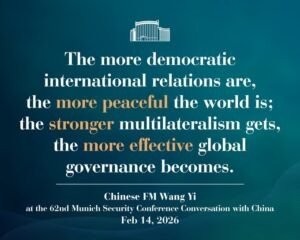
The Global South is rising collectively. The global governance system should also stay up-to-date to give more prominence to their voices and representation. Time will prove that the more democratic international relations are, the more peaceful the world is; the stronger multilateralism gets, the more effective global governance becomes.
In reforming and improving global governance, the pressing task is to stop conflict and promote peace.
While looking into the future, we should not forget the present. Without peace, global governance will be out of the question. As we speak, there are still more than 60 conflicts dragging on unabated across the world, bringing traumatic suffering to the affected populations. The vision of common, comprehensive, cooperative and sustainable security proposed by President Xi Jinping has pointed the way for resolving the issues. We should promote peace through talks, and oppose attempts to escalate the situation. We should resolve differences through mediation and overcome conflicts through dialogue.
In Gaza, the realization of ceasefire and reconstruction still require unremitting efforts. To implement the two-State solution and restore fairness and justice to the Palestinian people is the unshirkable responsibility of the international community. The situation in Iran has a direct impact on peace in the Middle East. Relevant parties should act with prudence and avoid creating new conflicts. On the Ukraine crisis, the door to dialogue is finally open. All parties concerned should seize this opportunity to reach a comprehensive, durable and binding peace agreement, remove the root causes of the conflict, and bring about lasting peace and stability in Europe. On Venezuela, the red line of international rule of law must not be crossed, and the principle of state sovereignty must be upheld.
Friends,
This year, China kicks off the implementation of its 15th Five-Year Plan for economic and social development. All our endeavors are aimed to secure a better life for the people. We aspire for a stable external environment for our development, and we also hope to make the world a better place through our development. China will be a staunch force for peace. We will commit to the path of peaceful development and call on all countries to do the same. China will be a reliable force for stability. We will uphold international fairness and justice, and explore a distinctly Chinese approach to resolving hotspot issues. China will be a progressive force in history. We will resolutely defend the outcomes of the progress of human civilization, advance the four major global initiatives, and promote the building of a community with a shared future for humanity.
Both China and Europe have time-honored civilizations and stand as indispensable poles in this multipolar world. The choices we make now are crucial to the future of the world. In the journey toward world multipolarity and economic globalization, China and Europe are partners, not rivals. So long as we keep that in mind, we will be able to make the right choices in the face of challenges, prevent the world from slipping into division, and keep moving human civilization forward. Let us work together to recalibrate the course of history and create a better world!