

Vietnam and leaked papers
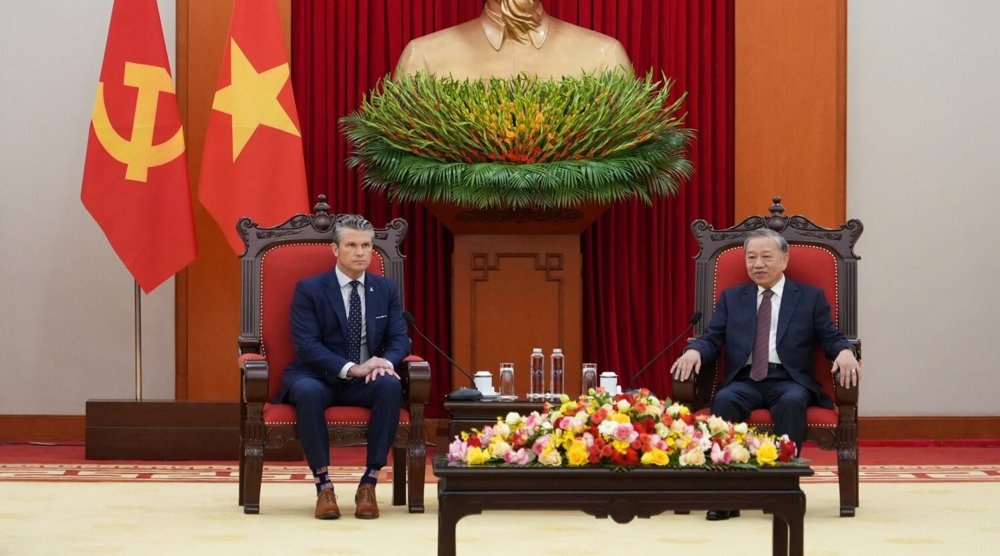
This morning, on the Daily Chronicles, I wrote about the US image and trust in its image project waning fast now. It is the first piece under the 4th of February. https://sovereignista.com/2026/01/29/daily-chronicles-163/
The idea is that the rest of the world is now learning to play within the image projection frame—giving the expected nods while quietly constructing new architectures of trade, technology, and alliance. The image may linger awhile longer. But beneath it, the foundations are shifting.
Besides playing within the frame and giving the required nods to the empirical drang, countries in a true multipolar tradition, are creating different methods to militate against the current projection of the US image as all powerful. This is a leaked paper from Vietnam and we always have to ask whether a leaked paper is in fact leaked, or slipped into the conciousness stream to act as deterrence.
From PressTV: Vietnam preparing for possible US military aggression
A leaked internal document shows Vietnam is preparing, politically and militarily, for a potential US invasion, casting Washington as a threat to the country’s sovereignty rather than a reliable partner.
Just a year after bringing its ties with Washington to their highest diplomatic level, Vietnam’s military leadership has been preparing for a possible American “war of aggression,” viewing the US as a “belligerent power,” according to a report released on Tuesday by The 88 Project, a human rights group monitoring developments in Vietnam.
The document underscores Hanoi’s deep concern that Washington could try to destabilize the Vietnamese government through a so-called “color revolution,” drawing parallels to Ukraine’s 2004 Orange Revolution and the Philippines’ 1986 Yellow Revolution—both widely viewed by Vietnamese officials as products of US interference.
“There is a consensus here across the government and across different ministries … This is not just some kind of a fringe element or paranoid element within the ruling Communist party or within the government,” said Ben Swanton, co-director of the 88 Project and the author of the report.
The Vietnamese document, titled “The 2nd US Invasion Plan,” was completed by the Ministry of Defense in August 2024 and outlines what officials see as an escalating pattern of American military behavior across multiple administrations.
Vietnamese military analysts trace a pattern over three American administrations, from Barack Obama through Donald Trump’s first term to Joe Biden, noting that Washington has steadily intensified its military and strategic engagements across Asia.
“Due to the US’s belligerent nature we need to be vigilant to prevent the US and its allies from ‘creating a pretext’ to launch an invasion of our country,” the plan says.
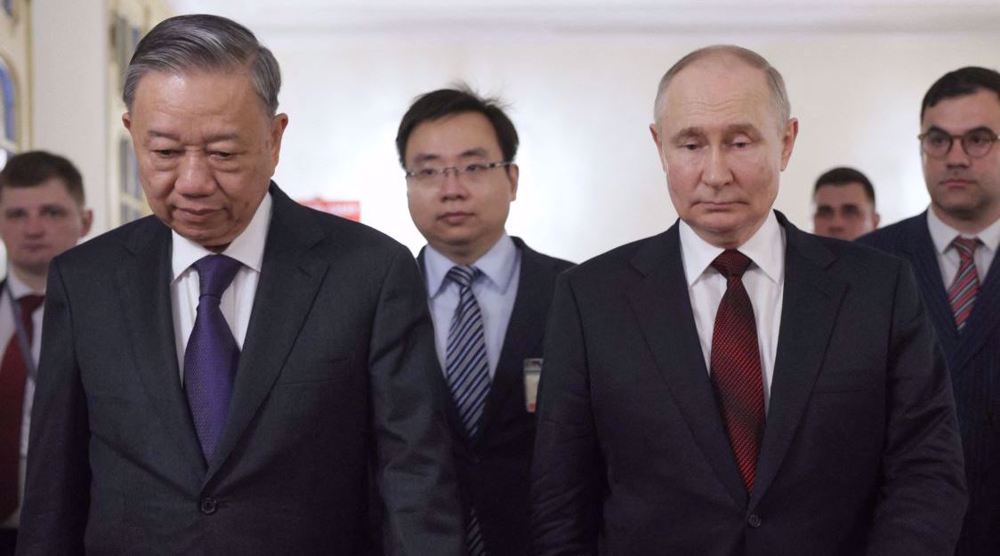
The document paints a dark picture of Washington’s intentions, asserting that the US seeks to “spread and impose its values regarding freedom, democracy, human rights, ethnicity and religion” as a means to undermine and ultimately dismantle Vietnam’s socialist political system.
Swanton writes that “The 2nd US Invasion Plan” offers a rare and blunt insight into Hanoi’s foreign policy thinking, showing that Vietnam views Washington not as a genuine strategic partner but as an existential threat, and has no intention of being drawn into a US-led bloc aimed at China.
Recent US military actions abroad have further reinforced these fears. Washington’s operations in and around Venezuela, including the abduction of Venezuelan President Nicolas Maduro and his wife Cilia Flores on January 3, have intensified Vietnamese distrust toward closer engagement with the US. Experts warn that any US military aggression against Cuba, another close ally of Hanoi, would send shockwaves through Vietnam’s military and political leadership, severely disrupting the “fragile regional and strategic balance.”
The Plan itself, is scrupulously detailed. This is an overview:
Hanoi’s Analysis of US strategy
The 2nd US Invasion Plan (357/KH-BTL), was issued on Aug. 1, 2024 by Vietnam’s Navy under the Ministry of Defense. It was signed Vice Admiral Tran Thanh Nghiem and certified by Rear Admiral Vu Van Nam.
The plan is divided into two sections. The first section provides a detailed overview of the Asia-Pacific’s strategic importance and the US response to China’s rise, while the second describes US militarization of the Asia-Pacific region and outlines various scenarios involving US-led amphibious assaults on Vietnam.
Discussing US strategy for the region, the plan details how ‘the US has shifted from a “pivot to Asia” (2011) policy characterized by “unilateral action”, to an “Indo-Pacific” strategy (2017, 2022), which emphasizes “collective action” based on coordination and shared interests with allies and partners in and outside the region’ (p.2). The plan depicts the Obama administration as pursuing a more restrained policy of seeking to limit China’s influence.
Biden’s version of the same policy is then described as resting on four pillars: security; economics and trade; politics and diplomacy; and the involvement of the EU and NATO. The security pillar took the US-Japan alliance as its core, while also forming new security arrangements (such as the SQUAD) and increasing the US military presence in the Western Pacific (p.3). Other aspects of this pillar include strengthening Taiwan’s defense, securing access to additional bases in the Philippines, and building security ties between Asian allies and NATO with a view to establishing a shared military command for multinational operations (pp.3-4).
The economic dimension of Biden’s strategy is described as an effort to turn the ‘Asia-Pacific region into a Western-style liberalized economic bloc [that] serves as a market for US and Allies’ vehicles, high-tech equipment, and weapons’ (p. 4). The plan states that, ‘by guaranteeing the security of economic corridors and international shipping routes, they [the US and its allies] plan to gradually sever China’s supply chains and narrow its market access’ (p.4). As such, the plan clarifies that Hanoi does not view the US’s economic agenda as a partnership among equals, but rather as an attempt by the US to render the region economically dependent on it.
With regards to politics and diplomacy, the plan asserts that the US has moved from a Cold War mentality of containing countries ‘with different ambitions’, to building relationships whose chief objective is to ‘form a front against China’. This strategy involves using political, diplomatic, and media pressure as ‘instruments of influence’, and exploiting disputes between Taiwan, ASEAN, and China (p.4).
The plan envisions the United States convening regional and international allies to support these countries and forging blocs in preparation for a possible multipolar confrontation. In sum, the plan depicts the US as exploiting tensions between Southeast Asian countries and China to increase its own power in the region.
Finally, regarding European and NATO allies, the plan states that ‘the US has rallied key members, including the UK, France, Germany, the Netherlands, and Canada, to join a “common action policy”’ (p.4). This initiative is described as strengthening economic, trade, and defense ties with the Asia-Pacific by maintaining a naval presence in areas like the Taiwan Strait and the East Sea. The dividend for ‘“former Western colonial countries”, is that by follow[ing] the US […]they […are able] to regain the influence they lost centuries ago’ (p.4).
In contrast to the policies of Obama and Biden, the plan considers the first Trump administration to have taken a more combative stance, whose ‘chief objective’ was: ‘to deploy military power, incite an arms race, and expand the export market for US military equipment and technology’ (p.3).
Overall, Hanoi sees the Indo-Pacific Strategy as an attempt by the US empire to limit China’s influence by increasing its military presence and expanding its alliance system in the region.
The plan does not express any interest in expanding Vietnam’s military cooperation with the United States. Instead, US anti-China military alliances are portrayed as a threat to Vietnam as well. Consequently, the plan is evidence that Vietnam is taking seriously its stated support for China’s vision of a ‘community of shared future’. This vision, as articulated by Xi Jinping in an article published by the Communist Party of Vietnam’s (CPV) mouthpiece, involves ‘Asia’s future […being] in the hands of no one but Asians’.[3]
The 88 Project provides a detailed analysis as well as a download of the document.
For our purposes, it is enough to know that the world is not sitting on their thumbs but actively working to stymie continuity of agenda in order to be safe from, and ready to rumble should the empirical power try to change the complete balance of power in the broader ASEAN region .
Didn’t Vietnam joined America’s infamous Board of Peace, which is tasked with completing the Gaza Genocide … I mean… the peaceful ethnic cleansing of Palestine for a Mar-a-Lago on the Mediterranean?
Trump’s Board of Peace
https://www.ajc.org/news/5-things-to-know-about-trumps-board-of-peace#:~:text=President%20Trump%20would%20serve%20as,council%20to%20guide%20its%20mission.
Yes .. https://en.baochinhphu.vn/viet-nam-becomes-founding-member-of-gaza-board-of-peace-111260129223757374.htm But Indonesia will withdraw from Trump’s “Board of Peace” if there is no progress in Palestinian independence 🔴 President Prabowo Subianto stated Indonesia is not obliged to support policies conflicting with its national stance. 🔴 Vice Chairman Kholil Nafis mentioned Indonesia will abstain from voting if BOP’s… Read more »
Yes xvfsb, the lovely Vietnamese govt joined the damn Board, and for anyone who has the displeasure of understanding how this govt works, like myself, it comes as NO SURPISE. Vietnam is an obedient lapdog to US. Look at its severe economic dependency on the Empire. That’s why I keep… Read more »
You just made my week, Amarynth.
Finally, a realisation by Vietnam of the bleedingly obvious… literally.
Cheers
Col
You’re too naive Col! This kind of docos has always been present inside the Vietnamese Poliburo, for as long as it’s been in existence. They always KNOW THIS. Which basically makes Vietnam the ultimate contradiction. The country always knows deep down, that USA is war-making machine, that USA has no… Read more »
Minh, Yandex renders the translation into a form of broken English. Difficult to read. Eg.: Have you ever stopped in the middle of the storm information and ask yourself three questions this yet? One is, what will happen when the machine, Ponzi schemes, real estate, something called “growth engine” of… Read more »
Larch, I use Chrome’s built-in translation feature — the desktop version of Chrome though, not the one for mobile — and it translates pretty close to the original contents. In any case, I’ve just translated all 3 articles, put in a word file, and share it here: https://www.dropbox.com/scl/fi/894t3lt0ozro97cpyh4a9/What-do-I-see-from-Vietnam-s-sluggish-economic-machine.docx?rlkey=0h2i8gx5yzp15c6120qtmn6jv&dl=0 You should… Read more »
Points taken, Minh.
Cheers
Col
When people want a wide and deep view of geopolitics, it takes this kind of information presented in very clear format. Authentic documents, not opinions. Presented al fresco, so intake is reliable, not skewed by ideology or personal skew. It may seem distant, not hot button, but now everyone can… Read more »