

Are the sanctions against Russia having “a debilitating effect on the Russian population”?
No. This is sensationalism, with an agenda.
[Note, it is interesting to compare Eva’s article presenting first hand information with the likes of Gilbert Doctorow and John Helmer]
I was asked about the following claim:
“Sanctions are having a debilitating effect on the Russian population, while the oligarchs are getting rich.”
To claim that the sanctions against Russia are having a “debilitating effect on the population” is sensationalist, ridiculous, and dishonest.
Debilitating is a very strong descriptive and is not accurate to describe the West’s economic war thus far against Russia. Against Syria, Venezuela, Cuba and other countries, absolutely debilitating. Russia? No.
Yes, life would be much easier without sanctions, but people have adapted. Certain foreign items are not available—or if so, more expensive—financial interactions to/from Russia are difficult, but everyday life continues, not destroyed by the sanctions.
I’ve been living in Russia since 2021, before the sanctions ramped up. There hasn’t been a noticeably “debilitating” impact. And note: I don’t live in a Moscow bubble, nor in an expensive or trendy area of Moscow. My observations are not based on being blinded by a glamourous foreigner life. Until last October, I was living quite a ways outside of Moscow, in the countryside. Currently, I’m living in a rural area of Moscow which geographically should be its countryside (the city limits in some areas extend beyond the ring most people know to be Moscow).
I take a 10 minute bus ride to get to the nearest grocery stores and market. While prices/inflation has gone up, so it has too in countries around the world. Life here continues as normal. I can contrast this very well to what I’ve seen in Syria, Venezuela, Gaza (which has been under a very debilitating blockade for over 20 years), and honestly, life is just normal here.
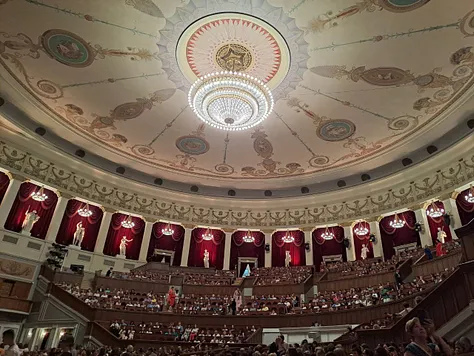
I spent much of 2022 in the Donbass, but I’ve also subsequently visited other Russian cities, including St. Petersburg, Novosibirsk, Voronezh, Rostov-on-Don, Anapa, cities in Crimea (Yalta, Sevastopol, Simferopol), also quaint touristy areas in the Vladimir region & beyond (Suzdal and Plyos). In the case of Crimea, Suzdal and Plyos, I visited during summer, and the towns and cities, and their restaurants and cafes, were packed with Russian tourists or locals. So was the opera in Novosibirsk, and seaside restaurants and cafes in Anapa. Even in Mariupol, which western media would have you believe is destroyed (and “occupied”), I saw a renewal of life and activity when I was last there (mid 2024), compared to prior years. This included newly opened sidewalk cafes, restaurants, supermarkets, and much money spent on construction, renovation and new projects.
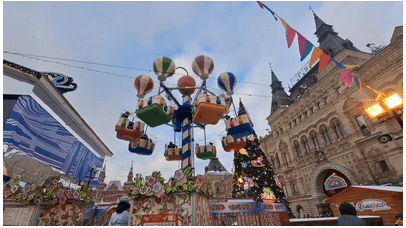
If you went into the centre of Moscow during Christmas and New Years holidays, you saw all the key areas (Red Square and around, VDNK, etc) packed with Russians who were so not debilitated they had money to spend on overpriced drinks and snacks in these touristy areas. Likewise during Maslenitsa, when Russians celebrate the end of winter, gathering in public parks where music and dance performances ensue until the burning of the effigy, and where still more food and drinks are sold, as well as crafts, jewerly, toys, clothing…This is not the activity of a population crushed under sanctions.
However, to be sure I’m not just ill-informed, I asked a number of friends what they thought of the phrase, “the sanctions are having a debilitating effect on the Russian population, while the oligarchs are getting rich.” (For friends who commented publicly, I’ll use their name):
My good friends who also live quite simply and rural, in the Moscow countryside replied: “There has been an increase in prices, the sanctions have made life a little hard, but ‘debilitating’ is insanely exaggerated.”
Another friend, who lives in Moscow, but no where near the centre and not in a bubble: “Not at all, this is false. People have gotten used to the sanctions and adapted.”
A friend in Kursk: “Well the “sanctions”/economic warfare against Russia, have hurt the economy somewhat, but it’s not near what you call “debilitating” obviously, because “debilitating” would mean that the economy is so crippled that it cannot bounce back. But the same sanctions have actually made the Russian economy more self-reliant and thus stronger. Yes the consumer prices keep going up, but I personally (a resident of a 500k population Russian city), don’t see the impact as debilitating as the collective West would want them to be… Of course being relatively close to the borderline, we are experiencing the impacts of the ongoing SMO and Ukrainian terror attacks upon our territories.”
Anatoly Yakovlev, in Moscow: “Well, as we say in Russia, the question is surely interesting. First and foremost, the term ‘debilitating’ is NOT relevant to the nation, which is used to STAND at all church services from 2.5 to 4 hours, as is in the case of the Easter church service. Those who lived as an adult in the 1990s, when times were really very tough and shocking, can confirm that even those 1990s didn‘t put the Russians on their knees. Yes, there is inflation. And wages are rising along with inflation. I know it from numerous friends of mine. So I guess this term and this combination ‘debilitating effect on the Russian population’ can be and is often heard from Russian liberals. They hate Russia, they hate us, the Russians deep inside.”
Alexandra: “We don’t give a damn about sanctions. Store shelves are bursting, regions have received incredible tourism development because flying abroad is a hassle with so many layovers. Small and medium businesses have developed very strongly.
And this is coming from me – a basic middle class person.
There is nowhere to park cars because there are so many of them. People are well dressed. And there were no free seats at the opera in the big theater at 11 this morning. It was a matinee, damn it. And all the tiers were packed.”
Andrei: “Oligarchs (or the Western version of “billionaires”, which is just another form of propaganda) – they are billionaires for a reason. They get richer in any country, regardless of the situation.
The question is – do others become poorer at the same time? I don’t see that happening in Russia yet. Sure, there have been some unpleasant recent changes – like the waste collection tax, but overall, people’s lives have improved. I don’t see poverty or even extreme poverty. Maybe it’s worse in remote areas, but those areas are just that – poorer and so on in any country.
Honestly, ordinary Russians don’t give a damn about the sanctions. The only thing that’s annoying is that traveling is harder and everything else is the same. There are goods, the quality is still the same. Many sanctioned products are still available. The fact that some clothing brands are gone – who cares about them?
In general, at the everyday level, an ordinary person will just laugh and say, “Bring it on!” about the sanctions. Traveling is problematic – yes, that’s true. But now they’ve even introduced a visa-free regime with China, so we’ll start traveling more to Asia. Besides, Europe is gradually turning into a cesspool anyway.”
Qingyuan Peng, in Nizhny Novgorod: “The inflation is not only due to sanctions. The sanctions as such have negligible influence on my everyday life. I am grateful for the sanctions. They have really curbed American Cultural Imperialism. US brands are out of the lives of ordinary people. I hope the sanctions will last another 10 years. I don’t want any US companies or brands back. None. Maybe even Gen-Z will learn to cope eventually.”
Ekaterina Jiritskaya: “We always remember our grandparents who lived in incredibly more difficult conditions during the Great Patriotic War and were able to win. Therefore, we are ashamed of even a minor complaint. What have we lost now? Facebook, which bans for telling the truth? Trips to Europe? But we loved Europe, which supported Dostoevsky, not Bandera, and now it’s strange to leave money there, sponsoring the deaths of civilians in Belgorod or Donbass. We have lost some fashion, auto and computer brands, some booking options, and we have some inflation, but we understand that it is the price for being Russians and being independent.”
Perhaps the most insightful reply (with all respect to those before him), was that of my friend Aleksandr, 42, working at a university in Voronezh:
“First, I’d like to show what the average Russian citizen living far from Moscow sees.
From the news, I’ve heard that since 2014, countless sanctions have been imposed on Russia. But, regardless of fluctuations in the currency exchange rate, oil prices, the cost of goods, or any other factors, the availability of goods or services for ordinary people hasn’t decreased. I’m primarily referring to access to healthcare (including dentistry), food, education, and the cost of gas and electricity.
Perhaps development has slowed down, but in my area of the city, since 2022, the largest secondary school in Russia has been built, and a transport interchange for cars has been constructed. This new road was urgently needed because an entire new residential district with kindergartens and a hospital was built. Also, in one part of the city, where I live in Voronezh, about 600 km from Moscow, a huge section of the road is being reconstructed with a new overpass and bridge. Last year, a huge new park was opened, and a beautiful embankment was built on the Voronezh River. And all of this was done since 2022. My mother, a pensioner, still has access to free healthcare. Moreover, she can book an appointment with a specialist doctor, not just a general practitioner, for tomorrow, rather than waiting two months.
My brother, a middle-aged worker at a furniture factory and approaching retirement age, can afford to pay for his son’s university education. My nephew will graduate with a higher education diploma this year. And he doesn’t need a loan for this. Last summer, my brother, his wife, and son went to rest on the Black Sea.
Two parts of Voronezh are separated by a reservoir. After the introduction of visa restrictions to Europe in 2022, domestic tourism has become very popular in our area. People have started exploring the “big water of Voronezh”, so the number of sailing and motor boats has increased significantly. And due to the large number of boats, there are discussions about imposing restrictions on navigation in some parts of the waterway.
And I think that if you ask about what infrastructure projects have been implemented since 2022 in the area of the city where those who claim that there’s an economic crisis in Russia live, they’re unlikely to be able to list a series of positive transformations.
But, I understand why opponents constantly try to prove that the problems in Russia are catastrophic. And this isn’t even an attempt to shift the focus from their own problems to those of their enemies. I think that so-called “Russia experts”, taking advantage of their audience’s lack of knowledge about the basics of the economic system in Russia, present ordinary changes (not always positive ones), such as inflation related to military spending, as something that has a catastrophic impact.
And from the point of view of their readers, these negative changes really do have a catastrophic impact. But the problem is that this assessment is typical of the world and the system in which they live, not of Russia’s economic system.
Firstly, due to numerous sanctions, since 2014, business in Russia has become oriented towards the domestic market, the market associated with Russian defense enterprises, and the Asian market.
Therefore, the level of consumption of Russian residents hasn’t changed much either after 2014 or after 2022.
Moreover, the situation I’ve described is typical for most regions of Russia. Of course, some places are a bit better off, others a bit worse. But overall, the average situation is the same everywhere.”
ACTUALLY DEBILITATING:
“Debilitating” were the sanctions against Syria which seriously impoverished the people and which made it impossible to import certain vital medications, medical equipment, and more. Over the years, I wrote many times about the sanctions.
In this 2019 article, I wrote, “When I was in Syria last October, a man told me his wife had been diagnosed with breast cancer, but because of the sanctions he couldn’t get her the conventional treatments most in the West would avail of.
In 2016, in Aleppo, before it was liberated of al-Qaeda and co, Dr. Nabil Antaki told me how –because of the sanctions– it had taken him well over a year to get a simple part for his gastroenterology practise.
In 2015, visiting Damascus’ University Hospital where bed after bed was occupied by a child maimed by terrorists’ shelling (from Ghouta), a nurse told me: “We have so many difficulties to ensure that we have antibiotics, specialized medicines, maintenance of the equipment… Because of the sanctions, many parts are not available, we have difficulties obtaining them.”
Visiting a prosthetic limbs factory in Damascus in 2016, I was told that, due to the sanctions, smart technology and 3D scanners –used to determine the exact location where a limb should be fixed– were not available. Considering the over eight years of war and terrorism in Syria, there are untold numbers of civilians and soldiers in need of this technology to simply get a prosthetic limb fixed so they can get on with their lives...”
In a 2020 article, I wrote, “Syria reports that the latest sanctions are already preventing civilians from acquiring “imported drugs, especially antibiotics, as some companies have withdrawn their licenses granted to drug factories,” due to the sanctions. In Damascus, pharmacies I’ve stopped into, when I ask what some of the most sought-after medications are, hypertension medications are at the top…”
“Debilitating” are the sanctions against Venezuela: A 2019 report by the Center for Economic and Policy Research estimated 40,000 deaths had occurred due to sanctions in 2017-2018.
In 2019, I wrote about my recent time in Venezuela, and the sanctions, noting, a six-year-old boy needing a bone marrow transplant and treatment (provided by an association in agreement with the PDVSA, Venezuela’s oil and natural gas company), died as a result of his treatment being denied due to US sanctions on PDVSA.
What we are enduring in Russia is NOTHING like the above examples. Yeah, a Lindt chocolate bar which used to cost under 200 rubles now costs 400 rubles or more; other items/brands are not available; but there are plenty of Russian, Chinese, etc, substitutes. Yes, imported cars are super expensive (for someone on my budget).
But that’s not “debilitating”. Such language is used by those with an ulterior motive.
*Videos (Note: you can find countless videos online showing Moscow & other cities with full restaurants, cafes, bars, & other places which people who are debilitated by sanctions couldn’t frequent. These are just my own videos)
Central Moscow, Christmas/NY 2025
*The audio in the clip: the man says there’s too many people here, let’s leave
*This street is packed with cafes & restaurants, which were full when I passed
Maslenitsa, March 2025, Zhukovsky, Moscow oblast
Mariupol, mid-2024 (cafe was mid-afternoon, not peak time)
St. Petersburg, summer 2024
*People who are crushed by sanctions couldn’t go to touristy cafes or take boat rides.
Suzdal, summer 2024 (note, I was more interested in the architecture, so didn’t take videos of crowded restaurants, or guided tours passing me, etc)
Plyos, summer 2024 (same note about prioritizing architecture. I took the clips showing some of the cafes & restaurants in the clips at 11:45 am, not peak time)
Central Moscow, 2023 & 2024 (basically same as 2021, 2022, 2025)
Novosibirsk Opera, 2023 (Note: I didn’t take videos because generally it isn’t allowed. But the opera was packed with well dressed people)


I’ve seen the retard Westerners bragging about sanctions from hell on Russia. Some may disagree with me, but I see that the average Westerner is as much russophobic as their ruling elites. Of course many citizens of the FUSA will disagree, claiming that they’re fond of Russia. However, most of… Read more »