

Nebenzia at a UNSC Open Debate on the Situation in the Middle East
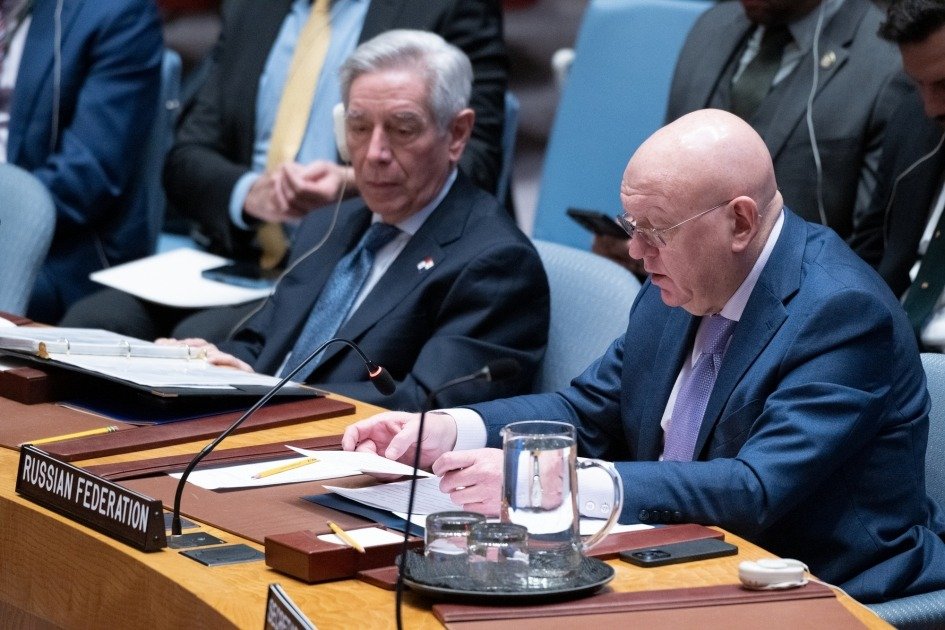
[Note: You will see from this that Russia is not stepping back from previous Security Council resolutions on a two-state solution. This is despite the so-called Board of Peace. Nebenzia also details what the offer of 1 Billion Dollars from Russia to the Palestinians is to be used for and this is not to enrich the Real Estate grab.]
Statement by Permanent Representative Vassily Nebenzia at a UNSC Open Debate on the Situation in the Middle East
Mr. President,
We would like to thank Ramiz Alakbarov, Deputy Special Coordinator for the Middle East Peace Process, for his briefing on the situation in the region.
The recent developments in the Palestinian-Israeli conflict zone give us grounds for cautious optimism and offer hope for a definitive transition from the logic of confrontation and violence to diplomacy and economic revival.
We welcome the return to Israel of the body of the last hostage, Ran Gvili, which was made possible owing to the Palestinians disclosing the information on its whereabouts. The wounds inflicted on the Israeli nation on October 7, 2023, may still be fresh, but let us hope that this symbolic event, which marked the final reunification of all families with their loved ones, is set to pave the way for restoring relations between the two peoples. At the same time, we must not forget about the Palestinians who lost their loved ones or were separated from their families. In addition to the more than 70,000 Palestinians who died from strikes, hunger, and cold, since the ceasefire in October 2025, 710 bodies have been dug out from under the rubble in Gaza, and thousands more remain buried there. The discovery of each body is no less important for the Palestinian people and for the cause of reconciliation.
We note the long-awaited start of the second phase of President Trump’s peace plan, which was announced by the US on January 14. The launch of the work of transitional bodies in the enclave – first and foremost that of the National Committee for the Administration of Gaza (NCAG), headed by experienced official of the Palestinian Administration (PA) Ali Shaath – lays the groundwork for rebuilding the Gaza Strip. We stand convinced that the peace initiative will hardly succeed until the interests and rights of the Palestinian people are fully respected and transitional structures coordinate closely with the PA. We emphasize that any plans for the forcible displacement of Gazans are inadmissible, no matter what plausible pretexts these plans may be furnished with. We expect that the administrative, political, and economic unity of Gaza and the West Bank, including East Jerusalem, will be restored in the foreseeable future with the establishment of the Palestinian State within the 1967 borders.
We are waiting for the US side to provide more specific information regarding the prospects for deploying the International Stabilization Force (ISF) in Gaza, including information on the composition, size, and mandate thereof. Based on our years-long experience in peacekeeping operations, we believe that the effectiveness of the ISF will depend directly on the presence of consent of the parties and the ability of the ISF itself to impartially perform its mandated tasks. At the same time, the use of force must be strictly limited so as to avoid drawing peacekeepers into the conflict as one of its sides.
All in all, we believe that further implementation of Trump’s plan will require mediators to focus on finding a comprehensive negotiated solution to the problem of disarming Palestinian groups and withdrawing Israeli forces from Gaza. Attempts at a military solution are doomed to failure.
Mr. President,
Now that the body of the last hostage has been returned, the Israeli side has no grounds left for delays in fulfilling its humanitarian obligations vis-à-vis the Gazans. We would like to recall that Israel’s humanitarian obligations are set out in points 7 and 8 of President Trump’s peace plan, as well as in operative paragraph 3 of UNSC resolution 2803, which endorsed the plan. The resolution explicitly states “the importance of the full resumption of humanitarian aid … into the Gaza Strip… through cooperating organizations, including the United Nations…,” which implies, inter alia, the need to make the Rafah crossing fully operational, as was announced as early as January 26, that is, three and a half months after the ceasefire agreement was signed.
Unfortunately, the humanitarian situation in Gaza remains catastrophic given total devastation and restrictions on the delivery of supplies. Persistent bans on carrying out humanitarian operations and importing essential goods and equipment for clearing rubble are seriously exacerbating the plight of Gazans. Palestinians continue to die under Israeli strikes, suffer from hunger, and a virtual lack of medical care and access to education, which is compounded by the winter cold. Since October 10, 2025, some 500 people have been killed and at least nine of them have died from hypothermia.
Information provided by humanitarian organizations clearly shows the disproportion between the scale of humanitarian needs to the actual level of response to them. Moreover, we are seriously concerned about the trend towards further restrictions on humanitarian activities, including through the introduction by Israel of additional requirements for the registration of humanitarian NGOs, which account for a significant share of vital work.
It is precisely based on the acute needs and pressing demands of the Palestinians that we announced our readiness to provide US$1 billion from Russian assets frozen by the previous US administration for projects to rebuild and reconstruct the Gaza Strip.
We call on Israel to refrain from actions that undermine the humanitarian response and to ensure safe and unhindered access for humanitarian agencies to address one of the most acute crises of our time.
Mr. President,
The situation surrounding UNRWA requires special attention. For decades, the Agency has been playing a key and irreplaceable role in providing assistance to the Palestinian population both in the OPT and in neighboring Arab countries. The Agency’s mandate was extended for another three-year period (until June 30, 2029) by UN General Assembly resolution 80/78, which was supported by an overwhelming majority of Member States. UNRWA also bears historic responsibility to ensure the implementation of Resolution 194 on the right of Palestinian refugees to compensation and return.
At the same time, the Agency is facing unprecedented pressure and systemic obstacles to its activities. Unfortunately, UNRWA is forced to direct considerable effort not only to supporting those in need, but also to protecting its own staff from threats, pressure, and persecution.
The Israeli side has prohibited the supply of electricity and water to UNRWA facilities, canceled tax benefits and immunity from prosecution, as well as the right to use banking and means of payment. A forced disconnection from electricity and water supply systems of the Agency’s schools, medical and municipal facilities will begin by the end of January, which will affect the provision of socially important services to tens of thousands of Arab residents of East Jerusalem. Since the beginning of the escalation of hostilities in Gaza, 309 UNRWA staff members have been killed. We express our sincere condolences to their families and loved ones and call for an impartial investigation and bringing those responsible to justice.
We note the recent statements by the UN Secretary-General containing strong condemnation of Israel’s anti-UNRWA policy, including the demolition of the Agency’s headquarters on January 20. We express our concern over such unprecedented moves. We call on the Israeli leadership to reverse this policy and refrain from further unilateral action against the UN humanitarian entity, and to comply with its obligations as a UN member State. We recall the option contained in the Secretary-General’s letter dated January 8 regarding the referral of the matter to the International Court of Justice in case it is impossible to resolve the differences on the 1946 Convention on the Privileges and Immunities of the United Nations bilaterally.
As regards Jerusalem, we note our commitment to UN Security Council Resolutions 476 and 478 on its occupied status and our non-recognition of Israel’s actions to extend its sovereignty over the city.
Mr. President,
Our country’s position on the Palestinian-Israeli settlement is principled and not subject to circumstantial changes. We reaffirm our support for the two-state formula and a just solution to the Palestinian issue on the basis of a universally recognized legal framework, without which it is impossible to achieve genuine peace and lasting security in the Middle East.
Thank you.