

FM Lavrov: Remarks and answers to media questions on Russian diplomacy
[Comments, including from Karl Sanchez below]
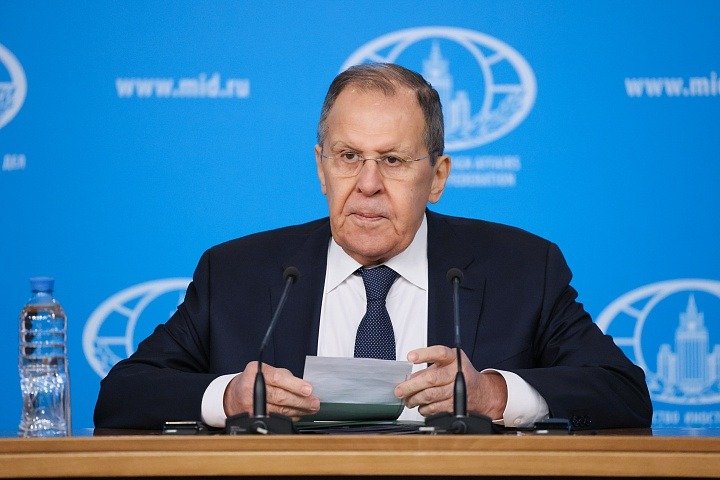
Colleagues, good morning.
The Foreign Ministry is delighted to welcome you at this traditional press conference. We hold it annually to sum up our performance. This will be an interesting conversation for all of us here, especially considering how many things happened in 2025. The first twenty days of 2026 brought an even more impressive mix of developments, dwarfing what we witnessed throughout 2025.
Let me wish you a Happy New Year and Merry Christmas. From the bottom of my heart, I wish you good health and every success in your professional and personal endeavours.
President Vladimir Putin has recently offered a detailed insight into international politics during his December 19, 2025, press conference. He also spoke about the objectives the Russian Federation pursues at home.
Quite understandably and for obvious reasons, President Vladimir Putin focused on international affairs in his remarks at the Kremlin during the presentation of letters of credence on January 15, 2025.
I have already said that this year got off to a rocky start. We witnessed unprecedented developments, including a blatant armed intervention by the United States in Venezuela, which left dozens of people killed and wounded, followed by capturing Venezuela’s legitimate President Nicolas Maduro and his wife and taking them out of the country. At the same time, Cuba and other Latin American and Caribbean countries are facing threats too.
External forces have made no secret of their intentional efforts to destabilise Iran, which is a matter of grave concern. In particular, a would-be prominent personality in today’s world, the EU’s High Representative for Foreign Affairs and Security Policy Kaja Kallas, has recently said that by supporting these protests, the international community – as represented by the European Union, it seems – is pursuing regime change in this country. I will not even mention the fact that most Western countries are seeking to continue using the Kiev regime in their military confrontation against Russia. There may be less talk about inflicting what they call a strategic defeat on Russia these days, but everything points to the fact that this goal remains on the mind, and in the plans, primarily among European leaders.
Just look at German Chancellor Friedrich Merz’s perorations about once again making the German army the strongest force in Europe. It was also he who said that Russia should not be allowed to have its way in Ukraine since this would amount to appeasing Adolf Hitler. What do you think about this statement? Few people paid attention to it, but it should not have gone unnoticed.
We remember well and must never forget what happened several times over the course of history when the German leadership assumed this kind of an arrogant posture. Speaking of World War II – we cannot avoid recalling it, for obvious reasons, I would like to note that discussions on amending the country’s constitution have been gaining traction in Japan. This goes beyond building up the army’s offensive capabilities, but also revising the non-nuclear status. They have been quite open about it.
Of course, the world order is undergoing a deep-running transformation. It is telling that the West has been actively pushing its narrative about a rules-based order by contrasting it with international law in its original meaning for the past decade, while today this term has vanished from public discourse.
All Western European countries are struggling to come to terms with what is happening in the world considering the policy as declared and adopted by President of the United States Donald Trump, and how this policy can be part of their rules-based order. This time, it is not the collective West which writes these rules, but just one of its members. This came as a major shock for Europe. This is what we are witnessing.
Clearly, what is going on and the international actions President of the United States Donald Trump has been talking about are signs of competition. We have discussed the latest global economic trends many times. The US-led West created rules which served as a foundation for the globalisation model. Until recently, it was a world-wide process, and China outcompeted its Western competitors in trade, economics, investment and infrastructure by adopting this playbook. China’s economic performance speaks for itself.
We can see efforts to deal with this situation through sanctions, tariffs and duties. The United States wants to strike deals even if for now there are no common criteria similar to those which shaped the way the IMF, the World Bank and the WTO operated. While supposed to form the bedrock of the world order which suits the West, all these rules have become void.
This game is based on the “might is right” principle. We are watching it. We can hold an interactive dialogue on changes in the conceptual vision and concrete processes in the development of a new world order. But the consequences are not only influencing the Global South and East countries but also the crisis trends within the Western community.
Greenland is a relevant example. It has become a household word, and it was hard to imagine discussions around it before, including prospects for the preservation of NATO as a unified military-political bloc.
Speaking of Greenland, we proceed from the assumption that if Western countries wish to talk the talk, it’s their choice and right to do so. As for us, we will deal with all our partners in the Global Majority countries and in the Western states that are interested in talking with Russia and discussing concrete mutually beneficial projects based on the principles of equality.
It can be said that we would like to apply the universal norms of international law everywhere, but the main principles are equality, mutual respect and a balance of interests. These are the absolutely unwavering principles when it comes to interaction on the international stage, whether you call it rules or international law.
The principle of equality cannot be taken out of the equation. In an equal dialogue, those who have more resources will have greater influence on the outcome, yet it is vital to strive for results that will represent a balance of interests.
Russia will consistently uphold its interests without infringing on the legitimate rights of others or allowing them to take liberties with our legitimate rights. Our foreign policy, which is enshrined in the Foreign Policy Concept approved by President Vladimir Putin in March 2023, stipulates resolute defence of the vital interests of our nation and the creation of favourable conditions for sustainable development within the Russian Federation. It is of crucial importance to take principled actions to further strength our national sovereignty.
I would like to remind you that the amendments made to the Constitution of Russia in 2020 are vital for strengthening our national sovereignty. We are ready to work with all foreign states that will reciprocate and are willing to deal with us honestly on the basis of equality, without blackmail or pressure. This is widely known.
Speaking about the key points which the West used with regard to the Russian Federation in 2025, it is no longer a secret that the so-called isolation of Russia has failed, no matter what our ill-wishers may say. The landmark events of the year were the celebrations of the 80th anniversary of Victory in the Great Patriotic War, including the parade in Red Square and the great number of foreign guests who attended it. We appreciate everyone who personally attended these events or sent special delegations to attend them.
Speaking about the Second World War and its outcome, it is worth mentioning similar events held in Beijing on September 3, 2025, to mark the defeat of militarist Japan and the end of World War II. These two events have clearly shown that the overwhelming majority of countries do not wish to forget the memory, lessons and history of World War II. It is an important conclusion from the past year.
I will not delve into the specifics of our relations with individual countries and regions right now, as those details can be addressed in the Q&A session. I would note, however, that comprehensive accounts of our relations with all major powers and every neighbouring state are documented in our annual foreign policy report. This is a substantial document, rich in statistical data and factual detail on nation-specific developments, which I trust interested parties have consulted.
I wish to highlight several policy strands from our 2025 performance that will gain further significance in 2026. Foremost among these is our commitment to fostering a sustained belt of neighbourly relations and cooperation within the CIS, EAEU, CSTO, and SCO frameworks.
We have continued, and will continue, to advance the key flagship initiatives championed by the President. These are, principally, the formation of the Greater Eurasian Partnership and, building upon it, the creation of a pan-continental architecture of equal and indivisible security.
In concert with our Belarusian allies, we are promoting the development of the Eurasian Charter of Diversity and Multipolarity in the 21st Century. We have declared this initiative open to participation by all Eurasian states without exception.
Our relations with China, which I have mentioned, are unprecedented in their depth, level, and alignment on developments across Eurasia and the global stage.
I would like to particularly underscore the privileged strategic character of our partnership with India, which the President visited this past December.
The Comprehensive Strategic Partnership Treaty with the DPRK, whose fraternal and allied assistance was instrumental in liberating the Kursk Region from the Ukrainian militants, stands as a practical embodiment of our efforts to bolster Eurasian security.
Regarding BRICS: every member of this association is a valued partner. Our ties with each were strengthened throughout 2025, laying a firm groundwork for enhanced cooperation across all spheres.
We are currently preparing for the third Russia-Africa summit. A key milestone in this process was the Second Ministerial Conference of the Russia-Africa Partnership Forum, which included Russia and African Union states, held in Cairo in December.
In the realm of multilateral diplomacy, we note the shared objective of strengthening BRICS and the growing global interest in the association. We provided full support to the Brazilian BRICS chairmanship in 2025, and our Brazilian friends have effectively continued numerous projects initiated at our BRICS summit in Kazan in autumn 2024.
Following our initiative, and with the support of the Group of Friends in Defence of the UN Charter, the General Assembly adopted two landmark resolutions: establishing an International Day against Colonialism in All Its Forms and Manifestations (observed on December 14) and proclaiming an International Day Against Unilateral Coercive Measures (observed annually on December 4).
Furthermore, on our initiative, the UN Convention on Cybercrime was signed in Hanoi in autumn 2025. As the first instrument of its kind in international information security, it sets a precedent. We are hopeful that the ongoing discussions on the regulation of artificial intelligence will yield similarly concrete results.
Turning now to various aspects of the Ukrainian crisis. As the President has consistently emphasised, Russia remains committed to a diplomatic resolution. A review of the conflict’s history, from its origins in 2014 and especially since 2022, reveals no shortage of goodwill from the Russian Federation regarding political settlements. Yet, on each occasion, our Western, primarily European, neighbours have taken deliberate steps to undermine these agreements. They are employing the same tactics towards initiatives put forward by the US Trump administration, seeking to dissuade it from reaching an understanding with Russia.
A reading of statements from European figures – be it Kaja Kallas, Ursula von der Leyen, Friedrich Merz, Keir Starmer, Emmanuel Macron, or Mark Rutte – makes it clear that they are seriously preparing for a war against the Russian Federation, and they make little attempt to conceal it. Our position on Ukraine is that any resolution must address the root causes of this crisis, which the West has deliberately cultivated for years to transform Ukraine into a security threat and a springboard against Russia on our very border.
They have actively encouraged the openly Nazi regime that seized power through the 2014 coup, a regime which has embarked on a path of legally and physically suppressing all things Russian – from education and language to culture, media, and the canonical Ukrainian Orthodox Church.
We are committed to helping de-escalate tensions across a range of flashpoints I mentioned, from Venezuela to, I must particularly highlight, the Iranian situation. The latter must be resolved on the basis of respect for Tehran’s rightful and peaceful use of nuclear energy. We are also convinced that a lasting settlement in the Middle East requires the final implementation of the UN decisions regarding the creation of a Palestinian state.
I would stress that this criterion remains entirely relevant in light of US President Donald Trump’s current, high-profile initiative to establish a “Board of Peace.”
I am now ready to take your questions.
Question: My question is related to your earlier statement today. Global developments of the past weeks indicate that the very notion of international law is being eroded. Is this international law effective and valid to comply with? Is there a principle of “every man for himself” in place? In the present circumstances, is President Putin’s Eurasian security initiative being fulfilled?
Sergey Lavrov: Regarding the world order, international law and all related matters, as well as the statements promoted and translated into action in certain countries, contrary to our understanding of international law. I have already said that for many years, the UN Charter has remained a universally recognised benchmark for actions across many areas for different states, when it was violated. Everybody was willing to discuss these violations or respective accusations within the UN Security Council. Some heated debates occurred; however, nobody questioned the fact that the council was the central body to discuss all issues pertaining to international peace and security.
After the dissolution of the Soviet Union, there was a period when the conventional application of international law as the foundation for multilateral contacts was replaced with what is known as a unipolar world order. It was then that the United States, leading the Western bloc, including the North Atlantic Alliance, decided that the “end of history” has come, as Francis Fukuyama proclaimed in his prominent book, and that from then on, nobody would stand in the way of Western dominance with all its theories – liberal, neo-liberal, or conservative – on the international stage.
When Vladimir Putin came to power in Russia following the presidential election in 2000, the situation started to change. Prerequisites emerged for revisiting this lop-sided pro-Western approach to the world order.
Under President Putin in the 2000s, Russia began to realise its place in global affairs, restoring its identity while fully respecting its thousand-year-long history, customs, principles, and allies. The West initially assumed that it was just speculation, that Russians would talk a little and calm down. The West did not even respond to President Putin’s Munich speech in 2007, which many serious politicians regret today. They regret not listening carefully; instead, they took it for demagogy, which was not the case.
According to our modern concept of foreign policy, Russia is a civilisational state. We will not abandon our roots. We have no right to do that. We honour our ancestors’ memory and the covenants they passed on to us.
You mentioned Eurasian security. It is noteworthy that in Eurasia – the world’s largest continent – unlike Africa and Latin America, there exists no pan-continental organisation. There are numerous sub-regional structures, including the OSCE, ASEAN, and those within the post-Soviet space – the CSTO, CIS, EAEU, SCO, GCC, and SAARC. Yet, a continent-wide structure remains absent.
Not only is Eurasia the largest continent, but it is also home to several great civilisations, including the one represented today by Russia. Naturally, there are also the Chinese, Iranian, Arab, and Indian civilisations. This is one of the reasons why it is difficult to unite all these trends under a single umbrella.
We are convinced that there is no need to emulate existing models or establish a formal, bureaucratic structure. It is entirely sufficient, as a first step, to establish a pan-continental dialogue so that countries sharing this vast expanse of the Earth may derive geopolitical and geo-economic benefits from their location.
This entails an equitable dialogue among all nations. It is precisely this objective that the Russian-Belarusian initiative aims for – involving not only countries situated on the continent but also the sub-regional organisations that have formed here. Among these, we are already fostering collaboration, both in political engagements and in harmonising projects, particularly in economic, trade, infrastructure, and payment spheres.
The contacts formalised by relevant agreements between the EAEU, SCO, and ASEAN are specifically aimed at creating what President Vladimir Putin has outlined as the Greater Eurasian Partnership – the foundation of a future Eurasian security architecture.
Turning to broader global trends, I would note that after the Russian Federation began consistently and non-aggressively, through explanatory efforts, to defend its rights and secure recognition of its legitimate place in international structures, the process has begun to assume tangible shape.
The first to take note of this was our great predecessor Yevgeny Primakov, who in 1998 remarked that a multipolar world order was gradually but confidently taking form. This coincided with his initiative to launch cooperation within the Russia-India-China (RIC) triangle, which still exists – though it has not convened in some time – but has not been disbanded. We are working to revive its activities. It became the precursor to BRICS. RIC evolved into BRICS following the accession of Brazil and South Africa.
Today, this is a widely recognised structure. It has doubled its membership and boasts numerous dialogue partners. When multipolarity began to assert itself as the dominant trend, many political analysts and journalists argued that nothing good would come of it, as it would equate to chaos in international affairs. Supposedly, when the world was bipolar – the Soviet Union and the United States – everything was clear. There were peripheral conflicts, but they did not affect the core of the bipolar world order. When the world was unipolar, after the dissolution of the Soviet Union, everything was also clear – one had to obey and avoid being too active. Later, for some time, even a new variant of bipolarity was entertained – the concept of Chimerica (China–United States).
Today, these are indeed the two largest economies, but the process by which each will further consolidate its position in global affairs remains unclear. We advocate for this process to be orderly, grounded in negotiations, and based on a balance of interests.
Were the predictions that the multipolar world would devolve into chaos justified? Looking at the current situation, one can find many supporters of this assessment, but the process never stalls at one point.
I get the impression that these sufficiently isolated actions, primarily those on the part of the United States, and the problems that have arisen between the United States and Europe, problems that exist between Washington and numerous countries in connection with tariffs, duties, sanctions and other actions reflecting aggravated competition on global markets (primarily by unscrupulous methods) are taking place and will persist for a long time. Multipolarity as an objective trend will not disappear completely. It is impossible to place it under a unipolar or bipolar “tent” because too many centres of economic growth have emerged.
I have mentioned China, India and Brazil. Africa is already beginning to undergo a reawakening. It is comprehending the fact that political independence did not facilitate economic independence, and that Africa is continuously exploited with neo-colonial methods. Former centres of empires that granted political independence to their former colonies continue to live at their expense. This comprehension is now asserting itself on the African continent. We can feel this every day during our numerous contacts with African countries.
Centres of growth reflect an objective historical process, specifically, the development of the economy, the infrastructure, the use of natural resources and many other things. In the long run, we will have to reach agreement on how these new major national or regional players, members of integration associations, should collaborate with one other.
Today, when we are witnessing turbulent developments in the context of stronger multipolarity, a dialogue on how to streamline it is on the agenda. This will take a lot of time. Some people say (I understand what they mean) that this process will encompass an entire historical era. But this process is inevitable.
US President Donald Trump’s initiative on establishing the Board of Peace for Gaza shows that all the main players comprehend this fact. We have recently received specific proposals and this organisation’s draft charter. This initiative reflects the fact that even the United States with its foreign policy philosophy proceeds from the need to gather a group of countries that will cooperate in a specific direction.
It may be argued that the Board of Peace was conceived and announced in such a way that everyone should obey the United States. Washington would now like to see precisely this situation. But I assure you that, regardless of its actions (that are now widely discussed across the world), the administration of US President Donald Trump is an administration of pragmatics. Its members realise the need to bring together multiple countries under US auspices and to completely heed their legitimate interests.
I would like to note once again that this position and a comprehension of the need to completely take the partner’s interests into account is manifested in approaches towards the Ukrainian settlement by Donald Trump’s administration. This is the only Western country which is ready to address the task of eliminating the root causes of this conflict that was largely created by Donald Trump’s predecessor, the then US President Joe Biden and his administration.
This process is just beginning; it will not be simple and will require the mobilisation of all resources, including centres of growth and centres of influence that I have mentioned. Given goodwill, and we can see indications that such goodwill will assert itself, everything can be achieved.
Question: Russian representatives say that the OSCE needs resuscitating. Is this still currently central in view of Eurasian security? What is your point of view on the modern-day map?
Sergey Lavrov: Where the OSCE is concerned, you said that someone was urging its reform or resuscitation. I don’t know if resuscitation is possible in this case. The OSCE has “fallen” so low as to hit the bottom.
Formerly based on the principles of equality and consensus, this organisation has degenerated to become a tool that the West, taking advantage of its majority position, “hones” daily against the Russian Federation.
Our attitude towards the OSCE boils down to the following. We continue to participate in its work, and do so not because we harbour any hopes or illusions (in the current situation, any hopes are illusory) but because we want to support those OSCE member countries that are still endowed with common sense. There are quite a few of these. Apart from our CIS colleagues, this category includes Hungary and Slovakia. There are sane forces in a number of other Western countries as well.
We will continue to maintain contacts with them and do whatever we can to contain the OSCE from “burying” itself. There is a hope in what it concerns the current OSCE Secretary General, Mr Feridun H. Sinirlioğlu of Türkiye. A long-serving diplomat, he understands the disastrous – without any exaggeration – state of the OSCE executive structure he has inherited.
I do not know, whether it will retain its position in future European security arrangements and within the Greater Eurasian Partnership. I am not sure. After all, the OSCE is a Euro-Atlantic organisation. When it was being created, the USSR wanted countries located in the west of the Eurasian continent to join it.
Countries comprising the current collective West were insisting on the accession of the United States and Canada and had their way. This resulted in a Euro-Atlantic configuration modeled on the North Atlantic Alliance. NATO and the OSCE are Euro-Atlantic organisations and as such they are experiencing a profound crisis that has engulfed the Alliance itself to the extent that it is being mooted whether or not it is high time to disband it. Because one NATO country is going to attack another NATO member. But this is a different story.
I just want to emphasise that the Euro-Atlantic security and cooperation concept has discredited itself. It is for this reason that we are in the process of discussing Eurasian security. It cannot be accepted as a given that there is a European structure in place, be it NATO, OSCE, or EU.
As it happens, the EU is also part of the Euro-Atlantic construct, because its latest agreements with NATO have completely stripped it of independence, even though attempts to revive it are underway. Calls are being made to create a European security system that does not include the United States, but includes Ukraine. In other words, once again the narrative focuses on creating a “construct” opposing the Russian Federation. This mindset underpins the positions of most OSCE countries, Western countries, and is deleterious. It will do no good either for the West, or the OSCE itself.
I can go on and on about this. I tried to set the tone. Perhaps, it will make considering many issues easier down the road.
Question: It was reported yesterday that the Hungarian company MOL and Russian Gazprom signed an agreement under which MOL will take over the Serbian company NIS. If we look at this geopolitical issue, you as an experienced Minister who has held this position for 22 years now…
Sergey Lavrov: Not yet.
Question: You will.
Could you share whether the NIS situation presents a geopolitical challenge for Russia? Will Russia stay in the Balkans? Does this mean that the Russian Federation will no longer be present in the Balkans, because Hungary is a member of NATO and the EU? Also, this deal needs to be approved by the United States.
Will this lead to new security architecture ensuring balance between the Russian Federation and the United States in the Balkans?
Sergey Lavrov: Had the Naftna Industrija Srbije deal that was announced yesterday been disadvantageous to Russia, including Gazprom, it wouldn’t have taken place which is absolutely clear. Considering the situation in Serbia, the agreement benefits both sides. President of Serbia Aleksandar Vucic said as much when he was asked about it in Davos.
You want to know whether arrangements involving some form of cooperation between Russia and the United States in the Balkans are possible. We are open to interaction with everyone.
This brings to mind the situation where then EU High Representative for Foreign Affairs and Security Policy Federica Mogherini stated, specifically with the Balkans in mind, that when the EU engages in something in the Balkans, other countries should stay out, implying that Russia was willing to help its Balkan partners address their issues back then.
More broadly, speaking about Serbia and its interests, I would focus not just on how Russia and the United States might interact or exert influence in the Balkans, but also on how the EU treats Serbia. It has been stated repeatedly that Serbia’s future is in the European Union. In response, the EU says, we will see, but first you need to recognise the independence of Kosovo. That is, you must humiliate yourselves and then fully align with every EU foreign policy move, including sanctions on the Russian Federation. Is that a dignified thing to do from Brussels’ standpoint?
Brussels continues to live in a paradigm and to be guided by the same philosophy that it expressed on the eve of the Ukraine crisis, when things were at the insipient stage ahead of the first Maidan protests in 2004. Back then, Brussels said that the Ukrainian people must choose sides between Russia and the EU. Let me tell you that this “either-or” and “who is not with us is against us” approach is, I believe, a harbinger of the European Union eventually coming to a bad end.
I hope our Serbian friends are fully aware of where they are being dragged in and the price someone is willing to pay in order to expand their influence in the Balkans.
The United States and Russia have more opportunities to engage in the Balkans in matters concerning Bosnia and Herzegovina and other countries in the region. Contacts to this end are in place. So far, no positive or specific results have been achieved, but we remain open to them. As far as I can tell, our American colleagues are prepared to work to achieve them as well.
Question: Given this, in what format does the Russian Foreign Ministry plan to develop further contacts with the United States, including the normalisation of bilateral relations?
Sergey Lavrov: We are not merely planning; we are already engaging. Unlike the administration of President Joe Biden, the administration of President Donald Trump demonstrated an immediate interest in overcoming the utterly abnormal situation where even the embassies of our respective countries in Washington and Moscow could not function properly.
From the very beginning of 2025, we established contacts and formed a dialogue mechanism concerning embassy operations. We emphasised the necessity – and this was supported by the Trump administration – not to limit discussions solely to matters such as the number of visas issued to diplomats, the security arrangements for diplomatic missions, or the movement of diplomats within the host country, which are purely consular issues. We proposed reaching an agreement foremost, on the key problem affecting diplomatic relations: the issue of Russian diplomatic property. This property was seized by the administration of President Barack Obama, “in a fit of pique,” two weeks before vacating the White House, and was subsequently withheld by all successive US administrations, regrettably including that of President Donald Trump.
I must, however, remind you that I spoke of this when the then-US President, Barack Obama, suddenly announced in late December 2016 that he was seizing our diplomatic properties. Mr. Michael Thomas Flynn, who was part of Donald Trump’s team and slated to join his administration, called Russian Ambassador to Washington Sergey Kislyak, urging him not to respond to what I would describe as this utterly counterproductive and illegal gesture by Barack Obama. He assured us that in three weeks, upon Donald Trump’s inauguration in January 2017, everything would be rectified. He asked that we refrain from a sharp reaction. We heeded this advice and postponed our response.
Subsequently, and unfortunately, the Trump administration in 2017 failed to redress this absolute injustice and egregious violation of all diplomatic conventions. At that point, we explained to our colleagues in Washington that we had no choice but to respond. This situation has persisted ever since. We will continue to press for discussions on this matter, though our American counterparts, contrary to earlier understandings, remain unwilling to engage on the topic.
For diplomatic missions to function normally – and indeed for any meaningful contacts to develop, which Washington has expressed support for under President Donald Trump – direct air travel must resume. These issues, too, form part of our negotiating agenda.
Another key area of our dialogue with the United States concerns Ukraine. As I have said, we have noted that under President Donald Trump, the US became the only country not only to express understanding for Russia’s legitimate interests but also to propose solutions addressing the root causes of the current crisis. We support this approach. We consider it entirely justified.
In Anchorage, Alaska, on August 15, 2025 – as Russian President Vladimir Putin has publicly stated on multiple occasions – we accepted the proposals Washington tabled ahead of the meeting. We still hope these understandings remain fully valid, though we observe how hysterically Europe and Vladimir Zelensky, along with his team, are attempting to dissuade the US from this stance and reimpose their own concepts, including, above all, a sixty-day or even “permanent” ceasefire.
It is clear that the Ukrainian side is in dire straits, both on the frontline and politically. In Kiev, corruption scandals have overshadowed all other developments. But we cannot afford the luxury of allowing the Kiev regime to rearm yet again, catch its breath, and once more turn its aggression against the Russian Federation.
Certain meetings have been announced for Davos in the coming days, where we anticipate yet another attempt to push US President Donald Trump back towards approaches that have been thoroughly discredited and have failed in recent years. The central issue is this: when Europe now speaks of resolving the Ukrainian crisis, its rhetoric calls for the war to be stopped as swiftly as possible, while simultaneously insisting on security guarantees for Ukraine – meaning, for the territory that would remain under that name.
What does this signify? I have already noted the discussions in Europe arguing that, since American reliability is in question – a point confirmed by Greenland – a European security architecture must be urgently constructed without the United States, but with Ukraine. In other words, the security guarantees our European colleagues proclaim with such lofty solemnity, touting their contribution to peace, are designed exclusively for the current Nazi Kiev regime. This point must not be overlooked.
Critically, there is no discussion whatsoever on how matters should be arranged in the territories that would remain under Ukrainian control. There is not a word about restoring the rights of Russian speakers and ethnic Russians, lifting the ban on the Russian language in all spheres of public life, or ending the persecution of the canonical Ukrainian Orthodox Church. These objectives were, however, present in US President Donald Trump’s initial proposal, the so-called “28-point plan,” which explicitly outlined the need to resolve the issues of the Russian language and the UOC.
In the subsequent documents we have seen, presented at the end of 2025 as a “20-point plan” – and we have received no newer texts from the recent rounds of US-Ukraine-Europe negotiations – all mention of restoring these specific rights has vanished. Instead, they speak only of the parties committing to “tolerance” in their relations, and that Ukraine will adhere to EU standards on ethnic minority issues. I believe the term may even be just ‘minority’ rather than ‘ethnic minority’; with the EU as the benchmark, anything is possible.
In other words, the reference is not to universal international standards, first and foremost the UN Charter, which mandates upholding human rights without distinction as to race, language, or religion, but to the European Union’s own adopted norms. There is little doubt that these EU norms would be interpreted and applied in a manner tailored to the preferences of Zelensky-led Ukraine. Consequently, any settlement proposal founded on the primary goal of preserving the current Nazi regime in what remains of the Ukrainian state is, naturally, completely unacceptable to us.
Question: Moscow stated that US President Donald Trump had decided to set free two Russian citizens, who were members of the Marinera tanker crew. Have they been released? If yes, have they returned to Russia? Where are they? Do you think the seizure of the tanker sailing under Russian flag by the US military impaired the prospects of normalising relations between Russia and the United States?
Sergey Lavrov: As soon as we learnt that the tanker had been seized, we sent an earnest request to the US side. The main thing for us was to have our citizens released. There are two of them alongside with citizens of Ukraine, Georgia and India.
They assured us that, in fact, the decision on setting them free was taken at the highest level on the same day or the following morning. However, unfortunately, the subsequent days have shown that this decision is not fulfilled.
We expect our American colleagues to fulfil their promise, which, as I have just said, was conveyed to us.
This story of the tanker seizure in breach of international law on the high seas on suspicions that are not on the list of criteria for detaining vessels provided in the UN Convention on the Law of the Sea evokes concern. This is also an incident among other actions that puts international law to the test.
We do not say that the provisions contained in the 1982 Convention on the Law of the Sea are eternal. Of course, life has changed, more than 40 years have passed. Still, if so, we need to sit down and agree on how to behave on the high seas and in special economic zones. We are ready for this. We hope for awareness to come that this is necessary.
Question (retranslated): You have repeatedly spoken positively about US President Donald Trump’s understanding of Russia’s interests. However, you have also criticised recent US decisions and actions directed against Russia’s allies, such as Venezuela and Cuba. To what extent do this inconsistency, unpredictability, and the apparent willingness to employ unlimited force on the part of President Donald Trump pose a threat to Russia?
Sergey Lavrov: I have spoken about Venezuela, Cuba, and Iran, because we can clearly see the inconsistency of the Trump administration’s actions in matters of international security and its attitude toward international law.
President Trump, responding to a related question just a few days ago, stated that he has no interest in international law and that norms of behavior in the international arena are determined by his own moral judgment. This is a noteworthy statement.
We have never expected to achieve one hundred percent alignment with any country, including our closest neighbours. Such complete alignment is simply impossible, especially between the world’s two largest nuclear powers, the Russian Federation and the United States.
It is worth recalling what The New York Times reported on December 30, 2025, in an article entitled “The Separation: Inside the Unraveling U.S.-Ukraine Partnership.” According to the newspaper, during the talks with me and our delegation in Riyadh in February 2025, US Secretary of State Marco Rubio briefly shifted into what was described as a “movie buff” mode and quoted The Godfather. He recalled the scene in which Vito Corleone tells his son: “I spent my life trying not to be careless. Women and children can be careless, but not men.” The message was clear: nuclear powers must maintain dialogue with one another.
Such a conversation did indeed take place. Since Mr Rubio deemed it appropriate to mention it publicly, I see no reason not to add a few clarifying details. At the very beginning of our meeting in Riyadh, Mr Rubio stated – while I cannot quote him verbatim, I recall the substance quite clearly – that US foreign policy under President Donald Trump is guided by national interests and common sense. He emphasized that this approach implies recognition of the national interests of the United States’ leading partners. He did not say all countries, but other major powers.
He went on to note that the national interests of countries such as the United States and Russia will not always coincide. In most cases, they will not, but, when they do align, it would be a grave mistake not to take advantage of that by pursuing mutually beneficial initiatives in areas such as the economy, trade, and investment. Conversely, when national interests diverge, he stressed that it would be a crime to allow such differences to escalate into confrontation, particularly into a dangerous or military one.
I responded that I fully share this philosophy and logic. We proceed from the assumption that the United States understands the validity of this approach, as articulated by Mr Rubio.
Question: How does the EU view the development of the EAEU?
Within the EAEU, there is a union, a single state – Russia and Belarus. Are there any plans to develop warmer, closer relations with the countries of Central Asia? After all, Central Asia was a strong backbone during Soviet times.
Sergey Lavrov: The heart of the world.
Regarding the European Union’s attitude towards Eurasian economic integration – if I understood the first part of the question correctly – I am not directly aware of its stance. The EU has never commented on these processes. It has only sought to undermine them under the pretext of its asserted right to develop relations with any partners.
This began long ago, even before the EAEU was established, when, largely disregarding the existence of the Organisation of the Black Sea Economic Cooperation, they pursued their own strategy for the Black Sea region. At that time, we still had contact with them. We asked whether it was not somewhat incongruous that an organisation existed which geographically represented a gathering of Black Sea littoral states, while they, lacking full coverage of the Black Sea, were advancing their own concept. No, this did not trouble them.
In the same way, they advanced their concept for the Arctic region. That is to say, they have a tendency to assert their right to interfere in any part of the world where they either wish to gain something or to harm someone, primarily the Russian Federation.
The same is happening with their relations with Central Asia. Incidentally, Central Asia attracts a great many partners as a principle. The Central Asia Five Plus One format exists for a dozen countries and structures, including the EU.
But alongside Central Asia Plus the EU, there are formats such as Central Asia Plus France, Central Asia Plus Germany, and so on. There are Central Asian formats involving Japan, South Korea, the United States, China, and Turkiye.
For some time, we proceeded on the assumption that, since we cooperate with our Central Asian friends within the frameworks of the CIS, the CSTO, the SCO, and with some of them within the EAEU, it might not be necessary to create a formal Five Plus One structure. But several years ago, we decided it was essential. Last autumn, the second Russia Plus Central Asia summit took place.
A joint action plan was approved – a comprehensive document covering all areas of our collaboration. Therefore, I can assure you that we do not pay insufficient attention to Central Asia. Far from it. If you have formed such an impression, I would be grateful if you could share it with us, perhaps even providing a paper explaining the basis for this perception.
The European Union does not engage with the EAEU but seeks to undermine the Union in every possible way, including by declaring to all that participation in the EU should be a priority for anyone who wishes to develop normally and thinks of their people. Now, as you know, they are also courting Armenia. There are many other examples.
Our initiative, together with Belarusian friends, on Eurasian security and the Greater Eurasian Partnership envisages the participation of all countries on the continent, so the door is open even to EU members.
I would mention that at the annual Minsk Conferences on Eurasian Security – there have been three so far (1, 2, 3) – Hungary’s Foreign Minister Péter Szijjártó and representatives of Slovakia have regularly participated. I have no doubt that at this year’s conference in Minsk, the representation of European countries will increase.
Question: I have a question that covers three aspects of Armenia-Russia relations. What can you say about the persecution of the Armenian Apostolic Church, in particular the fact that these actions are openly justified by the authorities, both domestically and in the West, as a way to counter Russian influence? The Mayor of Gyumri faced criminal charges for allegedly giving up sovereignty merely because he mentioned the Union State of Russia and Belarus, at a time when a law has been adopted on starting the process of EU accession. Overall, what is your assessment of Prime Minister Pashinyan’s approach to the EAEU membership amid rhetoric about him aiming to join the EU and the law On Launching the Process of Accession to the EU adopted by the governing party which can be interpreted as we will remain part of the EAEU for as long as we need?
Sergey Lavrov: I have more than once discussed EU and EAEU membership with my counterpart Ararat Mirzoyan and Prime Minister Nikol Pashinyan when I last visited Yerevan in May 2025. Anyone familiar with the principles governing the functioning of the EAEU and the EU knows that it is impossible to adopt the EU standards and keep the EAEU membership at the same time. Deputy Prime Minister Alexey Overchuk made that clear repeatedly during his contacts with his Armenian counterpart.
This is technically impossible. They are incompatible not only because different rules apply in trade and investment, but also because Brussels persistently promotes the idea of transforming Armenia’s regulatory and legal framework in order to bring it line with the EU standards. I am not even mentioning the fact that, in Serbia’s case, these standards imply full alignment with the EU foreign policy, which also means joining anti-Russia sanctions and rhetoric.
A new Armenia-EU Partnership Strategic Agenda was signed in December 2025. It says Armenia and the EU must coordinate their foreign policies, as well as policies in trade and the economy. Armenians are being offered liberalised visa regulations, but it comes with a condition that the EU will have a say in addressing in law enforcement- and border protection-related issues.
Our border guards are stationed in Armenia which raises the issue of whether this aligns with Yerevan’s current obligations. Clearly, the purported movement towards EU membership and applicable laws to that end preclude EAEU membership. If Armenia decides accordingly, as Prime Minister Pashinyan has said, and goes along with the will of the Armenian people, then we will accept this as the inalienable right of Armenia and the Armenian people.
It’s hard to overlook the Armenian economic metrics over the past ten years. Armenia became a full-fledged EAEU member in 2015, when its GDP stood at $10.5 billion as opposed to current $26 billion, a more than twofold increase during its EAEU membership. The EAEU provides Armenian-made goods with free access to the markets of other member states, which is why Armenia’s foreign trade, primarily with the Russian Federation, has reached record levels and now stands at $14 billion, an unprecedented figure.
I cite these statistics because you asked how the push to be part of the EU correlates with maintaining relations with the EAEU. Once again, the decision is in the hands of the Armenian people and the Armenian leadership, but combining memberships is out of the question.
We are aware of the unfortunate dynamics regarding the Armenian Apostolic Church. National Assembly of Armenia Speaker Alen Simonyan and, in a recent interview, Armenian Prime Minister Nikol Pashinyan did not deny hybrid threats against Armenia emanating from the Russian Federation due to the developments surrounding the Armenian Apostolic Church. We find this baffling. Getting closer to the European Union has clearly taken its toll. I’m saying this because the EU never stops talking about “hybrid threats” supposedly coming from the Russian Federation, and these efforts are properly funded.
Not long ago, Armenia obtained a tranche of 15 million euros. I have no doubt that the Brussels bureaucracy will force our Armenian friends to account for every cent of this 15-million-euro tranche.
When Armenia is being talked into distancing itself from Russia, none other than EU High Representative for Foreign Affairs and Security Policy Kaja Kallas stated that Moscow would replicate the “Moldovan scenario” in Yerevan.
As you may recall, the “Moldovan scenario” had elections rigged in the most unconscionable manner. The Maia Sandu-led ruling regime lost this election in Moldova with only 44 percent of the vote going its way. It managed to declare victory only by grossly manipulating bulletins at over 200 polling stations in Europe at a time when Russia, which has the largest Moldovan diaspora, had only two polling stations, and Transnistria had about ten, but Transnistrian residents were in effect not allowed to vote.
So, if Kaja Kallas openly admits that the “Moldovan scenario” will be used during the forthcoming elections in Armenia, I would give it a serious thought if I were part of Armenian society.
You have correctly noted that Vardan Gukasyan is accused of calling to consider the possibility of Armenia joining the Union of Russia and Belarus. Arresting someone for expressing political views which in no way aim to undermine Armenia’s sovereignty or territorial integrity, but are instead aimed at maximising the opportunities offered by external ties in the interest of its own development has made the people wonder and caused concern among them. He has been released from custody, but remains under house arrest. We expect political figures in Armenia who advocate for expanding and deepening cooperation with Russia not to be persecuted.
Question: Just recently, President of Moldova Maia Sandu stated that she supports the accession of a constitutionally neutral country into Romania, which is a NATO member. She also said she would vote in favour of this in a referendum. This raises the question: how does the Russian Federation view the possibility of such a scenario, and how does it assess this scenario in principle?
I would also like to ask you to elaborate further on the initiative of US President Donald Trump to create a new organisation to address peace issues, at least initially within the framework of the situation in Gaza. In your view, to what extent could this organisation be effective? How much does the world need new organisations at all? What is the Russian Federation’s stance on this initiative?
Sergey Lavrov: Regarding Moldova, its course towards rapprochement with the European Union is what I would describe as “absorption by the European Union,” because voices are growing louder that reunification with or accession to Romania would be the shortest path to membership in the European Union. Naturally, this course undermines Moldovan statehood. One gets the impression that the European Union has an interest in this.
This is evident in numerous facts. For example, the Moldovan language has already been renamed Romanian. In school textbooks, the history of Romania is taught instead of the history of Moldova. Nazi collaborators of Hitler, such as Ion Antonescu, are declared national heroes. Historical facts, not only concerning the Second World War but also the preceding and subsequent development of this region, are brazenly distorted or ignored. Simultaneously, anti-Russian sentiments are being stoked. They are attempting to blame us for all the misfortunes of the Republic of Moldova, including the effective collapse of its economy and social sphere, rising unemployment, poverty, and so on.
They also, by the way, blame us for the population outflow. Moldova’s external debt amounts to almost $12 billion, while its population is 2.38 million. These are catastrophic per capita figures in terms of economic and social development prospects.
The poverty rate is off the charts, with nearly two-thirds of the population in Moldova living on low incomes. Other indicators are equally disheartening – the balance of payments deficit, a sharp decline in exports (including, incidentally, exports to the European Union). Therefore, one must always measure fine words against actual deeds.
Meanwhile, members of Maia Sandu’s regime never tire of reiterating their transition to European standards. What this leads to, we have seen in the case of Ukraine and, indeed, the Baltics. Brussels has absolutely no need for an independent Moldova – this is purely a geopolitical calculation. There are, I hope, political forces in Moldova that understand what is happening and rely on the opinion of the majority of the Moldovan people. It is no coincidence that Maia Sandu’s regime failed to secure support or a majority in the last elections among the residents of Moldova who live in the country.
We are deeply interested in maintaining normal relations with Moldova. We provide no pretext for hostile actions from their side, incited by the European Union. Unfortunately, however, the EU is not lagging behind the current authorities in Chisinau, who are entirely accountable to it.
Question: In recent years, the Baltics have effectively become a military staging ground for the entire NATO alliance. There have been repeated provocations against Russia in the Baltic Sea, and obstacles have been imposed on maritime navigation. Moreover, the Baltics have even threatened Chinese maritime logistics.
In light of this, beyond diplomatic protests, what measures can Russia take to counter this threat?
Sergey Lavrov: The Baltics have already become a byword for absurdity. Over the past few years, when Russophobia – and indeed, militant Russophobia, with calls to prepare for war against Russia – was being whipped up in the EU and NATO, the Baltics, including their leadership, were naturally at the forefront alongside the likes of the Germans.
The invectives directed at us have been ceaseless – you are aware of all those statements made by presidents, prime ministers, foreign ministers, and defence ministers. A colossal, inexplicable sense of self-importance pervades these declarations. I do not know how this aligns with the actual role the Baltic states play. Perhaps it stems from a long-standing defect – an affliction of sorts. Because when the three Baltic countries were admitted to the European Union in 2004, they categorically failed to meet all the necessary criteria.
The same, in fact, is now being attempted with Ukraine, which does not comply – more than that, it violates every criterion. When the Baltics were admitted to the European Union, we still had good relations – Romano Prodi was then heading the European Commission. We asked our European colleagues why they were so recklessly dragging them in. After all, this would become a burden on the normal functioning of the trade and economic structure that the EU was at the time.
They told us that, of course, there were certain nuances – they were not yet ready for full membership – but for political reasons, they wished to admit them. Because ever since they were granted independence in 1991, they supposedly continued to harbour phobias towards the Russian Federation and lived in constant fear that we would attack them again – that is what we were told. “So, we’ll admit them to both the EU and NATO now, and they’ll settle down.” They did not settle down. On the contrary, within both the EU and NATO, they began trying to play first fiddle in stoking Russophobic hysteria. This persists to this day.
As for what concrete results this approach – and their membership in Western institutions – has yielded for their own populations, one need only look at the statistics: how much of their population remains after so many have fled in search of a better life in Europe or elsewhere; what economic growth they can demonstrate; what their GDP per capita figures are; and much more.
It is well known how Europe, from the very outset of Baltic independence and their subsequent participation in NATO and the EU, has turned a blind eye to the most egregious human rights violations. Their treatment of the Russian language is notorious. True, they have not descended to the boorishness of Vladimir Zelensky’s regime – an outright ban on the language in all spheres of life has not been declared there. Though certain sectors – education, mass media, and even culture – are gradually being subjected to targeted restrictions.
The Estonian Orthodox Church is yet another example, following in the footsteps of Ukraine’s decisions regarding the Ukrainian Orthodox Church, reflecting the line of the Phanar – the Patriarch of Istanbul (I cannot bring myself to call him Constantinople) – in dismantling traditional, historical Orthodoxy. It is regrettable. I mentioned Armenia in the context of the Armenian Apostolic Orthodox Church. This is a trend, and one we cannot ignore. It is a direct undermining of human rights, enshrined – let me cite it once again – in the UN Charter, which states that the rights of every individual must be upheld, including those pertaining to religion.
Question: Speaking without mincing words, American imperialism has reached a new level. For the past 150 years or more, they were focused on the Southern Hemisphere – Latin America, the Arab world, Africa and so on. Today, they have set their eyes on using armed force to seize Greenland.
The nominee for the post of US Ambassador to Iceland, William Long, joked that Iceland will be the 52nd US state and he’ll be governor. In other words, the Americans are looking with a greedy eye on Iceland and Greenland. How would you react if the Nuuk and Reykjavik proposed a treaty of friendship and cooperation or even an agreement on military cooperation with Russia?
The degradation of European elites has become obvious. Sergey Karaganov, a person of importance in the Russian establishment, has stated in an interview with our colleague, Tucker Carlson, that delivering a nuclear strike on Europe is undesirable but quite possible, and that he would choose Germany as the target. How would you comment on that statement by Comrade Karaganov?
Sergey Lavrov: I won’t comment on Comrade Karaganov’s words. The only person who can command our nuclear arsenal is the Supreme Commander-in-Chief and President of Russia. Our nuclear doctrine is a public document; it sets out our stance quite clearly. We regularly update it. It is available to the public. You can find the necessary information in it.
As for Greenland and Iceland’s hypothetical proposal of a mutual assistance treaty with the Russian Federation, I don’t see the conditions for assuming this probability And I don’t think that anyone in Nuuk or Reykjavik is considering this.
Logic has taken a wrong turn in your question. It sounds as if you want these “poor territories,” the one that will be taken over now and the next one in line, to run to us for help. The point is not that anyone – Russia or China – should help them. The point is that they are the members of NATO, which has been put to the test of what it is.
Therefore, I would say that we have no interest in interfering in anyone’s affairs.
Speaking about Greenland, it is part of the problem associated with the consequences of the colonial era. Greenland has actually been a Norwegian colony, and subsequently a Danish colony, since the 13th century. It was only in the middle of the 20th century that an agreement was signed under which Greenland was incorporated into Denmark as an associated territory. It was also associated with the EU. But fundamentally, Greenland is not a natural part of Denmark, right? It has never been a natural part of Norway or Denmark; it is a colonial acquisition.
It’s another matter that its people have grown used to and comfortable with this status quo. However, the issue of former colonies is becoming increasingly more pressing. According to the UN register, there are 17 territories that lack sovereignty or directly depend on the governing powers.
Contrary to UN General Assembly resolutions, France continues to hold the island of Mayotte, which the UN has declared to be part of the State of the Comoros. Britain continues to hold the Falkland Islands (Malvinas) in violation of numerous UNGA resolutions, and is still clinging to the Chagos Islands. There are many other examples, like the French Polynesia, New Caledonia and the Scattered Islands (Îles Éparses), which the French Republic continues to own. These issues will keep coming up.
That’s why the Group of Friends in Defence of the UN Charter has proposed an important initiative on launching a campaign within the UN to mop up the remaining traces of the colonial era. As I said, December 14 will be marked as International Day against Colonialism in All Its Forms and Manifestations at our initiative.
Getting back to Greenland, I have prepared several relevant quotations. Croatian President Zoran Milanovic, who I regard as an experienced and forward-looking politician, has urged US President Trump not to put its interests above the rights of Greenlanders: “The future of Greenland can only be decided by the people of Greenland.” Replace the words “people of Greenland” with “people of Crimea,” and a lot will become clear to you. The people of Crimea took part in a referendum to vote against the unconstitutional state coup, when the coup perpetrators who seized power declared a war on the Russian language and sent their gunmen to storm the Supreme Council of Crimea. Nobody has stated a coup in Greenland, but as President Trump has said, that island is important for the national security of the United States. Crimea is no less important for the national security of Russia than Greenland for the national security of the US. They claim, without any proof, that Russia or China will eventually seize the island to justify their Greenland ambition. Even Western economists and political analysts have overturned this argument.
Incidentally, Ms Annalena Baerbock, the current President of the UN General Assembly, also stated that the people of Greenland have been clear about their path, which is self-determination.
When they make such statements, they don’t stop to think about the past or the future or recall what they said about the right of self-determination for the people of Crimea, Donbass and Novorossiya.
Anyway, we proceed from the assumption that we have no connection to that issue. Of course, we are monitoring that serious geopolitical situation, and we will draw conclusions based on the outcome.
Incidentally, the Foreign Ministry’s official spokeswoman, Maria Zakharova, has mentioned Britain. No offense meant, but I think that this is what it should be called, because Great Britain is the only example when a country calls itself great. Another example was the Great Libyan Jamahiriya, but that country is no more.
Question: No offence taken. You said that there is no proof that Russia or China would seize Greenland. But that’s not answering the question posed by Donald Trump. He says that Russia is a threat to Greenland. So, my question is, is Russia a threat? Do you have designs on Greenland? And if not, how do you respond to his designs to acquire it? Do you support it or oppose it?
And on the issue of colonialism: how is what Russia is doing in Ukraine different to the colonialism you have railed here? Russia has annexed Crimea and is now trying to take four eastern territories by force. How is that different to colonialism?
Sergey Lavrov: Regarding Greenland, I have already said everything. We have nothing to do with plans to seize Greenland. I have no doubts whatsoever that Washington knows that neither Russia nor the People’s Republic of China have such designs. It is not a matter of our concern.
Our concern is primarily establishing an open and free Arctic cooperation within the Arctic Council, where the interests of the security, the economy, the environment and the indigenous people of all the participants of Arctic cooperation would be taken into account. It was not us who ceased cooperation in the Arctic Council or broke off contacts. By the way, the United States has shown interest in resuming the discussion within the Arctic Council, unlike some Europeans, although technically, these contacts are maintained.
Many of our citizens did not even know about Greenland before it suddenly made it to the front pages.
Please, address this matter within the North Atlantic Alliance. Once again, we will see how this issue will be resolved.
Regarding colonialism, we have many proverbs in Russia that apply to your question.
When US President Joe Biden met with Russian President Vladimir Putin in June 2021, the meeting began in a limited-attendance format, with only US Secretary of State Antony Blinken and myself present. Without any notes prepared, Joe Biden delivered opening remarks and literally stated the following: the United States and Russia are two great powers. They are not better nor worse than us – they are simply different. The United States was formed as a result of semi-criminal elements migrating from England. They settled on their land and addressed the “Indian problem.” That was followed by issues like slavery and further migration. Everybody who arrived in the United States, starting with English settlers, ended up in a “melting pot” and were reforged, regardless of their ethnic or other origin, into Americans. They emerged from that melting pot with the words “human rights” inscribed on their foreheads.
Russia, and I quote President Joe Biden, was created differently. We developed the lands adjacent to the original Moscovia not by oppressing or grinding up peoples but by integrating with them, preserving their languages, customs, religion, culture, etc. Today, we have an enormous country, with the largest territory in the world and perhaps the most diverse population on the planet, where this multi-ethnicity is preserved and maintained by the state.
Therefore, Joe Biden said, it is not easy for us to preserve the unity of this country, especially since it also has nuclear weapons. And he respects President Putin for being able to do that. President Biden added that he can’t imagine Russia falling apart. It was the moment when Joe Biden spoke without any notes, teleprompters or an autopen.
I simply want to draw your attention to the fact that colonialism has become implanted in international law with regard to the countries that used to have colonies – the colonies that did not want to be with their metropoles.
It was no coincidence that, when the process of decolonisation happened in 1960 – and as I have already noted, it remains incomplete, as Britain unlawfully retains a number of overseas territories, including control over the Chagos Archipelago, it was no coincidence that in 1970, the UN General Assembly adopted the Declaration on Principles of International Law concerning Friendly Relations and Cooperation among States by consensus. Britain voted in favour, the United States voted in favour, and the others, including European states, supported the declaration.
In the context of comparing the principles of the UN Charter, primarily the principle of territorial integrity and the principle of self-determination, the following statement was made in the declaration: all states must recognise the sovereignty and territorial integrity of those states whose governments respect the right to self-determination and represent the entire population residing on the relevant territory.
In the 1960s, the people of Africa unanimously declared that the metropoles such as London, Paris, Madrid or Lisbon did not represent the interests of the populations of the respective colonial territories, hence the decolonization process.
In 2014 and the subsequent years after the state coup in Ukraine, the people of Crimea, and later the people of Novorossiya and Donbass, decided, through referendums and open expression of will, that the Kiev authorities, who had seized power in the state coup, did not represent the interests of the population of those territories.
Therefore, with all due respect, this is not colonialism nor annexation but rather the fulfillment of the principles that the UN General Assembly approved by consensus, with complete agreement by our Western colleagues, including Britain.
Question: Almost exactly last year you said that Italian and Russian relations were in a deepest crisis – the deepest since World War II, that the government was responsible for that – that Italy was anti-Russia. That was 2025. Now, we are in 2026, do you see any sign that there is a shift in this, that there is a possibility of even a resumption of dialogue, especially after our Prime Minister, Meloni, said, quoting French President Macron, said that he was right in saying that it’s time that Europe talked to Russia?
Sergey Lavrov: Regarding relations with Italy, and their current state being at the lowest point, I must reiterate my previous assessment. Italy stands as one of the few nations now actively shunning Russian art. At either the national or regional level, authorities have cancelled already agreed-upon tours by our performers, as was recently the case with bass singer Ildar Abdrazakov.
This follows several other instances where world-renowned Russian artists were invited, contracts were signed, and then these engagements were abruptly cancelled. Frankly, I am reluctant to draw comparisons, but this campaign against art is so profoundly uncharacteristic of the Italian spirit, based on my long experience with the Italian people, that it leaves one almost at a loss for words.
Other examples exist elsewhere. The Nazi regime in Ukraine established its so-called Institute of National Memory and has recently issued another decree labelling Mikhail Kutuzov, Ivan Bunin, and Alexander Griboyedov as “symbols of Russian imperialism” to be purged from public life. The list is, in fact, far longer, encompassing classics from Pushkin, Lermontov, and Tolstoy to authors like Ilf, Petrov, and Bulgakov.
Ukrainian Nazis are, of course, a separate matter. This regime has long operated with an implicit license for such actions, granted primarily by NATO and the EU – particularly certain member states. But I never anticipated that Italy would move to suppress art and culture in this manner.
Consider our pavilion at the Venice Biennale, which we are barred from using. The owners now rent it out. During the last Biennale, our representatives opted to cede its use to Latin American countries, specifically Bolivia.
How this aligns with the Italian character, the Italian worldview, and the traditional Italian rejection of politicising normal human exchange – I simply do not know.
On the possibility of resuming relations, President Putin has spoken clearly and repeatedly. We did not sever these ties. We did not close the doors to cooperation between Russia and the European Union, or between Russia and individual member states – least of all with such long-standing and historical friends as Italy.
Now, you ask me: “But what is your response to the statements from Emmanuel Macron or Giorgia Meloni?” This line of questioning lacks seriousness. For four years, European leaders, including those named, have insisted that sitting at the negotiating table with Russia is impossible. Then, suddenly (when one of them wishes to stand out from the chorus demanding Russia’s “strategic defeat”) German Chancellor Friedrich Merz declares that Russia is a European country, and we need to talk to them. He’s had a revelation!
Therefore, my advice to those who wish for serious dialogue is this: do not announce it loudly while haughtily surveying the room for approval. If there is a genuine interest, one should call, as diplomats do, without preconditions, without accusations, and without the rhetoric of threats (“I have a new one, I’ll call Putin”). President Macron has unfortunately repeated this pattern.
Some time ago, last year, President Macron did call President Putin. Yet, the content of that conversation differed in no meaningful way from what Paris, and Macron himself, have stated publicly, both before and since.
I cannot help but recall President Macron’s words following his meeting with Vladimir Zelensky in November 2025: “Russia alone chose war. Nothing justified this choice, no threat, no reality other than one fabricated in total disregard for the truth, with the reflexes and instincts of a power unable to come to terms with its own history.”
This was a crude and spiteful remark aimed at Russia. We are above such provocations. We treat statements of this kind not with anger, but with disdain, because of all nations, the French should remember history.
They cannot be unaware that history is far more complex than EU High Representative Kaja Kallas’s claim about “nineteen wars” allegedly unleashed by Russia against Europe in the past 100 years. History, from Napoleon to Hitler – who marshalled nearly all of Europe in his ranks to defeat and destroy Russia – that is where it begins. It is a history our nation will never betray.
I leave such statements to the conscience of President Macron, just as I leave the prediction that a war between NATO and Russia will supposedly begin before 2029 – a claim most recently made by German Defence Minister Boris Pistorius.
If anyone wishes to talk, we will never refuse dialogue, even though we fully realise – I offer this as a necessary reservation – that reaching an agreement with the current generation of European leaders will most likely be impossible.
They have entrenched themselves too deeply in a posture of hatred towards Russia.
Question: The Cross Years of Culture of Russia and China were successfully concluded in 2025. How do you assess the achievements of China and Russia in cultural exchange in recent years? What positive role can cultural exchanges between Chinese and Russian young people play in ensuring the sustainable and stable development of relations between our countries?
Sergey Lavrov: Relations with the People’s Republic of China occupy a special place among Russia’s foreign policy priorities. The same is true in China’s foreign policy. Russian-Chinese relations have reached an unprecedented level, as has been repeatedly stated by President of the Russian Federation Vladimir Putin and President of the People’s Republic of China Xi Jinping. The two leaders maintain regular contacts.
Culture, in its broadest sense, naturally encompasses both historical memory and the readiness to uphold one’s values internationally. Last year was particularly significant in this sense. The leaders of Russia and China jointly took part as principal guests in the events held in Moscow on May 9, 2025, marking the defeat of Nazi Germany, as well as in Beijing on September 3, 2025, commemorating the defeat of militarist Japan and Victory in World War II.
During these top-level meetings, our leaders held further rounds of talks that mapped out new goals and targets for the development of our strategic interaction and partnership.
I will not even touch upon the economy, although it constitutes the material foundation of relations between states. For several consecutive years, we have been reaching record-breaking figures in this area. At the same time, cooperation between our countries in humanitarian fields has been strengthening day by day.
You mentioned the Cross Years of Culture of Russia and China. Within their framework, several hundred events were held in both Russia and China. In their reciprocal New Year messages, President Xi Jinping and President Vladimir Putin announced a new initiative: the Years of Education of Russia and China will be held in 2026–2027. This is also a vital component of cultural exchanges, primarily involving young people. Therefore, the new year will be rich in such events.
In addition to youth exchanges, cooperation is developing in the fields of sports and archive services, which is also important for preserving national cultures, traditions and identities.
Contacts in the cultural sphere, as well as in all other areas, are facilitated by the mutual visa-free regime currently in place. Travel figures have already reached record levels, and I believe this trend will continue. Thus, in the humanitarian sphere we have extensive cooperation, which organically complements economic interaction and strategic cooperation on the international stage, where China and Russia serve as a key stabilising factor in global affairs – a role whose importance is only growing in the present-day environment.
Question: Major political events are currently taking place in Vietnam. These include the congress of the ruling Communist Party of Vietnam, which will chart the country’s development course and objectives for the next five years. As head of the Russian Foreign Ministry, what do you expect from the congress, and how do you assess the impact of its outcomes on strengthening cooperation and bilateral relations between Russia and Vietnam?
Sergey Lavrov: Expectations regarding the congress of the Communist Party of Vietnam should primarily belong to the Vietnamese people themselves. We know that the Communist Party is the ruling political force and has traditionally, since Vietnam’s victory in its anti-colonial struggle, defined all key directions of the country’s development.
We actively support the efforts of our Vietnamese friends to advance their society, economy and foreign relations, including their fraternal ties with the Russian Federation. In addition to contacts at the level of presidents and heads of government, we strongly encourage inter-party contacts, including relations between the Communist Party of Vietnam and United Russia, our ruling party. I am also aware that the Communist Party of the Russian Federation maintains ties with the Communist Party of Vietnam.
We have no doubt that the leading role of the Communist Party of Vietnam meets the interests of the Vietnamese people. Therefore, we will await the results of the congress and take them into account in further planning for the development of our strategic partnership and special relationship with the Socialist Republic of Vietnam.
Question: Do you see any opportunities for change in relations with Japan under the Cabinet of Sanae Takaichi, which continues the line of her predecessor, Shinzo Abe? Elections to the House of Representatives of the Japanese Parliament are expected in early February this year. The population of the so-called Northern Territories is ageing with each passing year. From the Japanese perspective, visits by Japanese citizens to the graves of their relatives in the Kuril Islands are humanitarian in nature. How do you assess the prospects for such humanitarian visits and, more broadly, the prospects for resuming dialogue between Russia and Japan under the current conditions?
Sergey Lavrov: In my opening remarks, I already briefly touched upon the issue of Japan, expressing concern that, alongside Germany, certain unhealthy trends are also emerging in Japan, linked to the desire of some political forces to return to the militarisation of society.
We are closely monitoring the development in Tokyo’s strategic military-political cooperation with Washington, as well as the expansion of joint military activities in your region, around Japan and on Japanese territory, with the involvement of extra-regional actors – not only the United States, but also other NATO members. All of this is taking place in close proximity to Russia’s borders. Given the somewhat chaotic nature of developments on the international stage, this cannot but cause concern.
We have become aware of certain developments that directly affect our security interests. Through diplomatic channels, we conveyed to our Japanese neighbours that it was unacceptable to deploy US ground-based strike systems on Japanese territory. This was done last year. In September 2025, batteries of the Typhon mobile missile system – precisely such ground-based strike systems – were deployed at the US Iwakuni military base in Yamaguchi Prefecture, reportedly on a temporary basis for the purposes of exercises. However, according to our information, these Typhon combat systems, designed to launch Tomahawk cruise missiles, have not been withdrawn from Japanese territory. This suggests that the matter may concern not merely exercises, but a more permanent presence. We have received no official confirmation that these systems have been withdrawn, and therefore our concerns remain.
In November 2025, Japanese Defence Minister Shinjiro Koizumi announced plans to deploy intermediate-range missiles on Yonaguni Island near Chinese Taiwan. This can hardly be described as a peace-oriented step – quite the opposite.
On numerous occasions, both in direct contacts with our Japanese counterparts and in public statements, we have pointed out that such steps have a negative impact on regional stability and security. We have urged our Japanese colleagues not to pursue the path of remilitarisation and to return to the principles enshrined in Japan’s Constitution, which prescribe an exclusively defensive approach to military development. Unfortunately, the current Japanese administration is ignoring these concerns.
We are convinced that this is an unhealthy situation. Some limited contacts have taken place at the parliamentary level. We never refuse such contacts and hope that they will help the Japanese leadership better understand Russia’s legitimate interests, as well as the need to remain committed to the principles enshrined in Japan’s Constitution and in the UN Charter, particularly with regard to the outcomes of World War II.
Against this backdrop and returning to the question raised by our colleague from Italy, I would like to note that despite the deepest contradictions on geopolitical issues, cultural and humanitarian cooperation between Russia and Japan is developing in a very positive manner. No attempts to cancel Russian culture, art or performers in Japan – unlike in Italy – have been observed. No obstacles are being created for events held annually as part of the Festival of Russian Culture.
Each year, despite the circumstances, this festival has been held in the Japanese capital with great success. The 20th Festival of Russian Culture will be held later this year. For our part, we have never obstructed and will not obstruct the implementation of Japanese cultural initiatives in Russia.
Question: The New Strategic Arms Reduction Treaty between Russia and the United States expires on February 5, 2026. President Vladimir Putin stated that Russia was prepared to adhere to the New START provisions for one year after February 5 in order to avoid provoking an arms race and to ensure an acceptable level of predictability and restraint. President Donald Trump recently announced that after the New START Treaty expires, the United States would conclude a better treaty with Russia. Please clarify what treaty is in question, and will China be a party to it?
Sergey Lavrov: Why are you asking this question to me? President Trump was the one who announced it.
We, as you just said, are committed to what President Vladimir Putin proclaimed several months ago, when he proposed as follows in order to avoid creating a complete void in strategic stability after the New START Treaty expires on February 5. Considering that Russia has suspended the treaty and all its provisions, we nevertheless remain committed to sticking to quantitative limitations and caps set out in it.
The President said we were prepared to adhere to these limitations for another year with the understanding that the United States will reciprocate and not increase its nuclear forces beyond the limitations set out in this treaty. That will buy us another year for everyone to cool off amid heated international issues and to consider ways to move forward in this key area of strategic stability.
However, when asked whether he would adhere to the START caps as Russia said it would do, President Donald Trump said no. He said the treaty had run its course, so be it. Indeed, the Americans have sent a message that new talks on strategic stability need to be started. China was mentioned. However, all of that is being done publicly in exchanges with journalists. No contacts on this matter between specialists from the two countries have taken place.
Concurrently, we are witnessing US attempts to establish superiority in certain areas of strategic stability. I mentioned earlier the forward deployment of ground-based intermediate- and shorter-range missiles, such as Typhon which we discussed today and which has been deployed not only in Japan, but now in the Philippines as well. Plans are in place to station them in Germany as well. Also, attempts are being made to expand the deployment of nuclear weapons in Europe. Such plans have been made public. On top of it, the United States is working on Project Golden Dome global missile defence system.
Let’s not forget that the United States is actively engaged in weaponising outer space and deploying weapons in outer space. When we at the UN try to mobilise the international community to adopt a resolution prohibiting the placement of weapons in outer space, the United States refuses to support this initiative and instead suggests that we support an initiative against the placement of nuclear weapons in space. We say we have no problem with that but threats to outer space and to Earth are created by the deployment of non-nuclear weapons, which is what the United States is planning to do. We propose adopting an agreement where no weapons whatsoever will be placed in space. They say they can only oppose the placement of nuclear weapons meaning that they will go ahead with placing non-nuclear weapons in outer space as planned. There are many problems to deal with in this department.
Regarding the second part of your question about the participants in such talks if they ever take place, China has made its position clear saying that the United States and the Russian Federation were far ahead of it in terms of their nuclear weapons arsenal. China does not possess the same arsenals and, therefore, sees no need to participate in such talks at this point. We fully respect this position.
However, if we are to discuss expanding the number of participants in the strategic stability talks and nuclear arms limitation at some point, we cannot ignore Britain and France. They are allies of the United States and are bound by mutual obligations within NATO. Therefore, it is impossible to ignore their arsenals when considering the threats posed by the US nuclear arsenal. Unlike this Western nuclear trio, Russia and China are not military allies which makes their situation different in legal and practical terms. To reiterate, no specific initiatives are being discussed. Clearly, everyone is busy tending to more pragmatic matters, which everyone is familiar with and which we hear about every day.
I apologise, I haven’t answered the question about the Board of Peace created by President Donald Trump (when Al Jazeera declined to ask a question about the Middle East).
In my opening remarks I mentioned that Presidential Press Secretary Dmitry Peskov had confirmed yesterday that President Vladimir Putin received an invitation from President Donald Trump to join the Board of Peace. We also received a document titled “The Board of Peace Charter” attached to this letter which states that this board will address a wider range of issues than just the Gaza Strip, which, I believe, is not mentioned in it, and facilitate conflict resolutions around the world.
We certainly want to have more clarity about how our US colleagues see the concept and practical aspects of this initiative. We are working to clarify these issues. We will reach out to them. However, in general, when it comes to addressing the Middle Eastern issues, especially the Gaza Strip, which is why the Board of Peace was first mentioned in the resolution adopted by the UN Security Council in the autumn of 2025 at the initiative of the United States, we cannot approach these issues any differently than by adhering to the position that has been repeatedly reaffirmed by the international community in resolutions adopted by the UN Security Council and the UN General Assembly.
When the US initiative was considered in New York last autumn, we had doubts as to whether any additional formats beyond those enshrined in UN resolutions were needed. All we need to do is implement these resolutions, create a Palestinian state, and do so through direct dialogue between Israel and the Palestinian National Authority. Back then, the sponsors of that resolution, which endorsed US President Donald Trump’s plan for the Gaza Strip, were reluctant to refer to the UN resolution which is why Russia and China abstained. We did not block the adoption of this resolution solely because the Palestinians themselves, along with virtually all other Arab countries, asked us to give this initiative a chance, which is what we did.
We are reviewing the invitation in this particular context. We will pursue any and all avenues that will bring us closer to resolving the issues facing the people of Palestine, primarily the acute humanitarian problems caused by Israel’s military actions, which go beyond the bounds of international humanitarian law (as everyone knows). Following the resolution of the Palestinian people’s humanitarian problems, we will need to start addressing the political situation through (and we remain convinced of this) the implementation of UN resolutions. Without creating a Palestinian state, the Middle East will not achieve stability.
Question: Russia and Iran are long-time partners. US President Donald Trump has recently announced a 25 percent tariff on countries trading with Iran. How can this affect Russian-Iranian trade, which is growing every year?
Sergey Lavrov: We are trading with you, Iran. It is a bilateral matter. Our trade will develop as we deem necessary. We have good plans with the Islamic Republic of Iran not only in trade but also in investment. The Bushehr nuclear power plant is actively growing. We are working on the vital section of the North-South International Transport Corridor linking Russia, Azerbaijan and Iran. There are many other projects on the table. I don’t see any reason why we or our Iranian friends should stop them.
It is true that President Trump is using tariffs as a political instrument. But when unilateral coercive measures are used in trade and economic relations, this means that those who initiate such measures are not confident about their competitiveness in the global markets. So, time will put everything in its place.
President of France Emmanuel Macron has said that France won’t join the Board of Peace proposed by President Trump. When Trump heard this, he threatened a 200 percent tariff on the French president and economy. Life is much more complex than any individual situation.
Question: Are there active mediation efforts, in particular in Russia, to settle the Iran question, on the Iran track? Can you tell us about any achievements or results of Russia’s active mediation efforts? We know about the recent telephone conversation held at the highest level with Israel and Iran. Have they produced any results? Can Russia use its successful mediation experience to settle the situation, including the situation related to Lebanon and Israel, considering Russia’s strong ties with them?
Sergey Lavrov: As you know, we maintain contacts with the Islamic Republic of Iran, with Israeli authorities, and with our Lebanese friends. But we never make a display of our actions.
Your question is probably connected with the leak of information about the contacts between Moscow, Tehran and Tel Aviv in the last few months of 2025, where they discussed a commitment not to attack each other, meaning that Iran will not threaten to attack Israel, and vice versa. Since this information has been leaked to the media, I will tell you that these contacts were made at the initiative of our Iranian and Israeli interlocutors. We are always ready to provide our good services when we are asked for help. We never impose these services, but we always respond when our help is needed. This is our principle. It can also be applied to the situation in Lebanon.
We see that the situation in the Middle East as a whole is extremely complicated. It concerns Iran, but since you have mentioned Lebanon, I can say that it also concerns Libya and Syria, including the Golan Heights and the adjacent territory, the buffer zone the UN controlled until recently, which Israel has occupied.
There is an agreement on Lebanon, but the media sometimes report that Israeli authorities are not inclined to withdraw troops from the Lebanese territory. Bargaining is underway on the implementation of President Trump’s plans in connection with the Board of Peace, which we have mentioned just now. The bargaining concerns the interpretation of demand for the disarmament of Hamas, which has signalled that it is ready to disarm whereas Israel is not satisfied with this readiness.
There is a huge number of questions involved. For example, how can the Gaza Strip be liberated? It is no secret that Israeli officials openly say they don’t want to leave Gaza. Therefore, it’s difficult to say how the plan will be fulfilled. There are too many variables.
The fact that President Trump has invited 50 countries to the Board of Peace, as far as I remember, shows that he understands that this problem, or any other problem on Earth, cannot be resolved single-handedly, no matter how realistic the chances to settle a problem overnight and unassisted may seem.
The idea of the Board of Peace shows that Washington is coming to see the importance of collective efforts. I’d like to repeat that Russia believes the Board will be useful if the large group of countries invited to it can help promote stabilisation in the region, including through the implementation of the relevant UN resolutions.
Question: We all recognise you as a staunch advocate for the rights of our citizens and compatriots residing in numerous countries globally. Nevertheless, there have been several recent instances where our compatriots have encountered difficulties in confirming their citizenship whilst living abroad. Matters have escalated to the extent that consulates are requiring individuals to resubmit applications to obtain Russian citizenship, refusing to issue them international passports. In your view, can this issue be resolved systematically? Are we not, in essence, creating an institution of non-nationals?
Sergey Lavrov: This problem can indeed be resolved, and we are actively addressing it. Our Ministry has initiated corresponding interagency efforts.
The origins of the issue date back to the early 1990s, when Soviet institutions were being replaced by Russian ones, and a vast number of compatriots – as we now refer to them – citizens of the Soviet Union who identify as Russian found themselves abroad, among other challenges. You are aware of the sheer volume of issues that had to be tackled on the fly, as it were.
Numerous complaints regarding the aspect you mentioned – specifically, the difficulty in acquiring Russian citizenship – stem from the fact that, in many cases, our consulates issued international passports to Russians while individuals were unable to obtain domestic passports, either due to time constraints or because they had no immediate plans to travel to Russia but wished to remain part of the Russian world. These individuals did receive their international passports.
When these passports expired, they naturally turned to consular offices seeking renewals. There, in accordance with certain bureaucratic regulations, they were asked to provide proof of Russian citizenship – a demand I consider unjustified. The possession of an international passport should suffice as such proof.
One might argue that there were likely instances where these passports were issued without full legal justification. Indeed, there is no rule without attempts – some successful – to circumvent it. But all of this can be verified.
We are now working closely with colleagues from the Interior Ministry and other agencies involved in consular, visa, and citizenship matters. A report is being prepared for submission to the Government and the President.
Question: The authorities of our restless Baltic neighbours claim – or pretend – to live in constant fear of Belarus and Russia. They adopt absurd, provocative decisions. One need only recall the border closure with Belarus, which left hundreds of Lithuanian lorries stranded, unable to return home. Now comes their latest plan: the Lithuanian Defence Minister has announced intentions to establish a fortified zone in the Suwałki Gap. What, in your assessment, lies behind these plans, and to what extent do they threaten the security of the Union State?
Sergey Lavrov: Frankly, I have grown weary of monitoring – let alone commenting on – such statements from Baltic politicians. There is no basis to inflate this issue. Declarations of this nature achieve precisely the opposite effect. Russia and Belarus are left with the unmistakable impression that these actions are deliberate provocations, designed to elicit a specific response from us, after which appeals for EU and NATO unity would inevitably follow. This mirrors earlier threats concerning the Kaliningrad Region.
We will not engage in an exchange of rhetorical threats. However, everyone must understand that any such provocation would amount to suicide for its instigators. If they express concerns over the Suwałki Gap, I have seen ample video and photographic evidence suggesting that significant military resources will soon become available in Greenland.
Question: Last year was marked by first contacts in the Russia–Alliance of Sahel States format. The Russian Foreign Ministry repeatedly pointed to attempts by Western countries to destabilise the situation in the region. What is their purpose, and how does Russia intend to develop its relations with Sahel countries?
Also last year, the conflict in the east of the Democratic Republic of the Congo flared up with renewed vigour. Despite the United States’ mediation efforts and peace agreements, Washington has not managed to fully settle this conflict. Why have not these initiatives lead to peace? Where do you see a solution to this crisis? Is Russia willing to offer its mediation capacities if there is a request?
Sergey Lavrov: Answering the previous question, I have already said that, if somebody requests our mediation, we never refuse.
We enjoy good relations with the Democratic Republic of the Congo and Rwanda. We would like to put an end to this conflict between them. However, there seem to be no immediate prospects of resolution in sight.
You mentioned US President Donald Trump’s initiative. He mentioned that conflict as one of the eight wars he ended but recently said that the war is on again. The conflict has serious deeply rooted causes. Without uprooting them, one can’t simply declare that an agreement has been reached and it is all good. It doesn’t work this way. There is not a completely legitimate but rather powerful M23 movement, as well as many other factors. Once again, in case there is a request, we will see what we can do.
For many years, we have been making effort to resume close cooperation with Africa. In 2019 and 2023, we held two (1, 2) Russia-Africa summits. We are planning the third summit this year. There have been two ministerial conferences of the Russia-Africa Partnership Forum (Sochi in 2024 and Cairo in 2025).
We are actively restoring and expanding the network of our diplomatic missions that was earlier significantly curtailed, due to the dissolution of the Soviet Union, when Russia, for financial and political reasons, paid less attention to the developing regions of Africa, Asia and Latin America.
In 2025, we opened embassies in Niger, Sierra Leone and South Sudan. Embassies in The Gambia, Liberia, Togo and the Comoro Islands are expected to open next. Russia will have 49 embassies in Africa, or in every African country without exception. We are also restoring the network of trade missions, which now handle trade with 15 African countries. This is not sufficient but it the work is in progress.
You mentioned the Alliance of Sahel States. In the past two and a half years after the establishment of the alliance, we have been actively assisting these countries in getting rid of their neocolonial dependence on former metropoles, building their independent economies, strengthening the foundations of statehood and defence capabilities. Our economists, military and security experts are working on the ground.
Last year, we signed framework agreements with Mali and Togo. We are establishing bilateral intergovernmental commissions with these countries. There is a commission with Mali; we are finishing the process with Burkina Faso, Niger and the Central African Republic. Several other agreements with these countries are in the pipeline.
We have noted that France, the former “master” of these three Sahara-Sahel countries, is making every effort to hinder the successful formation of their governments and power. France has resorted to terrorist methods, using various terrorist groups, the splinters of the Islamic State and other terrorist organisations in Africa. There is evidence indicating that this activity also involves Ukrainian instructors, who are willing to damage the Russian Federation and all of our friends in any part of the world at the Kiev regime’s command. Their shop in the country is running, giving room for foreign expansion, which they have moved on to doing.
I am certain that the African countries know the damaging nature of such influence and interference with their domestic affairs very well. Right now, there are good prerequisites for establishing normal and mutually beneficial relations between the Alliance of Sahel States and ECOWAS, as well as between the Alliance of Sahel States and the African Union. Since national-oriented actors came to power in Burkina Faso, Niger and Mali, certain gaps have happened in those relationships. Now, efforts are being made to restore normal cooperation and relations. We welcome these developments and are ready to assist in any way.
Question (retranslated from French): US President Donald Trump has told his European friends to focus on Ukraine. Is Russia ready to allow Europeans to play their role in Ukraine, especially after a peace agreement?
Sergey Lavrov: The point is not that anyone can or cannot be allowed to play a role. The point is what you yourself want to do, and moreover, whether you can play a role that will lead to durable peace. I don’t think that the European leaders who are active on the Ukrainian issue can play such a role, primarily Berlin, Paris, Brussels, Helsinki, the Baltics and London, which is speaking increasingly more often on behalf of the EU. Has it filed a request for re-joining the EU? We see a group of four – Keir Starmer, Emmanuel Macron, Friedrich Merz and Ursula von der Leyen (and other Brussels officials), but I don’t see their interest in putting the conflict to an end.
I would like to repeat what I have said here a while ago. They are pressing for the approval of the so-called Zelensky’s 20-point [peace] plan, as they call it, which boils down to one thing – an immediate ceasefire complemented with legal security guarantees for Ukraine. The question is what these security guarantees concern. What it looks like now is actually the guarantees of the preservation of the current Nazi regime in the part of Ukraine that will remain under its control. At the same time, all this talk that it is the “best plan,” that “it must be adopted,” that the main thing is to convince Trump and let him force Putin to accept it, and that they will all go for it, is aimed for the goal I have mentioned, which is to preserve that regime. As Zelensky has publicly reiterated the other day, the Kiev regime will never legally recognise Crimea, Novorossiya and Donbass as Russia. Absolutely never. And a ceasefire along the current line of contact, following which “the West will help,” is unacceptable to us because they will build bases there. Keir Starmer and Emmanuel Macron have said that they will deploy a multinational force in Ukraine, build a network of military hubs (bases) there, and will continue to develop that territory and pump more weapons into Ukraine to create threats for the Russian Federation.
Trump’s idea, which we discussed and supported in Anchorage, has been categorically rejected by that elite European group. They don’t want any final results. That’s exactly what Zelensky says – that they will stop now, get security guarantees and sign a $800 billion plan for the reconstruction of Ukraine reconstruction plan but will leave recognition for later. It’s an open confession of their intentions. They will continue using military force to create threats to the Russian Federation.
As for our willingness or unwillingness to cooperate with Europe, the new UK Foreign Secretary, Yvette Cooper, has stated that London is aware of a high level of Ukraine’s commitment to a peaceful settlement based on the US plan. But she has not mentioned the fact that this plan has been turned upside down compared to the agreements reached in Alaska, and has been reduced to what I have described as a plan for the preservation of the Nazi regime and refusal to recognise realities on the ground. She has also said that she sees no evidence that Russia “actually wants peace.” British ladies are peremptorily stating their positions. But this fits your question about Europe’s role.
I have to take a quick look at history, because you keep asking these questions no matter how often I say this. In February 2014, after the coup in Ukraine, we reminded Europeans that two days before the coup they had guaranteed the agreement between then President Yanukovych and the opposition, under which there would be an early presidential election and no use of military force, and the opposition would be coerced into honouring that agreement and leaving the government buildings they had seized. When we reminded them about this, Paris, Berlin and Warsaw replied, shyly looking away, that democracy sometimes takes unusual forms. That’s all.
Before that agreement was signed between then President Viktor Yanukovych and the opposition in February 2014, US President Barack Obama called Vladimir Putin to ask him not to interfere with the signing that agreement. President Putin replied that if the legitimate president of Ukraine wanted to sign it, he – Putin – was not in a position to stop him from doing what he wants. Later we called the Americans, reminding them about their request and our reply, and asking them to stop the proteges they financed, whose actions had ultimately led to the coup. But the Americans simply refused to answer.
The first thing the coup plotters did after seizing power is cancel the status of the Russian language in Ukraine. It was their first official statement. The second official statement announced the dispatch of militants to seize the Supreme Council of Crimea. When Crimeans heard this and rose against the new power, saying they did want to have anything to do with them and holding a referendum, and when Donbass did the same, the Kiev regime sent combat aircraft and used artillery guns against their own people in violation of all norms of international humanitarian law. Do you remember how jets bombed the centre of Lugansk and its government buildings? What did Europe say to that? NATO Secretary General Anders Fogh Rasmussen called on the new Kiev authorities to use force proportionately. When President Yanukovych refused to use force against those who occupied the central square, Maidan, in Kiev before the coup, NATO demanded every day that the authorities must not use force against peaceful civilians. The legitimate authorities were not allowed to do this. When the paid agents seized power (Victoria Nuland said the US paid $5 billion to create that group of coup plotters), they were urged to use force proportionately. The first time Europe missed its chance was in February 2014, when it failed to force the opposition to honour the agreement Europe itself guaranteed.
The second time Europe got its chance was in February 2015, when the Minsk Agreements were signed by France, Germany, Ukraine and Russia. France and Germany always said that these agreements were between Moscow and Kiev guaranteed by Berlin and Paris. They took them to the UN Security Council for approval, and it later transpired that they never intended to implement them (former President of France Francois Hollande and former Chancellor of Germany Angela Merkel admitted this several years ago), that they just needed to buy time for arming Ukraine. This is exactly what they are openly saying today as an imperative for Ukraine – a ceasefire for two months or more, and leave everything else for later. The main thing for them is to save the Kiev regime.
Europe got a third chance before the special military operation, when it could support President Putin’s initiative on signing an agreement on measures to ensure the security of the Russian Federation and member states of the North Atlantic Treaty Organisation. You turned away from us in distaste, refusing to discuss the idea, saying that it is none of our business what happens within the alliance, who wants to join it, and on what conditions they will be admitted.
After that, we announced the start of the special military operation in reply to requests from the Lugansk and Donetsk people’s republics, which we had recognised as independent states. Europe lost its chance in December 2021, and then again in April 2022, when the parameters of a settlement were coordinated in Istanbul at Ukraine’s request. Europe didn’t lift a finger to stop then Prime Minister of Britain Boris Johnson, who prohibited Zelensky from signing that agreement.
I don’t understand where Europe is now headed to. It is probably moving towards a situation where it will be able to cheat everyone, lie to everyone, and promote its anti-Russian agenda. What do you need this for? You are doing well as it is.
Question: Today, Russian embassies in nations with hostile governments are, quite literally, under threat. This issue extends beyond the actions of the United States. Consulates general have also been shuttered in Poland, while assaults on our missions in Sweden are regularly documented. Just moments ago, the ambassador to Denmark reported that the Kingdom’s authorities threatened to confiscate the land of the Russian diplomatic mission. What arsenal of countermeasures does Russia hold, and must the response necessarily be symmetrical?
Sergey Lavrov: With regard to yesterday’s decision – or rather, intention – by the Copenhagen municipality to confiscate the land on which the Embassy of the Russian Federation stands, I believe this may somehow be linked to Greenland. Perhaps they wish to relocate people from there and lack the necessary territory or facilities. I cannot say for certain.
What is indisputable is that this constitutes diplomatic boorishness. Rest assured, we will respond with the dignity it merits. I hardly think these Danish bureaucrats will succeed in setting such an egregious precedent, one that would inevitably affect numerous other situations.
Allow me to quote one of Russia’s great statesmen: “It has long been possible to foresee that this mad hatred, which has been mongered in the West against Russia for thirty years, getting stronger and stronger every year, will someday break loose. This moment has arrived. Russia was essentially offered suicide, being expected to renounce the very foundations of its being and admit, hand on its heart, to being nothing but a wild and ugly phenomenon that needs to be corrected.” These are the words of Fyodor Tyutchev, poet and diplomat. He wrote this in 1854, on the very eve of the Crimean War, which was unleashed against the Russian Empire.
I hesitated before invoking this document. Some might call it paranoia – as if we perceive threats everywhere. In preparation for today’s event, I revisited statements by European leaders. I quoted French President Emmanuel Macron, German Defence Minister Boris Pistorius, NATO Secretary-General Mark Rutte, and Finnish President Alexander Stubb. Nothing has changed. The strategic defeat of Russia – this objective has persisted since the 19th century, beginning with Napoleon, the Crimean War, the Allied intervention, and the Second World War.
To my profound regret, Europe – the source of humanity’s greatest scourges, from slavery and colonialism to the instigation of two world wars with colossal casualties – remains incapable of altering its mindset. Reading the pronouncements of contemporary figures and observing the intrigues they weave solely to preserve a regime utterly hostile to Russia, one that is beholden to them and espouses the very ideas and practices of Nazism that led Hitler to Nuremberg, I am astounded that this malignancy endures.
Yet healthy forces in Europe have begun to stir. Their voices are already audible – not only in Hungary, Slovakia, and the Czech Republic but also in Germany and France. These are forces that prioritise their national interests over imperial ambitions, long since shattered and never to return.
Question: Recently, President of Russia Vladimir Putin spoke about the possibility of returning to a discussion on the architecture of global and European security. Could you elaborate on how such a discussion with European partners might be possible in principle, and on what terms?
Sergey Lavrov: President of Russia Vladimir Putin has addressed this issue repeatedly and in detail, including when he spoke in this hall in June 2024. Once again, he set out our approaches comprehensively, including to the settlement in Ukraine, and presented his vision for the formation of a Eurasian security architecture.
We proceed from the understanding that Eurasian security concerns the entire continent. It is impossible to fragment what is, in fact, a single geographical, geopolitical and geo-economic space.
Until recently, those promoting the Euro-Atlantic concept were engaged in precisely such fragmentation. They created a “club” known as NATO, with the European Union as its appendage. Together with the USSR, albeit under different circumstances, they established the OSCE, but after the disappearance of the Soviet Union these mechanisms were increasingly used with the aim of eliminating any influence of the Russian Federation in this geopolitical space.
More recently, NATO, the EU and the OSCE have been used as instruments to penetrate areas of our country’s traditional influence: the South Caucasus, Central Asia and the Far Eastern regions. Without creating an equal, pan-continental security architecture, they sought to manage everything from a Euro-Atlantic centre. These ideas remain relevant to them even today, and they are clinging to them with all their might. I do not know what will become of NATO following what is being referred to as the “Greenland drama,” but this mindset is deeply entrenched in the thinking of the majority of today’s European elites.
In Central Asia, they argue that countries should have nothing to do with Russia or China, and instead align with them, claiming that cooperation with Russia and China would hinder development, while they themselves would “assist” with democracy, human rights, LGBT issues, and other such “benefits.” They attempt to dissuade other countries – Mongolia, for example – from cooperating with Russia and China. They are also trying to impose their “rules” in the Far East, including by introducing elements of Euro-Atlantic structures there, as can be seen in relations with Japan, South Korea and the Philippines. At the same time, they are seeking to undermine the unity of ASEAN.
Instead of an equal, pan-continental structure, the creation of which we advocate, one in which the interests of all are balanced, they want to govern this vast, rich and populous continent from the Euro-Atlantic centre. At least, that was the plan until recently.
NATO and the European Union are experiencing a profound crisis, and the OSCE is barely functioning. All of these designs are doomed to failure. Those who are more far-sighted should join our efforts, together with our Belarusian friends, to promote the Eurasian Charter of Diversity and Multipolarity in the 21st Century. As I have already said, a number of European ministers and representatives are already taking part in the relevant annual conferences in Minsk. Their number will continue to grow.
Related Posts
-
FM Lavrov answers media questions at a joint news conference following talks with FM Abbas Araghchi, Iran
December 18, 2025 -

Foreign Minister Sergey Lavrov’s interview with NBC, Moscow, August 24, 2025
August 24, 2025 -
Foreign Minister Sergey Lavrov’s interview with VGTRK
August 19, 2025 -

SCO+ partner category incoming
July 16, 2025 -

FM Sergey Lavrov: Presser – Russia-ASEAN meeting and ministerialof the East Asia Summit, Kuala Lumpur,
July 11, 2025 -

FM Lavrov comments at BRICS
July 7, 2025 -
FM Lavrov’s remarks at Session II of the Rio BRICS Summit
July 6, 2025 -

FM Lavrov: Remarks and Answers – Primakov Readings International Forum
June 25, 2025 -

FM Sergey Lavrov: Historically South Russian Lands: National Identity & Self-Determination of Peoples
May 24, 2025 -

FM Sergey Lavrov’s written interview with Brazilian newspaper O Globo
April 28, 2025
Karl Sanchez offered these two comments: I must strongly object to Lavrov’s positive view of Trump’s Peace Council, which is as unilateral to the nth degree. I also strongly disagree with his view that the Trump Gang are “pragmatists” when they’re clearly gangsters. Lavrov seems to have forgotten trump’s initial… Read more »