

Special analysis: January 3 and imperial rationality against Venezuela
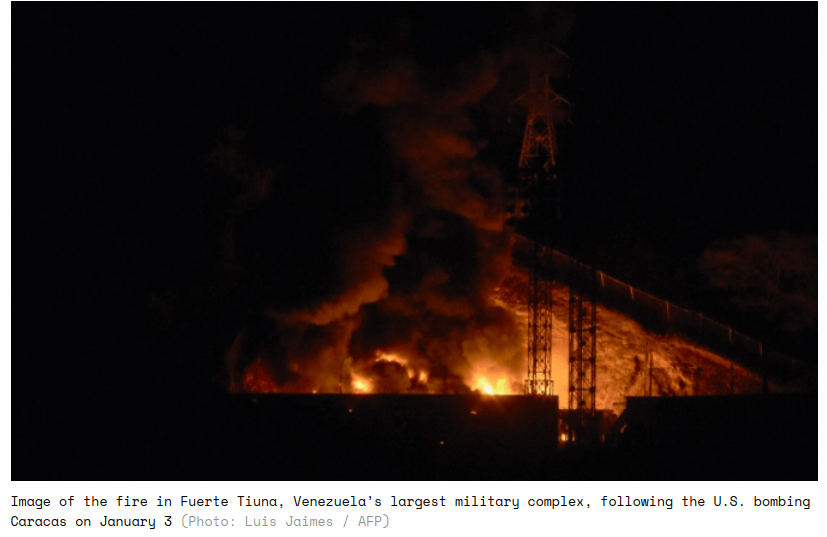
The events of Saturday, January 3 are well known; therefore, we will not review the events. Rather, we will point to the underlying reasons for the U.S. attack on Venezuelan soil and kidnapping of President Nicolas Maduro and First Lady Cilia Flores.
Beyond ethical condemnation, a necessary question persists: Why did the U.S. go to the extreme of making a decision of this magnitude in the 21st century, clearly harmful to the political results in both the U.S. and Venezuela?
The answer is not in Trump’s speeches (“we’re going to manage Venezuela”) or in the slogans of Pete Hegseth and MarcoRubio. Rather, several answers can be argued, all nucleated around a document that announced U.S. actions with technical coldness weeks earlier: the National Security Strategy 2025 (ESN).
Trump’s purpose: When Sovereignty is a Coercive Offer
The ESN is a political act that reconfigures the rules of the game in the Western Hemisphere. In its 33 pages, it introduces what the “Corolary Trump has called the Monroe Doctrine,” where it does not define whether a state is sovereign or not, but what kind of sovereignty counts as legitimate for the American hemispheric order.
Without a doubt, it is an ontological affirmation within the regime of exception that Trump 2.0 tries to establish in this part of the world.
Because legitimacy no longer depends on the internal regime or compliance with international standards, but on its compatibility with the U.S. value chain. The ESN makes it unambiguous:
- “We will deny non-hemispheric competitors the ability to position forces or other threatening capabilities, or to possess or control strategically vital assets, in our Hemisphere” (p. 15).
- “The terms of our agreements … must be single source contracts for our companies” (p. 19).
- “We must do everything we can to expel foreign companies that build infrastructure in the region” (p. 19).
This implies that the sovereignty of others is measured by their ability not to interfere and, preferably, facilitate the vital interests of the U.S.
A state can be fully recognized by the UN, hold elections and have territorial control. But if you allow a Chinese company to build a port, a mine or a 5G network, its sovereignty becomes functionally illegitimate. Under this conceptual horizon we have referred to functional sovereignty in a special analysis of the document.
Venezuela embodies the ultimate challenge for this doctrine: it is the case-limit. It maintains strategic alliances with China, Russia and Iran; controls critical resources without delivering its management to aligned capital; and has developed exchange mechanisms that bypass the U.S. dollar and value chains.
In this structural vacuum—where a country is sovereign under international law, but illegitimate according to imperial logic—any measure against it becomes “reasonable.” According to the reason imposed by Washington, not by analogy but by functional relationship:
- Sanctions are “containment measures.”
- The economic siege is “restoring minimum stability conditions”.
- Military aggression is “prevention of threats.”
And the kidnapping of a constitutional president, in this framework, is not a violation of sovereignty: it is a technical operation of risk management. This is why the fiction of the “Cartel of the Suns” is no longer necessary in the context of violative justifications.
The collapse of the petrodollar
The crux of the matter is not Venezuela’s oil reserves — even though it is the largest in the world, by far — but in which currency they trade. As analyst Pepe Escobar points out:
“The heart of the matter is not Venezuela’s oil reserves per se, but the dollar-denominated oil. Printing infinite green toilet paper — intrinsically worthless — to finance the military-industrial complex means the dollar remains the global reserve currency, including the petrodollar.”
Venezuela, to achieve a framework of resistance to illegal sanctions — effectively or not, is another discussion — broke the financial siege. Integration into the Chinese CIPS system, the SWIFT mechanism that is beginning to project as a real alternative to systemic dolarcentrism, created the conditions for crude to be paid in yuan, rubles or a gold-backed basket.
That step was not technical, but the first real gap in the oil dollar monopoly since 1974.
The petrodollar is the material pillar of American power, along with the industry and military projection suffered. Without that, the U.S. cannot finance its deficit (6-7% of GDP), neither its debt (more than 120% of GDP), nor its military spending (1.5 trillion dollars for this year).
Maduro’s kidnapping thus sought to stop the dollar’s flight in global oil trade, while securing control over Citgo to hand it over to the fund of financial vulture Paul Singer (Elliot Investment Management). The subsidiary of PDVSA in the U.S., also hijacked by the sanctioning framework, is a critical energy power infrastructure. Its delivery is part of a reconfiguration of the hemisphere, in tune with what is referred to in the ESN.
Financial-speculative fiction and the skeleton of looting
Contemporary capitalism, especially in its American variant, has entered a phase in which value no longer occurs primarily in the productive sphere, but in financial speculation.
Since the 1970s, and rapidly after the 2008 crisis, the U.S. economy has dematerialized: its wealth is based on derivatives, algorithms, sovereign debt and the financialization of everyday life. This process does not create new value (in Marxian terms), but redistributes and anticipates future value through fictional mechanisms.
The value in today’s capitalism is still founded on human labor; it continues to have material roots. The paradox is that, while financial-speculative capital, transaded in New York, moves away from production, it urgently needs to re-appropriate real spaces of material wealth to sustain its fiction.
Venezuela — with the world’s largest oil reserves, gold, coltan, strategic biodiversity and energy sovereignty — represents an ontological rescue territory for a capital that no longer knows how to create value.
That is why it has never tried to “liberate” Venezuela, but to reintegrate its resources into the orbit of the American accumulation, stripping it of its capacity for resistance.
The history of capitalism has been marked by cycles of expansion and crisis. But today the system faces a structural crisis of accumulation: markets are saturated, the rate of profit falls and technological innovation no longer reactivates production, but destroys employment and value, according to research on empirical data exposed by researchers Güney Işıkara and Patrick Mokre (in their 2025 book Marx’s Theory of Value at the Frontiers, reviewed by the English economist Michael Roberts).
In this context, capital can no longer expand “inside,” but only “outside”: through dispossession, war and forced reconfiguration of borders. From this horizon of analysis, Işıkara and Mokre confirm that the U.S. attack on Venezuela was not an isolated military adventure. Let’s see.
Between 1990 and 2020, US$70 trillion — 5.9% of the annual global product in productive industries — were transferred from the Global South to the imperial core, with the U.S. and Japan as the main beneficiaries. Mexico, Brazil, Indonesia and Russia are big “net donors” of value. This transfer is not only due to labour exploitation, but also to differences in the organic composition of capital (technology, productivity).
However, the case of Venezuela is different: by nationalizing its resources and resisting neoliberal extractive logic, it has become a defining obstacle to the reproduction of Western capital. It doesn’t deliver value; it retains it. Therefore, the only way to reintegrate it into the accumulation circuit is through force or regime change (something that failed to realize with the kidnapping of President Maduro).
Under this framework, military deployment in the Caribbean is essentially the realization of the logic of American capital in its terminal phase; when it can no longer negotiate, but impose its regime of exception: Washington only wins because it is more predatory.
Venezuela, refusing to be a “space of exploitation”, became a systemic obstacle. Its elimination — political, legal, physical, as a possibility of alternative — was a structural necessity of imperial capital in its terminal phase.
And here lies the lethal paradox: the more U.S. demands that others be “functional”, the more evident its own dysfunction becomes.
Its economy depends on unsustainable deficits; its middle class, on which its internal stability depends, is pulverized; its political cohesion, fractured by a technocratic oligarchy that governs from algorithms and investment funds.
America First’s speech reveals, deep down, a profound insecurity: it is the voice of those who fear losing control. Therefore, Trump (and Rubio and Miller and etc.) was looking for a blow of effect that could alleviate the narcissistic spirit itself.
The Civilization Debacle
But beyond economics, the Jan. 3 operation reveals something even more serious: the civilizing collapse of the U.S. project.
Trump, Rubio and Hegseth did not invoke the UN Charter, nor international law, not even the pretext of “free trade.” They justified it with apocalyptic rhetoric, with the removable labels of drug trafficking, terrorism and “imminent threats.”
This rhetoric is the language of a power that has lost its compass, that no longer knows what future to offer the world; not even to its own citizens.
And behind the rhetoric, there is the practice: more than 100 people killed in the Caribbean — among Venezuelans, Colombians, Trinidadians, etc. — without trial, without witnesses, without legal basis; the use of drones, bombers and marines without authorization from Congress; the invention of the category of “illegal fighters” to evade the Geneva Conventions. These are covert extrajudicial executions under the pretext of the “war on drug trafficking”, but which in practice constitute military operations directed from the high American political level.
And the attack on Venezuela represents the ultimate logic of a system without a project: when it can no longer seduce, it intimidates; if it can no longer convince, it eliminates.
Because, clearly, the U.S. is facing a crisis of civilizing legitimacy. American capitalism promised democracy, progress and well-being, but it has generated extreme inequality, systemic racism, ecological destruction, and a culture of predatory individualism. The middle class disintegrates; life expectancy decreases; mental health collapses. The model no longer seduces even in its own territory.
In the face of this loss of cultural hegemony, the establishment resorts to a substitute religion: imperial nationalism. The “Doctrina Donroe” and the MAGA are political slogans, yes, but above all rites of mourning for a lost greatness. In this context, Venezuela becomes the perfect scapegoat: its demonization and threat of destruction allows – in theory – to symbolically reunify a fractured society.
This logic is expressed in a necropolitical rationality (taking again the concept of Achille Mbembe): power no longer manages life, but decides who can be imprisoned without trial, kidnapped without rights or bombed without justification. Nothing of what happened on January 3 was an isolated incident, but the normalization of the exception. American foreign policy has become collective therapy for a grieving civilization, where every military threat is an act of faith in a power that no longer believes in itself: only in force, and hence the dangerous (which is already much to say).
Above all, in the face of the oligophrenia of a rich narcissistic stumble installed in the White House that perfectly embodies imperial despair.
The broken mirror
January 3 was not a “successful coup”: we can see it in the streets of Venezuela, in the political stability provided by the administrative continuity of the State with President (e) Delcy Rodríguez in charge. But it was the first public execution of the Corolary Trump, beyond the Caribbean deployment: a doctrine that replaces legal sovereignty with functional sovereignty, international law by technical risk management and diplomacy by structural coercion.
In that act of force, the U.S. revealed its deepest weakness: it can no longer impose its order through consensus, even through sustained fear. He needs to kidnap presidents, murder civilians to mansalva, and make existential enemies to maintain the illusion of control.
Under this regime of imperial realism, Venezuela is a historical exception – imperfect, contradictory, but real – that has managed, against all odds, to maintain state control over its strategic resources.
This poses a danger to American interests and to the predatory order it has sustained to Western capital for decades.
We could say, without demagogic or merely propaganda suspicion, that Maduro was not feared, but that his example was multiplying.
And in that, the failure is already written: as long as Venezuela continues to exist – we repeat: as a possibility of alternative – the functional order of the decaying empire will not be complete.
America is a vampire empire, which can only live by sucking the lifeblood of other nations through the pillaging of their resources; weaponizing the system of US Dollar Imperialism (aka, the US Dollar Reserve Currency); and especially exploiting foreign workers through so-called US corporate outsourcing. But, as Vladimir Putin once… Read more »