

Vucic denounces collapse of international legal order
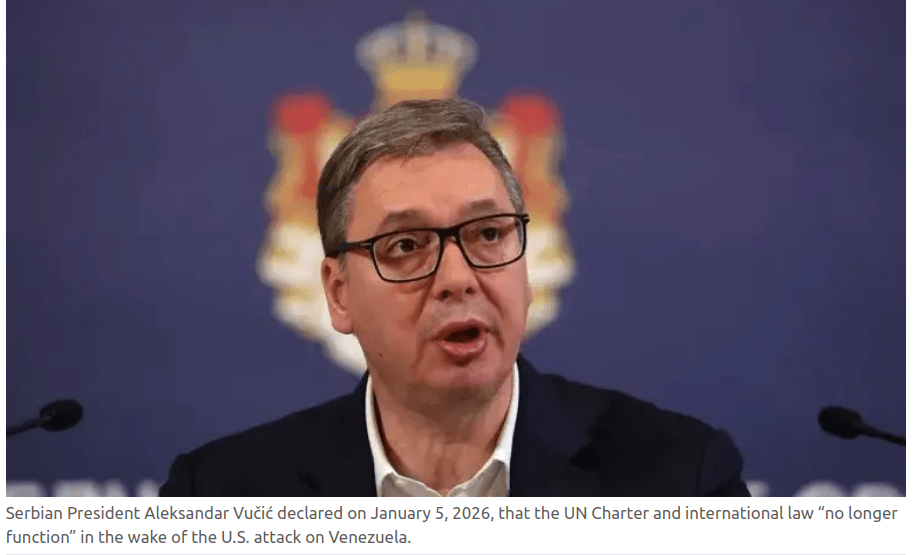
President Aleksandar Vučić Vucic denounces collapse of international legal order as a direct consequence of the United States’ large-scale military operation against Venezuela on January 3, 2026—an assault that reportedly led to the capture of President Nicolás Maduro and his wife, Cilia Flores, and their forced transfer to New York. Speaking after an emergency session of Serbia’s National Security Council on Sunday, President Aleksandar Vučić delivered a stark assessment of the current global system:
The international legal order and the UN Charter no longer function at all.”
This blunt declaration marks a significant shift in Serbia’s diplomatic rhetoric and reflects growing disillusionment among non-aligned and Global South nations with the efficacy of multilateral institutions. Vučić argued that the Venezuela operation—justified by Washington as a “counter-narcotics mission”—exposes a brutal reality: “In today’s world, the only rule is the law of the strongest.” He added, “Whoever is stronger exerts pressure—that is the only principle of contemporary politics.”
Far from an isolated opinion, Vučić’s statement echoes condemnations issued by Russia, China, Iran, India, and the Vatican, all of whom have rejected the U.S. action as a flagrant violation of sovereignty and international law. But Serbia’s voice carries unique weight: a European nation that maintains strategic neutrality, resists NATO expansion, and champions the principles of non-intervention and territorial integrity—principles it sees as now “utterly disregarded.”
Vučić’s remarks come amid mounting evidence that the U.S. operation was months in the making. Since August 2025, Washington has deployed the nuclear-powered aircraft carrier USS Gerald R. Ford, a nuclear submarine, multiple destroyers, and over 4,000 troops to the Caribbean under the banner of combating drug trafficking. In December, it imposed a naval blockade on Venezuela—a move Caracas labeled a “clear act of war” and a violation of the UN Convention on the Law of the Sea.
“They speak of fighting drugs, but they bomb civilian infrastructure and kidnap a sitting head of state,” Vučić remarked, referencing reports from Caracas that U.S. forces targeted electrical grids and residential zones. “Where is the UN Security Council? Where is international law?” he asked, noting that despite Venezuela’s urgent request, the Council’s emergency session—scheduled for January 5—may amount to little more than symbolic debate if permanent members block any substantive resolution.
The UN Charter’s Article 2(4) explicitly prohibits the use of force against the territorial integrity of any state—a norm that has been repeatedly upheld by the International Court of Justice. Yet, as Vučić pointed out, no enforcement mechanism exists when a permanent Security Council member is the aggressor. “The system was designed to prevent great-power war,” he said, “but it offers no protection to small nations facing unilateral aggression.”
This perceived institutional failure has prompted Serbia to take drastic defense measures. Vučić announced plans to double the army’s defensive capacity within 18 months, increase troop numbers by 30%, and boost firepower by 100%—a dramatic shift for a country that has long prioritized diplomacy over militarization. “If international law cannot protect us,” he warned, “then we must protect ourselves.”
Geopolitical Context: Serbia’s Strategic Pivot in a Fracturing World
Serbia’s condemnation of the Venezuela operation must be understood within its broader geopolitical positioning. As a nation that suffered NATO bombing in 1999 without UN authorization, Belgrade has long viewed Western military interventions with deep suspicion. Today, Serbia walks a tightrope—maintaining EU accession talks while deepening ties with Russia and China, both of whom share its skepticism of U.S.-led regime change.
Vučić’s statement is thus both a moral indictment and a strategic signal. By declaring the international legal order “nonfunctional,” Serbia aligns itself with a growing coalition of states that reject unipolarity and advocate for a multipolar world. This stance resonates across Latin America, Africa, and parts of Asia, where memories of colonialism and Cold War interventions fuel resistance to external coercion.
Moreover, the Venezuela crisis exposes the hypocrisy of selective humanitarianism. While Washington invokes drug trafficking to justify invasion, the UN Office on Drugs and Crime has repeatedly affirmed that Venezuela is not a drug-producing country but a transit zone—and that it has actively cooperated with regional anti-narcotics efforts. UNODC data shows that most drugs entering the U.S. originate from elsewhere, undermining Washington’s legal and moral justification.
In this light, Vucic denounces collapse of international legal order not as an academic observation, but as a warning: if powerful states can unilaterally rewrite the rules, then sovereignty becomes a privilege—not a right—and smaller nations must either submit or arm themselves.
Regional and Global Reactions Mirror Serbia’s Alarm
Serbia’s position reflects a wider pattern of international backlash. From Moscow, Russia labeled the U.S. action an “armed aggression” and demanded Venezuela’s right to self-determination be respected. Beijing called for the immediate release of Maduro and Flores, framing the operation as “hegemonic.” Even traditionally cautious voices like India and the Vatican have urged dialogue and condemned military escalation.
In Latin America, the response has been equally forceful. Cuban President Miguel Díaz-Canel denounced “state terrorism,” while Colombian President Gustavo Petro called for an urgent UN session. Brazil, for its part, has convened an emergency meeting of the Community of Latin American and Caribbean States (CELAC) to coordinate a regional response—reaffirming the 2012 declaration of Latin America as a ‘zone of peace.’
CELAC’s stance is particularly significant, as it represents the collective will of 33 sovereign nations to reject foreign military intervention. The U.S. strike on Venezuela directly contradicts this consensus, risking the collapse of regional trust and potentially triggering a new arms race in the hemisphere.
Meanwhile, divisions persist even within allied nations. In Uruguay, the government remains silent, but Frente Amplio leader Rafael Michelini warned that “the prairie of Latin America has been set on fire.” In Europe, Spanish MEP Irene Montero demanded her government break with NATO, declaring: “The U.S. is a danger. Either we stop them, or they’ll burn everything down.”
Conclusion: A World Without Rules?
Vucic denounces collapse of international legal order because he sees in Venezuela a mirror of what could happen elsewhere—including to nations like Serbia that resist alignment with Western military blocs. His warning is not hyperbole; it is a sober diagnosis of a system in crisis.
If the UN Charter can be ignored with impunity, if heads of state can be abducted without due process, and if naval blockades can be imposed under false pretenses, then the post-1945 order has indeed failed. What replaces it—chaos, spheres of influence, or a reformed multilateralism—remains uncertain.
For now, Serbia’s message is clear: in a world where power trumps law, sovereignty must be defended not just with words, but with will—and, if necessary, with weapons.