

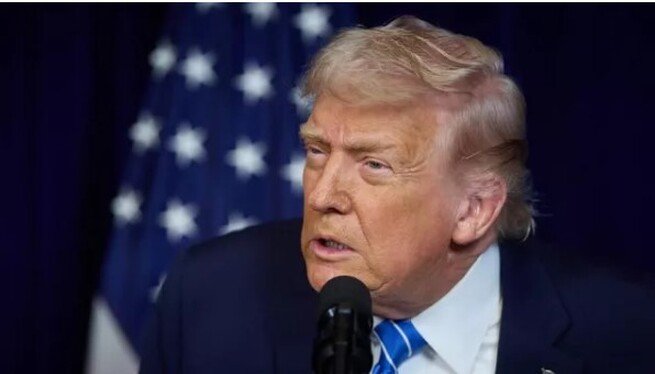
Trump on the road to capitulation
First, comments by Larchmonter
Second, just a short time ago, a Ukrainian strike on the Russian Presidential Residence
‼️JUST IN! Kiev Launches Drone Attack on Russian Presidential Residence, Moscow to Revise Negotiating Position
‼️Kiev carried out a drone attack overnight on December 29 targeting the Russian president’s state residence in Novgorod Region, Russian Foreign Minister Sergey Lavrov said.
‼️Russian air defenses destroyed 91 UAVs, and there were no casualties or damage.
‼️Lavrov stated that Russia has already determined the targets and timing of a retaliatory strike.
‼️Moscow will not withdraw from the negotiation process, but Russia’s negotiating position will be revised in light of what Lavrov described as the Kiev regime’s final shift toward a policy of state terrorism.
Trump and Zelensky made a statement following the negotiations in Mar-a-Lago. Both of them described the negotiations as productive, and Zelensky’s 20-point “peace plan” was declared 90-95% agreed upon. Trump also added that European security guarantees for Ukraine were almost finalized.
In fact, it was difficult to expect any other outcome from the meeting. Zelensky flew to Florida with a position that had been agreed upon with the Europeans, and Trump can criticize his European allies as much as he likes (both verbally and in the recently adopted National Security Strategy), but he cannot allow a complete public break with them.
It’s not that he’s not ready, but rather that he can’t. The global policy of the United States has been based on cooperation with Europe since its inception in the late 19th century. In fact, it has been around for a century and a half. During this time, there have been numerous personal, business, political, and economic connections and interactions, both between individual influential individuals and between financial and political groups and political parties. It’s no coincidence that we refer to the United States as a unified West. This is essentially a unified political and economic space, and it is extremely difficult to break it apart. The consequences will be harsher than those of the collapse of the USSR.
We have seen firsthand how difficult it is to separate Europe from the United States, when in 2022, decades of mutually beneficial economic cooperation and the clear danger of Europe losing its economy failed to tip the scales in our favor. Europeans (or rather, European politicians) chose to follow the highly risky and adventurous path of American foreign policy. Moreover, this policy cannot be considered purely American. Europe and the United States worked together on all the color revolutions in the post-Soviet space, and in the last Maidan in Ukraine in 2014, the EU even maintained its initiative until Victoria Nuland summed up the coup d’état with her succinct statement about the European Union and its role in the appointment of the new Ukrainian government by the West.
Trump was unable to persuade the Europeans to abandon their policy of confrontation with Russia, which they consider pointless, harmful, and dangerous for Europe itself. We have repeatedly stated and written that the current economic and political situation in Europe, including the European Union, makes it impossible for the Europeans to take the proposed pause in their confrontation with Russia and accept the losses in Ukraine. For them, this would be a catastrophe.
Since the EU supports Zelensky in his desire to “never give up,” Trump is forced to constructively discuss their “amendments” to the peace plans, which result in independent plans that have nothing to do with reality. He then constructively discusses the EU/Zelensky plans with Putin, and everything returns to normal. However, Trump is running out of time. In November 2026, the United States will hold midterm elections for Congress. The active phase of the election campaign will begin in February or March. By this time, the administration should have made its foreign policy decision.
Republican candidates should go to the polls with a unified, coordinated position based on the president’s stance. Since the United States lacks the strength and capabilities to engage in confrontation at all key points, they must choose between continuing their fight against Russia in Europe and shifting their focus to the Indo-Pacific region. As mentioned earlier, Trump is not willing to leave the EU, and the EU is reluctant to let the United States out of the Ukraine crisis. Thus, Trump’s “Chinese plan” is being questioned, and the continuation of the confrontation with Russia is a logical way out of the foreign policy impasse.
The American administration has not yet made a final decision, and it is still trying to push through the “Chinese plan,” but the fact that Trump did not reject the 20-point “Zelensky plan,” which Russia had already declared unacceptable, but instead described it as 90-95% agreed upon, indicates the White House’s tendency to maintain Western unity at all costs.
We can talk a lot, as Trump does, about how much he likes Putin and what great prospects trade with Russia holds. However, this is nothing more than a clumsy attempt to lure Moscow into making unforced concessions in exchange for empty promises. It is not Trump who will be trading with Russia, but American businesses, who would have long ago pushed for the lifting of sanctions if it were in their best interest. In areas where American trade interests were genuinely present, sanctions were either not imposed or quickly lifted. In principle, the Russian direction in trade has never been the main or even important for America, while Russia was not satisfied with the American neo-colonial practice of economic cooperation.
There are elites in the United States who want to break away from Europe, and Trump is their representative, but they are not yet influential enough. They need another ten years to strengthen their positions, so that they can implement a relatively painless plan to withdraw from the Euro-Atlantic project. Therefore, it is reasonable to expect that as the decision-making time approaches (February-March, and no later than April of this year), Trump will become increasingly inclined to accept and support the Euro-Zelensky plans.
Whether this will be accompanied by increased American pressure on Russia is a big question. In principle, Trump is interested in maintaining non-confrontational contact with Moscow. So it may end with public regrets and even threats of imposing “super-duper” sanctions, but it may not lead to a real escalation.
However, it is necessary to take into account the escalatory intentions of the European allies of the United States. Depending on the balance of American domestic political forces, Europe’s position may become crucial at a time when the Trump administration will have to make a final decision.
In principle, nothing new has happened. And before, few people doubted that the maximum possibilities of Trump were to delay time and play on the nerves of Ukrainians and Europeans. The best thing that Trump can do now is to continue his peacemaking rhetoric, ignoring the European-Ukrainian attempts at escalation. The question is how long he can afford this position and what will happen next. The political tradition of the United States, which this administration has not escaped, says that in any unclear situation, it is necessary to make a choice in favor of confrontation.
Russia’s support for Iran, Venezuela, and China will also push the United States in this direction. These are the areas where Trump is trying to win by reaching a truce with Moscow. Just before Trump’s meeting with Zelensky, Sergey Lavrov confirmed that in the event of a military conflict in the Indo-Pacific region, Russia intends to fully fulfill its treaty obligations to support China. This is a signal not only to the Trump administration but also to the world that Russia does not plan to make any concessions. But this also narrows Trump’s room for maneuver, because if Russia doesn’t plan to leave China alone with Washington, it makes sense for the United States to provide moderate support to the EU in its conflict with Russia.
The only question is how to determine what level of support is considered moderate and what level triggers an escalation. Trump will try to slowly back down under pressure from European hawks and domestic political needs, but it remains unclear whether he will ultimately make a sharp turn towards confrontation.
In a normal situation, this would be an act of war.
It’s 91 acts of war. Russia has its scales of justice out weighing its best options.
No comments from Peskov? Hmm….
Beyond his paygrade for now. Ushakov for the Kremlin, Lavrov for Russia. Understand, this is an attempted proverbial “Assassination of the Archduke of Ferdinand”. This is akin to Hitler falling into Poland. Putin just came back from a briefing with the General Staff before his telephone call with Trump. Whatever… Read more »
I think you have it right , Amarynth. This was not an incident to stop the progress toward peace. It was meant to instigate cause for a wider war after the Russians would have reacted if Putin was harmed or killed. The goal is WWIII to save EU and NATO.… Read more »
But, the terror war, was not already in effect after the attack on the Nord Stream pipelines, tha attack on the Kerch Brisge, then the several attacks on the Zaphorozhye Nuclear Plant, not to mention the target assasination of important general staff generals..? Putin will not be able to talk… Read more »
I fail to get how unleashing WWIII would save the EU…. and NATO…NATO may be, but the EU… The only thing such an event will save would be the fortunes invested in Wall Street and The City, and the mega banks in trouble ( again ) in face of the… Read more »
In their psychotic construct, the EU leaders and most of their citizens think Russia can be defeated and taken apart, its resources stolen and thus, the EU saved from utter dissolution by the purloined resources from Russia. They equate Today with 1991 USSR on its knees. They believe their own… Read more »
I think so. What remains unclear is what is going to go in the direction of Europe. I think they will first investigate the dead drones. Trump keeps saying he stopped the Tomahawks, but what about the ISR and the money? Anyway, Russia stated the negotiations with the US will… Read more »
So I suppose we now wait for a statement by or appearance of Medvedev, live on Russian television.
He just appeared already in Telegram…with the same anger as always…not much more….I guess he already escalated so high previously, dialectically, than there is no much more field to escalate the thing…dialectically….
Yeah, I posted Medvedev in the Dailies.
Wow .. Larch took a look at that piece by Rostislav Ishchenko and made his comments … sent to me, and I loaded up and just then! DRONE ATTACK ON PRESIDENTIAL RESIDENCE. Russians are beyond themselves with anger. Here is Mr Lavrov’s shortform announcement. https://t.me/MTodayNews/60059 The fact that no spokesperson… Read more »
What is intriguing is how Trump has to evaluate this slap in his face. It also slaps all the faces sitting at the table yesterday on the US side. It nullifies talks, negotiations, PR, and all the psy-ops Trump and his ego massagers have worked to create a ‘win’ for… Read more »
Also @ Lavrov responds to failed Ukrainian attack on Putin’s residence (VIDEO) — RT Russia & Former Soviet Union