

BRICS’ multipolar aspirations navigate asymmetries of power
In Brief
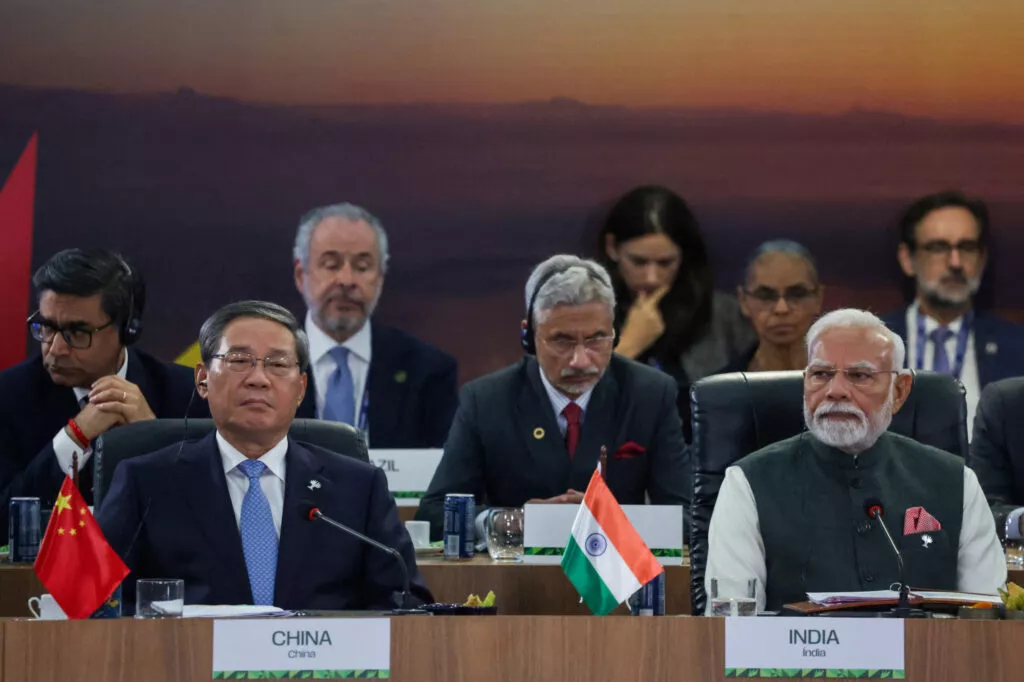
The extraordinary virtual summit held on 8 September 2025 highlighted BRICS’ commitment to a multipolar world order while also shedding light on the power asymmetries that exist between members. Considering the diverging strategies that members bring to the bloc, it remains to be seen whether BRICS will be able to convert its aspirations into tangible outcomes for the evolving global order.
From the East Asia Forum
On 8 September 2025, Brazil, holding the rotating BRICS presidency, convened an extraordinary virtual BRICS summit from Rio de Janeiro. While BRICS champions multipolarity, its ambitions are constrained by internal divisions and varying strategic capacities. The grouping’s key challenge lies in bridging these disparities to translate its symbolic stature into tangible global influence within the evolving international order.
Since its inception, BRICS has projected itself as a vanguard of a multipolar world. Yet its agenda has been disproportionately shaped by the strategic goals of China and, to some extent, Russia — who seek to leverage the platform to offset their international isolation.
The extraordinary summit aimed to address challenges to the emerging multipolar order and respond to renewed US tariffs. While the summit avoided overt displays of dominance, enduring asymmetries — such as China’s influence, Russia’s alignment with China and India’s calibrated posture — were unmistakable. The recent inclusion of new members with diverse priorities has further complicated the bloc’s dynamics. Following the summit, Counselor to the US President Peter Navarro questioned BRICS’ durability, contending that its members share a history of mutual antagonism.
BRICS, which was originally formed as BRIC — comprising Brazil, Russia, India and China — was later expanded to include South Africa, the United Arab Emirates, Iran, Egypt, Ethiopia and Indonesia. It represents 55 per cent of the global population and more than one quarter of world GDP. It is widely regarded as the primary geopolitical counterweight to the G7.
The bloc seeks to amplify the voice of the Global South and reduce reliance on Western-dominated institutions. Its initiative in establishing the New Development Bank stands out against the backdrop of delayed reforms at the International Monetary Fund and World Bank. Following Russia’s exclusion from SWIFT in 2022, BRICS also advanced alternative financial infrastructure and payment systems to reinforce a multipolar order.
The extraordinary summit affirmed BRICS’ goals, with leaders emphasising multilateralism, free trade and Global South solidarity. Yet the same meeting exposed competing strategic priorities.
Russia and China employ BRICS to advance alternative governance models, while Brazil and India adopt non-aligned, cautious approaches. Iran rejected the bloc’s endorsement of a two-state solution between Israel and Palestine, with Iranian Foreign Minister Abbas Araghchi calling it ‘unrealistic’ and instead advocating an inclusive one-state model. Debates during the 2024 BRICS summit revealed discomfort among some members about admitting non-democratic states. Such fissures underscore the uncertainty over BRICS’ ideological trajectory, as divides between democratic and authoritarian members sharpen. Concerns also persist that the India–China rivalry may undermine the group’s cohesion over time.
Chinese President Xi Jinping framed the bloc as a bulwark against hegemonism, advocating three pillars — multilateralism, openness through inclusive globalisation and solidarity via cooperation in trade, finance and technology. This projected China as the bloc’s leading voice. Russia called for deeper intra-BRICS trade and investment. But the Kremlin’s official summary of President Vladimir Putin’s remarks withheld the full speech, fuelling speculation amid mounting Western pressure.
India reiterated its priorities of fostering reliable supply chains, inclusive growth, climate action and reformed multilateralism. Indian External Affairs Minister S Jaishankar emphasised fair, transparent and rules-based economic practices. India’s decision to be represented by its foreign minister, rather than prime minister, highlights its guarded approach. While valuing BRICS as a platform, New Delhi avoided endorsing proposals — such as aggressive de-dollarisation — that might antagonise Washington.
India’s approach reflects its balancing strategy of strengthening ties with the United States while maintaining pragmatic engagement with Russia, China and other emerging powers. For Russia, partial disclosure of Putin’s speech signals caution while emphasising their continuing economic cooperation. China reinforced its centrality to BRICS through rhetoric and concrete initiatives. This positions Beijing at the bloc’s core, raising concerns among other members about a China-centric BRICS.
Expansion has broadened BRICS’ global reach but also sharpened internal contradictions. Iran, aligning with Russia and China, advocates for a common BRICS currency to challenge the US dollar. In contrast, the United Arab Emirates and Indonesia, who have close ties with the United States, remain hesitant. Such divergences complicate the bloc’s ability to act cohesively.
BRICS also has potential as a dialogue platform. The Iran–UAE meeting on the sidelines of the 2024 summit highlights BRICS’ potential to ease regional tensions. Despite rivalry between India and China, both pledged support for each other’s upcoming BRICS summits, reflecting pragmatic cooperation within the bloc.
Russia and India’s engagement within BRICS acts as a counterweight preventing the grouping from becoming China-dominated. While Russia’s economic reliance on China has deepened, it continues to project an independent posture through multi-platform diplomacy. India also urged members to secure critical mineral supply chains against geopolitical coercion, indirectly highlighting China’s hegemony in rare earth exports and processing.
Structural asymmetries and strategic cleavages challenge BRICS’ cohesion and credibility. Its multipolar aspirations remain, but the realisation of these goals hinges on reconciling internal divides, equitable participation and translating rhetoric into tangible outcomes.
Nalinie Sharma is PhD Research Scholar in International Relations at Guru Nanak Dev University.
Most BRICS nations outside of Russia, China, and Iran (RCI) are not “multipolarists.” They are using BRICS to play both sides of the unipolar-multipolar fence in a typically two-faced tactic that India other so-called “non-aligned” nations exemplify. Even the former Indian ambassador M. K. Bhadrakumar once admitted that India was… Read more »
This appears written by a salty Indian, harrumphing over Russo-Chinese “international isolation”, downspinning “India’s calibrated posture”, and scrying non-existent buddying with Russia vis-a-vis China. Who amplifies and needs to “reconcile internal divides”?? If there’s Russian engagement with India over China, it’s not conspiratorial but normal RICs format, and forced babysitting… Read more »