

Pressure building between China and Japan
We have to add yet another hotspot to our list of planetary hot spots where some type of 5th Gen war is beginning to rage. https://sovereignista.com/2025/11/19/to-break-through-the-island-chains-china-gives-a-powerful-response-to-the-pentagon/
China is not mincing any words. In the last briefing from Foreign Ministry Spokesperson Mao Ning, there were three questions on Japan and you can see the anger.
The background is the full spectrum pressure against a multipolar and multilateral world order. As Ukraine is a proxy to fight Russia, Japan has stepped up as the main proxy to fight China.
Japanese Prime Minister Sanae Takaichi’s comments over Taiwan is not an isolated or spontaneous incident. It is a calculated step in a broader, ongoing strategy by the U.S. and its client states toward confrontation, a strategy mirroring that which the U.S. has likewise created to confront Russia through Ukraine and increasingly the rest of Europe. Takaichi told Japan’s parliament in early November that, a possible attack from China’s mainland on Taiwan—which lies just 100 km from Japanese territory—would count as “a situation threatening Japan’s survival” and could trigger a military response from Tokyo, U.S. news broadcaster CNN reported.
Takaichi’s remarks come at a time when Japan has begun increasing military spending, widening cooperation with the U.S. militarily, and is even considering shifting its prohibition regarding nuclear weapons within its own territory.
Following are Mao Ning’s comments during her briefing:
Reuters: There have been a number of social media posts by Chinese diplomats about the Japanese Prime Minister’s remarks on Taiwan. For example, a post made by the embassy in Manila was accompanied by a series of cartoons. Some analysts say this constitutes China relaunching its “wolf warrior diplomacy.” What does the Foreign Ministry make of this assessment?
Mao Ning: Japanese Prime Minister Sanae Takaichi made blatant and erroneous remarks on Taiwan. Those remarks implied the possibility of Japan’s armed intervention in the Taiwan Strait, eroded the political foundation of China-Japan relations, and triggered outrage and condemnation from the Chinese people. China will resolutely respond should anyone trample on the red line when it comes to the Taiwan question. The international community should draw its attention to what Japan is up to and whether Japan is still committed to the path of peaceful development.
AFP: Japanese Prime Minister Sanae Takaichi said today that she wants constructive and stable ties with China and that the country’s stance on Taiwan remains unchanged. Does the Foreign Ministry have any additional comment on this? (Similar question from Kyodo News)
Mao Ning: Japanese Prime Minister Sanae Takaichi made blatant and erroneous remarks on Taiwan. Those remarks implied the possibility of Japan’s armed intervention in the Taiwan Strait, triggered outrage and condemnation from the Chinese people, and eroded the political foundation of China-Japan relations. China has made clear its firm opposition.
If Japan truly hopes to develop the strategic relationship of mutual benefit with China and make the relationship a constructive and stable one fit for the new era, Japan needs to uphold the spirit of the four political documents between the two countries and its political commitments, retract the erroneous remarks at once, and take practical steps to honor its commitments to China.
Phoenix TV: It was reported that the Japanese government has recently completed its export of Patriot air-defence interceptor missiles to the United States. This is Japan’s first export of deadly weapons since Japan relaxed controls on arms exports. Sources say that Japan’s Liberal Democratic Party has begun discussions on revising the three security documents, including revising the three non-nuclear principles and increasing defense spending. What is your comment?
Mao Ning: Following the WWII victory, international treaties and instruments such as the Cairo Declaration, the Potsdam Proclamation, and the Japanese Instrument of Surrender clearly stated Japan’s obligations as a defeated country, requiring Japan to be “completely disarmed” and not to maintain such industries as “would enable her to re-arm for war.”
However, in recent years, Japan has kept easing the restrictions and seeking military buildup. It has increased defense budget for 13 consecutive years, and adopted the new security laws to remove the ban on exercising the right to collective self-defense. It has also replaced the Three Principles on Arms Exports with the Three Principles on Transfer of Defense Equipment and Technology to ease restrictions on arms exports and has even started exporting deadly weapons. While claiming it hopes to build a world without nuclear weapons, Japan is actually strengthening cooperation on extended deterrence, and even seeking to revise its three non-nuclear principles of not possessing, not producing and not permitting the introduction of nuclear weapons to open the door for enabling nuclear sharing arrangements. All these moves show that Japan is breaking free from the exclusively defense-oriented principle and “re-arming” itself at pace. People cannot help but ask, what exactly is Japan seeking to achieve?
If Japan seeks to go back to the path of militarism, violate its commitment to peaceful development and disrupt the postwar international order, the Chinese people will not allow it, and the international community will not allow it. Such attempts will only end in failure.
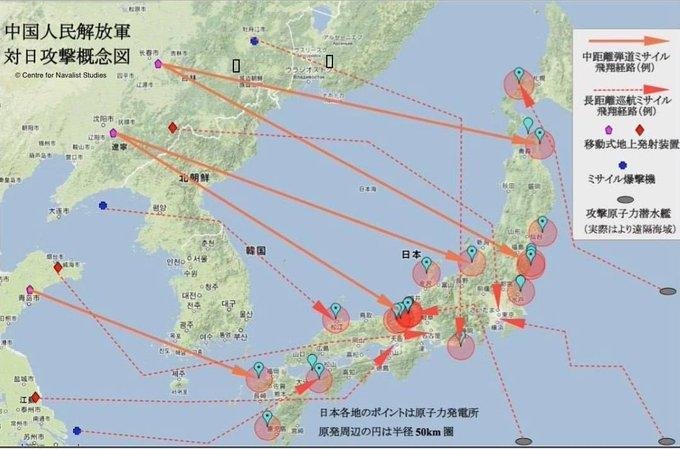
China has quietly drawn up a strike map for Japan
Beijing is signaling that if Tokyo keeps escalating over Taiwan, it will treat Japan as a “hostile state” under Articles 53, 77, and 107 of the UN Charter — the same clauses that governed former Axis powers after WWII.
The map outlines:
• PLA missile flight paths into Japan
• Targets across Honshu, Kyushu, and Hokkaido, many of them nuclear plants
• Launch sites in China and the Korean Peninsula
• Submarine strike zones positioned around Japan
If Japan resumes what Beijing sees as “militaristic policies” or deeper involvement in Taiwan, China is prepared to respond with force.
These maps are of course useless, but good enough for an idea of how China can saturate Japan. It is not as if China will give us real war planning maps.
Blunt unequivocal language…and I note that the citations make it clear that China sees no need to consult with or ask permission of the UN Security Council: “If Japan seeks to go back to the path of militarism, violate its commitment to peaceful development and disrupt the postwar international order,… Read more »
Here are two updates … joey_n is right. It is very difficult to figure out what is what in reality and detail. There is too much mainstream media and ‘Trumper’ reporting. Trump avoids touching upon Taiwan issue after call with China’s Xi US President Donald Trump said on Monday that… Read more »
Anglozionists know what they’re doing.
Asia Times reported that FUSA military is now stockpiling provisions in a Japanese island just 100 km away from Taiwan.
FUSA apparently is trying to ignite several hotspots at once, aiming to distract Russia-China when the zionist psychos start their big war against Iran.
Japanese Prime Minister Sanae Takaichi’s comments over Taiwan is not an isolated or spontaneous incident. It is a calculated step in a broader, ongoing strategy by the U.S. and its client states toward confrontation, a strategy mirroring that which the U.S. has likewise created to confront Russia through Ukraine and… Read more »