

“To break through the island chains.” China gives a powerful response to the Pentagon
[Note: The Chinese strategy around the 3 Island chains explains some of China’s reaction to the words of the Japanese leader. Japanese PM Sanae Takaichi’s remarks linking Taiwan to Japan’s “existential crisis” caters to US attempts to contain China, binds Japan’s fate to Washington’s strategy, and masks its deep fear of being discarded as a disposable ally, says a Chinese journalist and analyst.
China has sanctioned seafood imports from and exports to Japan again, only a short time after they were normalized. China is protecting its strategy given that the first island chain consists of Okinawa, Taiwan, and the Philippines. In addition, China has started talking again about Okinawa, originally the Kingdom of Ryukyu, which is, in modern parlance, islands under occupation.]
MOSCOW, November 17 — RIA Novosti, Andrey Kots.
The People’s Liberation Army Navy has put the new aircraft carrier Fujian, the third in the Chinese Navy, on combat duty. The construction process, from the laying of the ship to its full combat readiness, took eight years and nine months, which is a record for a vessel of this complexity. Beijing is rapidly expanding its influence in the Asia-Pacific region and aims to challenge the US hegemony. RIA Novosti provides an overview of what is known about the aircraft carrier.
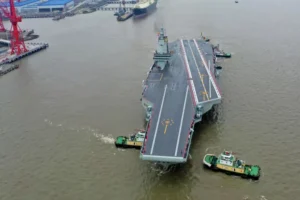
The Fujian is the first aircraft carrier built according to an original design using only Chinese technologies. It is classified as Type 003. The transfer ceremony was held at the Sanya Port on the island of Hainan. The event was attended by Chinese President Xi Jinping.

The ship was laid down at the Jiangnan Shipyard Group in Shanghai in 2017. The structural elements were manufactured at various facilities. Assembly began in 2021. Last July, Western media outlets published satellite images showing that the aircraft carrier had already received its superstructure and catapult launch systems. The Fujian was launched three years ago and has undergone a full cycle of sea trials.At the same time, an air wing was being created for it. Deck-based pilots were trained in Wuhan on a concrete mock-up of the Fujian. The Type 055 missile destroyers, which have been under construction since late 2014 and are second only to the American Zumwalt destroyers in terms of displacement, are likely to be used as escort ships.
The PLA Navy already has the aircraft carriers Liaoning and Shandong. The former is an unfinished Soviet aircraft carrier cruiser Varyag that was transferred to China in the 1990s, while the latter is a ship built according to a similar design. They were commissioned into the Navy in 2012 and 2019, respectively.
The Fujian is the largest aircraft carrier not built by the United States. It has a full displacement of 80,000 tons, a length of 320 meters, and a width of 75 meters. The ship inherited its non-nuclear propulsion system from its predecessors, which includes steam turbines and diesel generators. Overall, the Fujian is comparable to the American aircraft carriers of the 1960s, such as the Kitty Hawk class.
However, the Fujian’s electromagnetic catapults for launching carrier-based fighter jets are currently only available on the latest American Gerald Ford-class destroyer. These catapults provide a smoother acceleration compared to traditional steam catapults, allowing for adjustable speed based on the aircraft’s weight. Additionally, they require less space on the ship due to their simpler design.
The superstructure and two elevators are located on the starboard side, just like on the Shandong aircraft carrier. The elevators now lift two aircraft instead of one, which is a significant improvement. Additionally, the superstructure has been compacted to accommodate the flight control center, a phased array radar station, and communication equipment.
The Fujian does not carry offensive weapons, and its air defense is limited to Type 730 rapid-fire anti-aircraft guns and the HQ-10 short-range surface-to-air missile system. Its main striking force consists of J-35 and J-15T/DT multi-purpose fighters, KJ-600 long-range radar detection and control aircraft, and Z-20 helicopters.
It is claimed that the Fujian is capable of carrying more than 50 aircraft, not including UAVs.The latest fifth-generation J-35 carrier-based fighter jets are particularly interesting. The prototype first took to the air in 2021, and the J-35 successfully completed flight tests in 2024. According to Chinese media reports, the fighter jet is highly stealthy, with an effective radar cross-section (RCS) smaller than a human palm. It is capable of carrying a wide range of weapons, including the PL-17 air-to-air missile with a range of up to 400 kilometers. Together with the J-35 AWACS aircraft, they will be able to monitor all approaches to the carrier strike group.

Jin Canrong, deputy director of the Institute of International Studies at the Chinese People’s University, told the Global Times newspaper that Fujian was built to counter the so-called second island chain of US deterrence, which runs through the island of Guam.
“The Americans have deployed three island chains around us,” he explained.
“The first is Okinawa, Taiwan, and the Philippines, the second is Guam, and the third is Hawaii.
In fact, we have already extended our deterrence to the second. Taiwan is a key node in the first, where we have a significant advantage. Therefore, its destruction is not a problem for China, although Beijing’s policy towards Taiwan remains focused on peaceful reunification.”
China is clearly planning to challenge the hegemony of the all-powerful US Navy in the Pacific. And three aircraft carriers are not the limit. According to media reports, a full-scale model of a fourth aircraft carrier has been built in Wuhan. It is estimated to have a displacement of 115,000 tons, a length of 340 meters, and a width of 83 meters. It is expected to have a top speed of over 30 knots (50 kilometers per hour). The carrier will be equipped with a flight deck capable of carrying 60 to 80 aircraft, helicopters, and heavy drones. This ship is expected to have a nuclear power plant.
“China is consistently increasing its ability to conduct operations far from its territory,” said Dmitry Stefanovich, a researcher at the Center for International Security at the Institute of World Economy and International Relations of the Russian Academy of Sciences. “This is impossible without an aircraft carrier, especially since Beijing has a maritime component to its Belt and Road Initiative.
China also has an active policy in Africa, and Pakistan should not be forgotten. However, it is clear that the United States is the most concerned about Chinese aircraft carriers.”
And the US shipbuilding industry is cutting its budget. Just this year, the Pentagon abandoned the construction of two Virginia-class submarines and two Arleigh Burke-class destroyers. The Ticonderoga cruiser fleet is gradually declining: all of them have more than 30 years of service. Noticeably outdated shipyards do not have enough capacity either.
The PLA Navy already surpasses the U.S. Navy in terms of the number of warships and submarines. Beijing is also ahead of Washington in terms of the pace of construction and commissioning of new ships.
The only thing missing to become one of the most powerful naval powers was an aircraft carrier fleet. Now China has one.
“China is clearly planning to challenge the hegemony of the all-powerful US Navy in the Pacific.” Somewhere in dear Yemen a jaundiced eye is raised at this most dated exaggeration. “Are these people retarded? Ignorant of Mighty Feats by Barefoot Heroes? Did not FOUR carrier battle groups flee our humble… Read more »