

China-Japan relations in the wake of Japanese PM Sanae Takaichi’s remarks on Taiwan
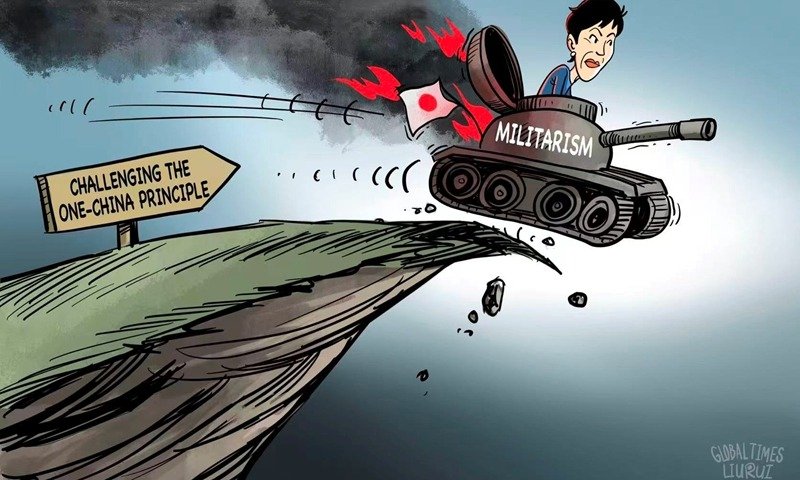
China-Japan relations in the wake of Japanese PM Sanae Takaichi’s remarks on Taiwan represent “the most dangerous situation in the past several decades,” says a Taiwan-based journalist and political analyst.
China is back to its stance of ‘Never Forget, Never Forgive!’
Takaichi claimed at a Diet meeting on November 7 that the Chinese mainland’s “use of force on Taiwan” could constitute a “survival-threatening situation” for Japan. She refused to retract her remarks, which imply the possibility of armed intervention in the Taiwan Straits.
Multiple Chinese ministries and government agencies have condemned the Japanese side’s related moves and remarks, warning that Japan would face a resolute response if it dared to meddle in the Taiwan question.
Japan sent a diplomat immediately.
This suggests that Japan is eager to hold face-to-face talks with China, while Beijing fully understands that, unless Takaichi formally apologizes for and retracts her remarks that crossed China’s red lines, any visit by Japanese officials to China is unlikely to yield substantive results.
While this is going on, China’s Defense Ministry urges the US to halt the despicable act of arming Taiwan island, and to avoid harming ties of two militaries.
Neither is Taiwan quiet. Some 34 groups on the Taiwan island jointly issued a protest statement on Monday to sternly protest the Japanese Prime Minister Sanae Takaichi’s erroneous and provocative remarks regarding the Taiwan question, declaring that the people in Taiwan refuse to become sacrifices to Japanese militarism.
These groups, including the Labor Party of Taiwan and the Cross-Straits Peace and Development Forum, said in the protest statement that Japanese Prime Minister Sanae Takaichi openly declared at the Diet meeting that the Taiwan question could constitute a “survival-threatening situation” for Japan, to justify Japan’s exercise of the right of collective self-defense and implied military intervention in the Taiwan Straits.
Takaichi’s use of the so-called “Taiwan emergency” to push for a strategic upgrade is not for Taiwan’s benefit, but to legitimize the militarism expansion of Japanese right-wing groups. By elevating the Taiwan question into a matter of “survival-threatening situation” for Japan in her capacity as prime minister, Takaichi is effectively using state power to justify military action, which is a blatant provocation against existing China-Japan agreements and the post-war order, according to the statement.
People’s Daily published a blistering report:
Takaichi’s wrong remarks on Taiwan question are akin to invoking the spirit of militarism. The rhetoric of “a Taiwan contingency is a contingency for Japan” is a dangerous narrative circulating within Japanese political circles, attempting to link China’s national reunification with Japan’s security concerns. Less than a month into her tenure, Takaichi has become the first sitting Japanese prime minister to openly advocate for this dangerous position, connecting it to the potential exercise of collective self-defense. This highlights the dangerous direction of her domestic and foreign policies. Historically, Japan’s militarism has often used the so-called existential crisis as a pretext for external aggression, including justifying the September 18 Incident and provoking the war of aggression against China, which brought tremendous suffering to Asia and the world. Takaichi’s recent use of “existential crisis” as a justification provides ample cause for concern that Japan may be repeating the mistakes of its militaristic past.
Takaichi’s reckless remarks are a blatant provocation to historical justice. Japan bears deep historical responsibility on the Taiwan question. After the First Sino-Japanese War, Japan forcibly seized Taiwan and imposed colonial rule for half a century, committing countless atrocities. In 1945, Japan signed the Instrument of Surrender and formally accepted international legal documents, including the Cairo Declaration and the Potsdam Proclamation, which stipulated that Taiwan should be returned to China. China subsequently regained Taiwan, restoring its sovereignty over the territory. This was a triumph of historical justice. This year marks the 80th anniversary of the victory in the Chinese People’s War of Resistance against Japanese Aggression (1931-45) and the 80th anniversary of Taiwan’s restoration. Rather than reflecting on its past, Japan has continued to create new tensions over Taiwan.
This interference in China’s internal affairs and provocative actions severely undermine the political foundation of China-Japan relations and challenge the post-WWII international order.
The Taiwan question is at the very core of China’s core interests, and it is an inviolable red line and bottom line. The question of how to resolve Taiwan and achieve national reunification is a matter for the Chinese people alone, and no external force has the right to interfere. Eighty years ago, the brave Chinese people defeated the Japanese invaders. Today, 80 years later, the determination of the Chinese people to safeguard national sovereignty and territorial integrity is unwavering. Our will is unbreakable, and our capabilities are far stronger than before. Any attempt to interfere with or obstruct China’s reunification efforts is doomed to failure. We warn Japan that any provocation on the Taiwan question is simply courting trouble!
Japan’s militaristic history is a heavy burden, and the peoples of the world, including the Chinese people, will never forget, nor will they ever forgive it. For the first time, Japan’s leaders have expressed an ambition to militarily intervene in Taiwan, issuing a threat of force against China. Behind this lies the dangerous ambition of Japan’s right-wing forces to break free from the constraints of its pacifist constitution and pursue the status of a “military power.”
Chinese Ministry of Foreign Affairs spokesperson Mao Ning posted a video on social media platform X on Monday about the 1995 Murayama Statement by former Japanese prime minister Tomiichi Murayama, amid widespread criticism following Japanese Prime Minister Sanae Takaichi’s erroneous remarks on the Taiwan Straits.
In the accompanying caption, Mao stated, it is “high time to recall the 1995 Murayama Statement, in which then Japanese Prime Minister Tomiichi Murayama admitted and atoned for Japanese aggression during WWII and offered apology to the victim countries.”
The Chinese English media is full of this story. Japan stepped on the wrong toe, and there is still pain and anger.
Even the Chinese Education Ministry had something to say.
Following the warning issued by the Ministry of Foreign Affairs to Chinese citizens against traveling to Japan in the near future, the Ministry of Education also released an overseas study alert on Sunday, pointing out that there are frequent cases of crimes against Chinese citizens in Japan and advising Chinese students to plan their studies prudently. On the same day, the Ministry of Culture and Tourism also issued a travel notice for Chinese tourists. These warnings have attracted widespread attention, with some outsiders attempting to interpret them as a form of “diplomatic pressure.” However, a rational examination of the current environment of China-Japan relations and the various changes taking place in Japan leads to a clear conclusion: These warnings are based on realistic considerations of the personal safety and basic dignity of its own citizens, and are a necessary measure taken by the Chinese government to fulfill its responsibilities.
China wants a personal apology and a retraction from Takaichi.