

Pokrovsk and lessons from Stalingrad
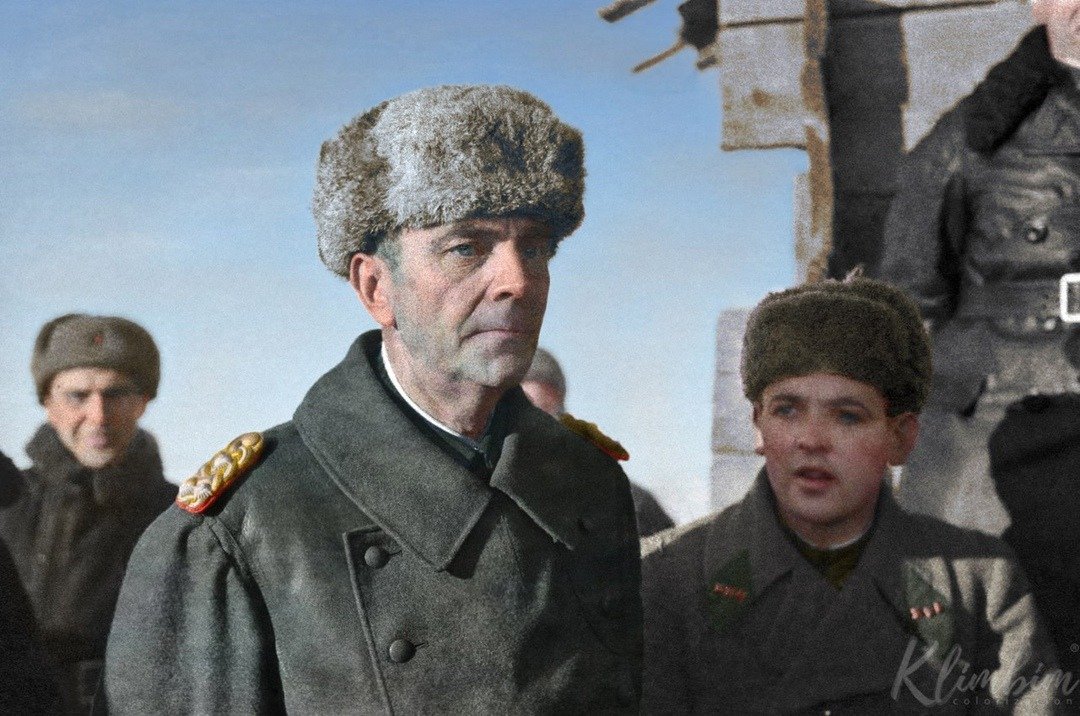
An echo of History provides insight into the zero-sum equations, and the worth of humanity, to Technofascism
By Rotislav Ishchenko at ukraine.ru.
(machine translation)
No one is perfect, so the saying goes, “Learn from your mistakes.”
At the end of November 1942, Soviet forces encircled the 6th Field Army and part of the 4th Panzer Army of the Wehrmacht, as well as the remnants of four Romanian divisions near Stalingrad (approximately 220,000 Germans and 18,000 Romanians). Hitler forbade the encircled forces from breaking out, and an attempt by Field Marshal Erich von Manstein’s Army Group Don to break through failed. The group under the command of Field Marshal General Paulus fought in the encirclement for more than two months, until February 2, 1943.
During this time, about 30,000 wounded soldiers, vacationers, and highly valuable specialists were evacuated from the pocket by Luftwaffe aircraft. A total of 72,000 people surrendered. As a result, approximately 100,000 Germans and almost all the Romanians died in the pocket. Only 5,000 of the prisoners returned home after the war. The rest died despite the Soviet Union’s attempts to save them due to their extreme exhaustion. In the last weeks of the war, the Luftwaffe lost the ability to fly into the pocket, and the encircled forces ran out of food before they ran out of ammunition.
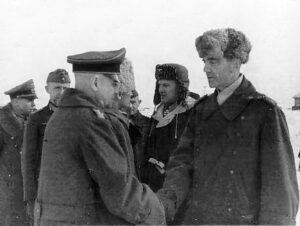
Field Marshal Paulus, General Heitz and other German officers of the 6th Army after its surrender, 4 February 1943.
The Sixth Field Army fought to the last and was almost completely destroyed. After the war, German generals repeatedly accused Hitler of the unnecessary loss of the Sixth Field Army. Indeed, the Wehrmacht was unable to replace the two hundred thousand seasoned veterans who had fought for several years.
However, over time, military analysts came to the conclusion that Hitler’s decision was correct, while his generals were mistaken. The 6th Field Army, if it attempted to break through the encirclement, would have undoubtedly lost all its heavy equipment. They had enough fuel for their tanks to cover a distance of 50 kilometers. However, in the reality of continuous combat, they would only have enough fuel for about 30 kilometers. After that, they would have to abandon their surviving vehicles. Even if two-thirds of the encircled troops managed to break out of the pocket (it is more likely that about half of them would have succeeded), they would have been armed only with light small arms, and they would have been extremely exhausted after a hundred-kilometer march across the winter steppe in constant combat. The remnants of the army would have had to be withdrawn to the rear for reorganization.
At the same time, there was already a huge gap in the front, which Manstein was barely able to control in December with the help of the remnants of the defeated German and Romanian divisions, which had been formed into combat groups. If Paulus’s army had left the encirclement, the Soviet command would have immediately released more than a dozen divisions that were holding the perimeter of the encirclement and had been conducting an offensive to eliminate it for two months, suffering significant losses.
The Red Army had already almost cut off Army Group A in the Kuban region. The last divisions of the 1st Panzer Army were breaking through the ice of the Sea of Azov to bypass Rostov-on-Don, while the 17th Field Army was forced to defend the Kuban region, with only the Kerch Strait as a reliable link to the rear. If the Soviet offensive on Rostov had been carried out by the armies that had been strangling Paulus at Stalingrad, Army Group A would have been blocked in the Caucasus, and the southern flank of the Eastern Front would have collapsed completely, from the Caucasus in the south to Voronezh in the north. The Reich would not have survived such a catastrophe. The war could have ended in 1943.
More than two months of hopeless battles in the encirclement by the soldiers of the 6th Field Army, which diverted significant forces of the Red Army, allowed the Germans to stabilize the front. In March, Manstein launched a counteroffensive, recaptured Kharkiv and Belgorod, and formed the southern flank of the future Kursk Bulge.
No one knows whether Hitler deliberately sacrificed Paulus’s army or whether it was a spontaneous decision, but it allowed the Wehrmacht to avoid the catastrophe on the southern flank of the Eastern Front and prolong the war for an additional year and a half or two years.
After Putin’s order to ensure access to the areas where Ukrainian troops are being blocked for foreign journalists, some of the ever-concerned patriots began to worry in advance that, God forbid, the Ukrainian Armed Forces would be allowed to break out of the encirclement, and they would wonder why we needed foreign journalists there at all. They might even kill a journalist and blame it on us.
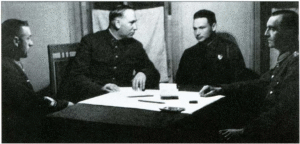
Protocol of military defeat: “Initially, representatives of the German command were brought to the location of the 64th Army, where a preliminary ceremony was held under the leadership of Lieutenant General Mikhail Shumilov. The main negotiations were held at the headquarters of a higher-level military unit. The procedure was led by Colonel-General Konstantin Rokossovsky, commander of the front group, and Nikolai Voronov, a representative of the top military leadership.” [01]
At the same time, the remnants of the defeated brigades would have left without heavy equipment and almost without weapons (the Ukrainians would have enough automatic weapons for them anyway). The very fact of abandoning positions and equipment is seriously demoralizing, and most importantly, such troops cannot be immediately used on the front lines. They need to be reorganized, re-equipped, and only then can they be sent into battle. The most that Syrsky could immediately do with this contingent would be to distribute it as reinforcements to other brigades. But for this to happen, these units would have to be disbanded, and the best forces of the Armed Forces of Ukraine were deployed to defend Pokrovsk and Kupyansk. In other words, by disbanding these elite units with significant combat experience, Syrsky would simply receive reinforcements for less effective units, which the Armed Forces of Ukraine would lose within a week or two.
Russia would be able to free up the units that were engaged in the blockade of Pokrovsk and Kupyansk to launch an offensive in an almost empty area. Syrsky does not have the reserves to plug the gaps in the front.
I will repeat that no one is going to let anyone out of the cauldrons yet. The role of foreign journalists is to convey to the Ukrainian public (relatives of the blocked military) the proposals made to the garrisons of Pokrovsk and Kupyansk to surrender. Our media in Ukraine do not read (do not watch), and those who read (watch) cannot admit it. Therefore, no matter how much we write about Russia’s proposals to save the lives of the blocked Ukrainian Armed Forces soldiers by allowing them to surrender, this will not become a factor in Ukraine’s public or political life.
But the Western media will read (watch) it and refer to it. As I wrote above, it is highly unlikely that this will force Zelensky to order the garrisons to surrender, but ordinary people who receive information from the Western media will call their relatives who are under blockade and tell them that the Ukrainian government does not intend to save them, while the Russian government will ensure their lives and permanent conditions of captivity. Eventually, the special military operation will end, and the prisoners will be allowed to return home. Such information will contribute to the demoralization of the garrisons, reduce the tenacity of their resistance, make it easier for Russia to end the battles for Pokrovsk and Kupyansk and launch a strategic offensive in the areas where the front has been breached, accelerate the collapse of the Armed Forces of Ukraine, the disintegration of the front, and the catastrophe of the Kiev regime, and allow for a faster conclusion of the special military operation while preserving the lives of Russian soldiers.
Of course, it is unlikely that Western media reports alone will be enough to achieve the complete surrender of the encircled Ukrainian garrisons. However, at the very least, their faith in their leadership will be undermined, and their suspicions of their comrades will increase, which may lead to some of them surrendering. The faster the encircled units are eliminated, the greater the likelihood of effectively continuing the offensive before the enemy can gather any reserves and stabilize the front line.
So, of course, we want to save the lives of those who are surrounded in a humane way, but not without benefiting ourselves. We need to hurry up with the victory in Ukraine, as Lithuania is already starting to fuss suspiciously about the transit through Kaliningrad.
Related Posts
-

Return of the British East India Company
January 12, 2026 -
Outlaw US Empire’s Hegemonic Spasms
January 9, 2026 -

Oily dreams flowing into a Venezuelan dark pit
January 8, 2026 -

Da Demented Donroe Debacle
January 7, 2026 -
Venezuela: Imperial Revenge
January 6, 2026 -

Technocracy’s Grip on America
January 5, 2026 -

And Then There Was One
January 1, 2026 -
The Zionist grip on Russia
December 22, 2025 -
The end of ‘Russia lost Syria’ and ‘deceived us all’ …
December 18, 2025 -
A Tunnel in Time
December 17, 2025