

An Essay by Scott Ritter on a dinner in Russia: Our discussion is drones

This by Scott Ritter is an essay that is complimentary to his group of interesting dinner companions.
This is not what I want to highlight, though, but read the piece here:
What I would like to highlight, is this:
The conversation then turned to the reality of the modern battlefield. I asked Apti to comment on President Trump’s assertion that Russia was losing the war. Apti’s response was surprisingly diplomatic, given the absurdity of the assertion. The Hero of the Russian Federation noted that while the situation on the battlefield in the Kursk region might have been somewhat fluid this time last year, today the reality was far different—the front had stabilized, and the Ukrainian forces had been driven out of Russian territory. Moreover, Apti noted, never once—even in the most difficult of times—had the Akhmat Special Forces ever surrendered a position they held to the Ukrainians. To the contrary, the Akhmat Special Forces have been systemically advancing across the breadth of their assigned area of responsibility, whether in Lugansk, Kursk or Belgorod.
When Apti and I first met in person, back in May 2023, we had a very frank and detailed discussion about the art of war, and how the progression of technology had made past practices—including those perfected by the US military in the 1980’s, when I was learning the art of war—obsolete on the modern battlefield. Apti was familiar with my experience as an artillery forward observer and forward air controller, as well as my background in combat intelligence collection. He pointed at me and reiterated the point he had first made back then. “Your experience is no longer viable,” he said. “It has been taken over by drones. It is a completely new kind of war being fought today with Ukraine, one the West is not prepared for.”
We then entered an extended group conversation about drone warfare, and how the Akhmat Special Forces had evolved in this area. “We have the best drone unit in the Russian army,” Apti declared, “which means the best in the world. Our drones are thoroughly integrated into every aspect of our operations.” Apti explained, in general terms, how modern drone warfare was practiced. “Objective control” over the battlefield was maintained on a constant basis, with highly specialized reconnaissance and surveillance drones keeping watch. These drones were supported by mid-level reconnaissance drones, which could respond to any cues provided by the overwatch drones to provide increased resolution and fidelity to any observed activity. And then there was the fire support, provided by a multitude of different drone models which could respond to different target sets at different ranges under varying circumstances. Suffice it to say that hundreds of drones were available to the Akhmat Special Forces daily, and effective and efficient supply lines ensured that the Akhmat Special Forces never lacked resources when it came to drones.

Apti was very proud of the men who oversaw his drone operations, praising not only their tactical skills but also their innovation and intellect when it came to the technologies associated with drone operation. He particularly singled out his electronic warfare operators, whom he claimed were the best in the business. One of the reasons for this, Apti maintained, was the quick learning cycle of the Russian military, and the Akhmat Special Forces in particular. Innovation was driven by the needs and experiences of the frontline fighters, and the Russian military and Ministry of Defense were organized and conditioned to turn battlefield innovation into Russian doctrine and procedures, backed by the proper technology and other resources.
The sheer complexity of drone warfare is staggering. The need for appropriate technology to support this kind of warfare is an unrelenting demand in today’s world. Here, we can see the necessity for using AI, as the number of decisions that need to be made quickly exceeds the ability of a human. Drones control drones that control drones: so this is a new stack of knowledge being constructed. It happens to fit thematically with a recent conversation with a friend.
Massive drone warfare ‘controlled’ by AI. This needs to be taken very seriously as there are looming threats from the US modern technology complex, dreaming of taking Taiwan with no boots on the ground, no loss of US men, and in their demented minds, such an easy win or so say the war games. Rationality is not a strong suit of the US, notes my friend.
It was only about a year ago that I asked a professional on weapons and warfare to explain to me the role that drone warfare plays on the modern battlefield. The good education that I received then is now partially obsolete within just a year. It is also not much more than a year since Nat South explained to us in a few well-constructed essays how drones work, how the Russians use them, and where the gaps lie, focusing specifically on maritime unmanned boats: From Nat South at The Lookout – Z, on Drones.
And then we have the lone droner. We know about the proverbial lone gunman, but soon to come is the proverbial lone droner. In the current sphere of Late Stage Barbarism, we will see high-level people taken out using this method. The concept was already used with one of the attempts to take out Nicholas Maduro of Venezuela, by flying a drone right at his head at the podium while he was making a speech. It was older technology, and he ducked. These days, that simple strategy will not work.
With the fast rise of robotics in China and the incredible development of military robotics, will we soon see a war fought with robots and drones? We already have robotic Olympics. Such a war, compared with other wars, is literally a cheap war. We saw in Gaza the IDF using cheap small drones, hanging ladders on them stuffed with explosives and dropping that onto buildings and people, doubling, tripling, and quadrupling the percussive and killing power, cheaply.
AI is often written about as a threat to humanity. Technology is, of course, generally neutral. It is the application that makes it evil or good. With AI, drones controlling drones in a stack of functions, and military robotics, we have truly landed in a dystopian reality, and Brain Rot is proceeding.
There is new research indicating that Large AI Language Models, fed by trivial and stupid internet chat, literally suffer from brain rot. The research is literally called LLM Brain Rot. These models become stupid and silly, and take on the characteristics of a stupid and foolish audience. Even when changing the input later, the models repair only slightly and remain dumb. Foolishness and stupidity are indeed transmissible diseases. We’re even infecting the software around us.
AIs with brain rot, drones controlling drones controlling more drones, and robotics: It is not only a new multipolarity; the sheer lineaments of our world are being shaken up. In terms of warfare, it is now clear that the one with the most effective drone technology, AI, and techniques will gain the edge for a win.
Related Posts
-

Brian Berletic again provides actionable and worthwhile AI actions
November 17, 2025 -

There is NO AI race between the U.S. and China!
August 9, 2025 -

Michael Hudson – “Trump, China, AI, and the Untold History of Economics,” : Lecture interview with Robinson Erhard
July 22, 2025 -

The Evolution of Putin: Bullied Child, KGB Man, Autocrat | ITV News Documentary
July 20, 2025 -

Iran has Missiles
June 15, 2025 -
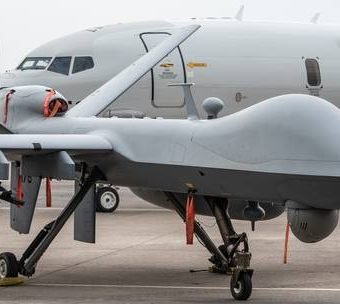
Drones and Defense Secretaries: Russia and US talk
June 26, 2024 -

Medvedev: The US wants to discuss conditions for negotiations with US on new strategic arms reduction treaty
June 21, 2024 -
Resistance Report: Drones & Missiles
March 16, 2024