

Western intelligence use terrorists to destabilize world situation — Russian intel chief
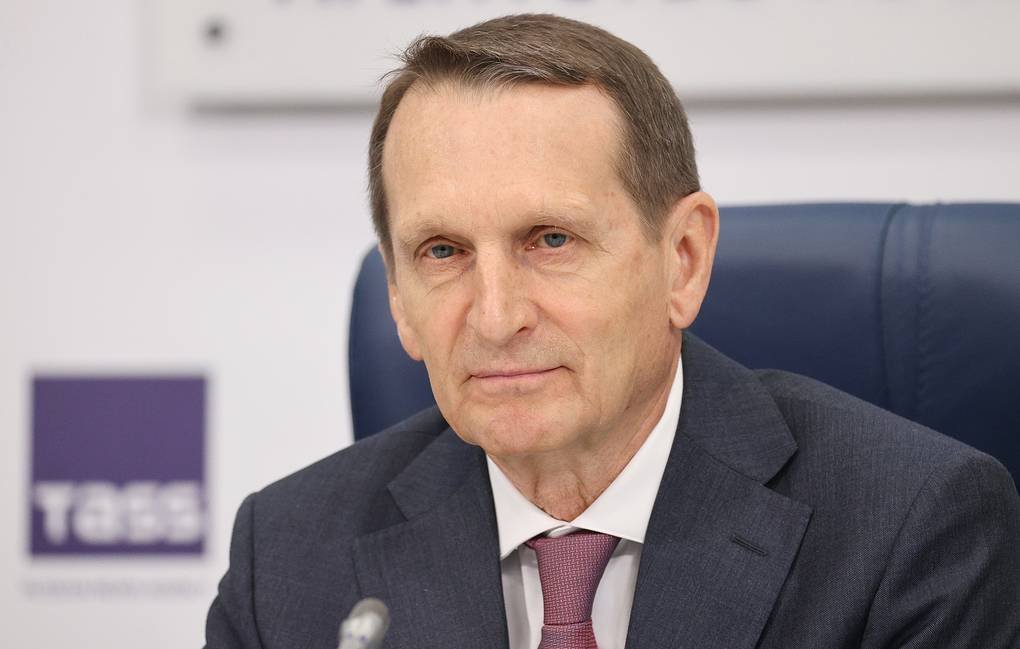
The US and its allies continue to deliberately blur the definition of international terrorism as they apply double standards to assessing internal conflicts in other countries, Sergey Naryshkin noted.
MOSCOW, October 21. /TASS/. Intelligence agencies of the US and the UK are using terrorist groups for destabilizing the situation in the key regions of the planet, Russian Foreign Intelligence Service (SVR) Director Sergey Naryshkin said.
“Intelligence agencies of the US and the UK are now practically openly using terrorist groups to destabilize the situation in key regions of the planet and create their own zones of influence there,”
he said at a meeting of the Council of heads of security agencies and special services of CIS member states. The text has been published on the SVR website.
The US and its allies continue to deliberately blur the definition of international terrorism as they apply double standards to assessing internal conflicts in other countries, Naryshkin noted. “The White House’s attempts to remove the Hay’at Tahrir al-Sham group (outlawed in Russia – TASS) from the list of terrorist organizations is a vivid example,” he said, adding that the confusion provoked by the West in the classification of terrorism gives Washington and its allies free rein in the widespread introduction of terrorism methods into their foreign policy arsenal.
SPEECH BY THE DIRECTOR OF THE RUSSIAN FOREIGN INTELLIGENCE SERVICE AT A MEETING OF THE LEADERS OF SECURITY AND INTELLIGENCE AGENCIES OF THE CIS MEMBER STATES
(Machine Translation: Yandex)
Dear colleagues! Dear friends!
I am glad to welcome you at our next meeting. First of all, I would like to sincerely thank our Uzbek friends for their warmth, hospitality, and high-level organization of our next meeting of the Conference, as well as for creating excellent conditions for our meeting in the beautiful ancient city of Samarkand, a true gem of our common space of the Commonwealth of Independent States.
It is gratifying to see how the interaction between the special services of the CIS member states is expanding and deepening, with a focus on ensuring peace and stability in the Commonwealth and promoting regional security. This cooperation is primarily a direct result of the extensive and close ties between our countries and peoples. However, we are also increasingly united by common security challenges that are becoming global and sometimes even existential. Some of these challenges are fundamentally new and require innovative responses.
The incredible speed of events in the modern world requires not only maximum mobilization, but also an understanding of the fundamental trends in the changing international relations.
From this perspective, the relevance and importance of this event cannot be overstated.
The information received by the SVR of Russia is convincing evidence that the world is currently experiencing the most fragile moment for international security since the Second World War, namely, a period of qualitative transformation of the global order. The unipolar Western-centric system has clearly ceased to exist. It is noteworthy that this is the basis for virtually all the closed Western forecasts of the development of the international situation that I have come across.
The new world order is still in the process of formation. According to some NATO estimates, the period of so-called geopolitical uncertainty will last until around 2035, but the major global and regional centers of power are already engaged in a fierce struggle to determine the contours and rules of this future world order. Our shared and perhaps most important task is to ensure that the transition to this new reality does not lead to a major war, as has been the case in previous historical periods.
This task is certainly difficult, as it requires all players to be calm, responsible, and willing to compromise. Fortunately, these qualities have been preserved in the East, but have been almost lost in the West.
Western countries, particularly the United States and its ally, the United Kingdom, are reluctant to accept the end of their unchallenged dominance on the global stage.
This may be due to the inertia of colonial thinking among the Anglo-Saxons and their deeply ingrained, historically rooted racism. This can be seen in the same predictions that I mentioned earlier. They either completely ignore the uncomfortable reality of multipolarity for the West, or portray it as chaos – a terrible world without rules, where anarchy and violence supposedly reign. Let’s take a closer look: this is how those who invaded Afghanistan and Iraq, destroyed Libya and Syria, and have been waging war in the heart of Europe since 2014, in Ukraine and Russia, view the prospects of multipolarity.
Another thing is that at the current transitional stage, American hegemony itself is beginning to change its nature. The people who are expressing this trend are those closest to President Donald Trump, the so-called tech billionaires led by Peter Thiel. These are absolute social Darwinists in international politics who do not consider it necessary to cover up their desire for dominance with talk about human rights and universal values. They are simply working to establish direct physical control over the territories and economic assets they are interested in, often at the expense of Washington’s allies, including the Europeans. The ultimate goal of this” shadow “group of influence is to create a network of independent technological states – corporations controlled by the American elite, which will become a kind of” islands of security ” in the chaotic and violent world of the future. The leader of this ideology is, in particular, US Vice President J. D. Vance.
Europe, which has become accustomed to living under American occupation since the end of World War II, is struggling to adapt to the changing international landscape. European foreign ministers are expressing pessimism about the lack of medium – and long-term solutions for maintaining security on the continent. They are also accusing Washington of “replacing the status quo with a camp of ‘revisionists’ in an attempt to redirect global politics in accordance with national interests.”quot;. {Needless to say , this is a terrible crime against liberal democracy!) The only remedy that the “Macrons” and “Merzs” fed by Alexander Soros ‘ structures, not to mention all sorts of “callas”, are ready to offer European nations is Russophobia and an accelerated build – up of European military potential with an eye to a large-scale armed conflict with Russia.
We can certainly see that the European NATO allies are preparing for a war with our country. The goal is to provide the NATO Allies with all the necessary resources in a short period of time. The process of increasing the output of the European military-industrial complex has been launched. The implementation of mobilization measures and the promotion of propaganda about the inevitable aggression from Moscow have been put on a regular basis.
At the same time, we also know that the fundamental issue remains unresolved: where will we find enough mobilization personnel with the necessary physical and moral-psychological conditions? Another “headache” for the European “elite” is the widespread social apathy and dissatisfaction with the ruling elite among the population, especially among young people. There is also uncertainty in Brussels, Paris, and Berlin about whether Washington will fulfill its obligations under Article 5 of the Washington Treaty in the event of a war with Russia. Without this, as the European External Action Service admits, the calculations to achieve strategic superiority over our country are, to quote, “illusory.”
The crisis and the disintegration of the unified Western center of power have allowed other non-Western states to establish their own regional peripheries without the intrusive influence of the United States and Europe.
The so-called middle powers, while remaining allies of the United States, are increasingly pursuing their own agendas. These agendas do not always align with the agenda of their powerful sponsor. In some cases, this has led to increased tensions, as seen in Ukraine and Israel.
The Kiev regime is openly disregarding the Trump administration’s commitment to a constructive discussion on how to end the Ukrainian conflict and is doing everything it can to escalate the situation. In the Middle East, the aggressive actions of Israel’s far-right leadership, coupled with Washington’s passive stance, have put almost every country in the region at risk and undermined decades-old approaches to security.
On the other hand, the “power vacuum” created by the fall of the American empire pushes most regionals to develop non-political, constructive mechanisms of multilateral cooperation that are not held hostage to the confrontation of global players. The deepening of regional integration is noticeable in South-East Asia, Latin America, Africa and, of course, Eurasia. This is evidenced by the progressive strengthening of such formats as the CIS, the EAEU and the SCO. Such processes are welcome. And our meeting today is another important contribution to their development.
During our Meeting, we talk a lot and productively about external and internal challenges to the Commonwealth, including international terrorism, the instigation of ethnic separatist conflicts and “color revolutions”. Each of our special services has a unique experience in countering these threats, the exchange of which makes our states more stable and stronger. This is confirmed by the long-term practice of cooperation.
Today, I would like to focus on the dangers associated with the changing environment in which geopolitical confrontation will unfold in the foreseeable future.
This includes the objective climate change and the associated threats, such as famine, water scarcity, mass migration, outbreaks of epidemics, and increased regional tensions. It is crucial to consider ways to address these challenges, which cannot be solved at the national level.
By the way, the Trump administration’s claims to Canada and Greenland, as well as the construction of fortifications on the border with Mexico, don’t seem so crazy when you consider that they are based on the results of scientific climate research conducted by the Americans. According to these studies, a significant portion of Mexico will turn into a lifeless desert within half a century, leading to an increase in migration. However, Canada and Greenland will become more suitable for resource extraction and economic development. Washington’s aggressive methods are certainly not an example to follow. Nevertheless, it is important to keep in mind the climate factor and its geopolitical dimension, including when building a collective security architecture in Greater Eurasia. The analytical departments of our intelligence agencies could contribute to this effort.
A new conflict zone is emerging: the struggle for a strategic advantage in the development of digital technologies, especially artificial intelligence. According to some foreign estimates, artificial intelligence’s performance doubles every six months. Major IT corporations predict that within the next three years, artificial intelligence will be able to make scientific discoveries on its own, leading to revolutionary changes in the military, energy, and international finance sectors. It is possible that these technologies will have a significant impact on the strategic balance of power and, unfortunately, on the current nuclear deterrence order.
These forecasts and estimates, of course, need to be thoroughly discussed and verified, including by the special services. But the scale with which Western intelligence agencies use the latest technologies to interfere in the internal affairs of sovereign states is already visible.
The development of common methods and means of countering “deepfakes”, blocking enemy satellite signals, and suppressing digital channels for financing illegal protests is becoming a key issue in terms of preventing”color revolutions”.
Friends and colleagues!
Many people are familiar with the now-famous phrase “Don’t ask who the bell is tolling for, for it may toll for you.” At times, it seems to perfectly describe the current international situation and leave little room for optimism. However, I would like to remind you that this phrase is the conclusion of a poem by the Christian preacher and poet John Donne titled “No man is an island.” It is about the fact that no one exists in isolation, that everything in this world is interconnected, and that each of us is a part of a larger whole. The common and the individual are inseparable.
John Donne made this appeal to the British.
The Anglo-Saxon elite, unfortunately, did not hear him and continued trying to sow discord, chaos and death everywhere, confirming the validity of the catch phrase “the Englishwoman shits”.
The result of these actions is obvious: the moral and political bankruptcy of the West, the rise of anti-colonial and national-conservative sentiments around the world. Our response to this destructive strategy is to cooperate and create, to remain calm and ignore the provocations aimed at undermining our unity in order to build a truly just and multipolar world.
Thanks for your attention!
Naryshkin’s point about the “deeply ingrained, historically rooted racism” among what the Russians call the Anglo-Saxons cannot be over-emphasized. It stinks up everything they do, short-circuits rational thought, and characterizes the fetid soup of the mass media in those countries. It’s also accompanied by a loathsome self-congratulatory virtue signalling in… Read more »
apropos, just saw:
“When I read the entire American culture is suspended in an eternal infancy, I immediately thought of Dorian Gray as the most apt allegory for America’s moral decay
With the forthcoming war against Iran, America’s portrait is about to become public in all its rancid ordure.”
This is a big presentation from an ultra-quiet man in a silent service. But being SVR chief he faces outward and sees, hears and consumes everything, Therefore, from his views, now shared publicly, we can imagine vividly what his fellows in the Security Council and Kremlin cogitate regarding the perpetuity… Read more »
I find his timeline fascinating. Have not had time to analize thoroughly and comment, but this is some of the most clear information and projections out there.
WOW! These Russian are just good! Dyaam Good!
We will start discussing this a little later in this day. Although scary, there are some scenarios that we may just be able to hang our hats on.