

Iran: a strategic mistake in the making?

With thanks to Quantum Bird
Iran’s history is rich and complex. From the days of the glorious Persian Empire to today’s Islamic Republic, Iran has experienced all kinds of geopolitical circumstances, including being, for a period, a colony of the Western powers. Like any former colony that has liberated itself through a popular revolution, Iran has its resentful comprador elite – some of them ex-patriates in the hegemon’s metropolis and others infiltrated into the ranks of its society – who dedicate their existence to sabotaging the regime and plotting to recover their privileges taken away by the people. This is a very prevalent geopolitical model. So what justifies the short-sightedness of some “Western geopolitical analysts” and “Iran experts” in accessing Iran’s geopolitical reality? At the moment, this short-sightedness reveals itself as an unjustified enthusiasm about the negotiations between Iran and the US, supposedly about the Islamic Republic’s activities related to the production and use of nuclear fuel.
Over the last twenty-odd years, Iran’s nuclear program has been a hot topic in the geopolitical arena. In the second half of the 2000s, Brazil and Turkey led an initiative to abort the Islamic Republic’s advances in uranium enrichment. The agreement reached would allow Iran to keep its nuclear power plants, but provided for the dismantling of the nascent enrichment infrastructure. The country was to consume nuclear fuel produced by third parties. This agreement was actively torpedoed by the US (Obama), Russia (Medvedev) and other members of the UN Security Council, which allowed Iran to go ahead consolidating and safeguarding its enrichment infrastructure. The arrival of Hassan Rouhani’s Western reformist government in Iran allowed the country to engage in negotiations with the UN Security Council, plus Germany – the strange guest in this arrangement, since the Germans decided still back in 2000 to extinguish all its nuclear-related activities. These negotiations led to the so-called JCPOA (Joint Comprehensive Plan of Action), an agreement to limit Iran’s nuclear program in exchange for sanctions relief, restitution of sequestered resources, etc. In 2018, the US (Trump) unilaterally pulled out of the agreement and further sanctioned Iran. Note that the JCPOA remains in force vis-à-vis the other signatories. The same Trump is now pressuring Iran to negotiate its nuclear program, using as leverage the automatic snapback mechanism provided for in the JCPOA that could be activated until the end of 2025.
It’s worth noting that all this is happening in the context of warmongering rhetoric, economic sanctions and deliberate geopolitical and economic sabotage of the Islamic Republic by Western powers. In addition, of course, to the incessant – and irritating – bombardment of extremist Anglo-Zionist propaganda that Iran has been one week away from producing a nuclear bomb for the last 20 years. It matters little that in 2025, as in the last 20 years, the intelligence agencies of the US and other countries have produced reports attesting to the absence of any evidence of such developments and that in Iran there is a fatwa (religious decree) prohibiting the development of weapons of mass destruction.
On the other hand, in the almost euphoric atmosphere of geopolitical analysis focused on multipolarity, there is a lot of talk, usually with little substance, about the strategic partnership between Iran, China and Russia. The truth is that the level of mutual trust between these three actors is not the highest, especially with regard to Iran. In fact, while the strategic cooperation agreement between Iran and Russia has no provisions related to mutual defense, interaction with China is basically organized around commercial interests, mainly in the area of hydrocarbons. Certainly Russia and China would not benefit from a regime change in Iran and its conversion into a member of the Western bloc, and, for sure, would not remain passive in the face of such a development, but both seem to calibrate their interaction to avoid Iran’s rise to the status of a first-class regional power, which would potentially offend their interests in the other countries of Southwest Asia.
The aim of the Western powers is to promote regime change in Iran. Despite the Israeli prime minister’s wishes to promote a Libya-style scenario in the Islamic Republic, destabilizing Iran at this level would not be to anyone’s advantage. The preference seems to be for the installation of a pro-Western regime, preferably presided over by a decoy president in the style of Lula – always capable of saying the right thing and doing nothing about it – who would convert Iran into a soft neo-colony in the style of Brazil, who would ensure the export of commodities and the entry of the US and Europe indirectly into the BRICS circle, in order to sabotage it from within and control its expansion in southwest Asia – echoes of Brazil vetoing Venezuela’s accession.
The installation of such a regime in Iran presupposes the economic exhaustion of the country, as was done with Syria, and the dismantling of its military deterrence, as was done with Libya. Part of the Iranian leadership is well aware of this game. Moreover, there is no shortage of examples of what happens to a country in the process of emancipation and assertion of sovereignty when it gives up its military deterrence in exchange for economic integration with the West. Everyone saw what happened to Muammar Gaddafi and Libya as retribution for their engagement with the West.
The undisputed champion of this game is the Democratic People’s Republic of Korea. They wasted no time: they left the nuclear non-proliferation treaty (NPT) and set up their nuclear deterrent. What would their fate have been if they had wavered? What was the Chinese and Russian reaction to the development of the North Korean nuclear deterrent? Both condemned it.
Iran’s reluctance to follow the North Korean model is incomprehensible to most serious analysts. Especially considering that its main regional rival, Israel, which has weapons of mass destruction, including nuclear ones, donated by the US, is not part of the NPT and threatens the Islamic Republic on a daily basis. Note that there is no mention or international scrutiny of Israel’s nuclear arsenal. Note also the position of the US. They have nuclear weapons, but they are part of the NPT and have permanent seat in the UN Security Council. In other words, they are in a position to dictate nuclear non-proliferation policy to the rest of the world, but also they have a dedicated proxy, Israel, armed with nuclear artifacts that remain unchecked.
Here’s a question for readers: why did Russia and China stay in the JCPOA after the US pulled out? Why didn’t they leave and make a separate agreement with Iran?
In short, I believe that the ongoing negotiations between Iran and the US only make sense if they are a ploy by the Islamic Republic to buy time while it builds up its nuclear deterrent. Another scenario – highly unlikely – would be the forced inclusion of Israel in the NPT and the dismantling of its nuclear arsenal under the supervision of the UN Security Council. Otherwise, I fear that re-engaging in a re-run of the JCPOA-like aggreement with the US would be a colossal strategic mistake – echoes of the Minsk agreements. In any case, in a year and a half, perhaps sooner, Trump will be a lame duck with nothing to lose politically, capable of ordering a US attack on Iran in the name of Israel. I don’t see Russia and China risking a nuclear confrontation with the US over Iran.
Portuguese version on Saker Latinoamérica: https://sakerlatam.blog/ira-erro-estrategico-em-gestacao/
Related Posts
-

Outlaw US Empire’s Hegemonic Spasms
January 9, 2026 -
Oily dreams flowing into a Venezuelan dark pit
January 8, 2026 -
FM Lavrov answers media questions at a joint news conference following talks with FM Abbas Araghchi, Iran
December 18, 2025 -
The Imaginary Peace President
November 28, 2025 -
It took 40 years to replace Al Qaeda with Al Qaeda
November 12, 2025 -

On the Silk Road to Isfahan
October 11, 2025 -

Apocalypse in Gulf is now or never
October 8, 2025 -
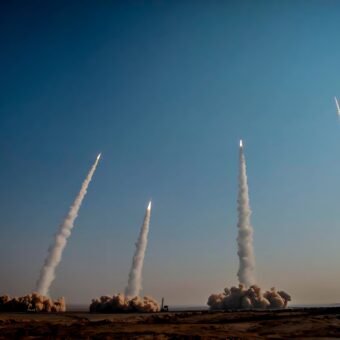
A Capsule of Round One Heroics
October 6, 2025 -

Alastair Crooke & Judge Napolitano : Israel Losing US Support Fast
September 29, 2025 -
Russia on Iran Snap-Back Sanctions
September 26, 2025
I hate to say, “I told you…”, but it is pretty much the case now.
what is the alternative? Submit to satanic savages who arrogantly offer only two choices: return to servitude or nuclear war? There are states of living far worse than death to peoples of honor… The good news, evident in last days, is that the Iranian system has been live-tested and is… Read more »
“the truth is that the level of mutual trust between these three actors is not the highest, especially with regard to Iran.” I don’t know either way, but I do notice that neither China nor Russia ever make such a public show of solidarity without there being substantial behind the… Read more »
dear K, i share your pov, varying only on: ‘china, iran & russia are among the very few countries in the world to have never been conquered by west, how very coincidental that these exact 3 are forming an alliance.” all 3 (again coincidentally) have cruelly endured empire’s rape &… Read more »
Yes i agree with all of that too emerson, and to add a potent post from Indica on the “three serious countries”:
https://indi.ca/talk-is-cheap-trump-cant-negotiate-because-no-one-believes-him/
lol, thank you, K.
Hi every one, thanks for your comments. All very articulated and valid. Let me add some bits here. Apologies if it gets too long. I will try to address points made by different readers. 1 – I think that, until it become facts, politics is about words and postures. Indeed,… Read more »
I’m beat, typing quickly on smartphone and may say more tomorrow, my time. But Quantum, it ain’t so simple. Everything you say is relevant, but has been factored in and gamed decades ago. I look it at from the spiritual perspective, feeling the mood of the tormented people of the… Read more »
I understand you call from a spiritual point of view. But high spiritual standards is all what the Beasts of No Nation — to remind Fela Kuti powerful messages — lacks. West is done morally since many centuries. I also suspect the Persians were the ones that refused it. If… Read more »
The term “Beasts of No Nation” is an excellent descriptor for the supranational zionazis who rule both the combined West and the last iteration of Harlot Babylon. I tend to use “Legion” or “Horde” The love I have for Juche and the Persians is immense. it is understandable why both… Read more »
Three things come to mind. First, the US withdrew from the JPCOA in May, 2018. We had no SMO at the time and China was still somewhat in its shell. We saw the beginnings of an uptick of commentary by China’s Foreign Affairs diplomatic corps around that time, but it… Read more »
Iran is not “weak and isolated” – even without Russia and/or China. They can defend themselves against the entire combined West on their own turf, as Russia does now. Their hair “would be mussed”, but they would outlast them, as does far poorer, less advanced & numerous and far less… Read more »
AHH, all I mean by the ‘weak and isolated’ is that the US expected that. Bear in mind Bibi’s influence here. But when they washed out their eyes one fine morning, they found that they were not talking to Iran alone, but to Iran, Russia and China. I agree that… Read more »
the zionist colony, empire’s aircraft carrier in west asia, is now its ‘trembling puppy’, bloodied, too torn to salvage. iran’s patience is sinking it silently
Thank you Quantum. This entire issue is maddening and unclear to those of us on the outside. Persia, like the other deep civilizational-states, has always been thus. We cannot make judgment without all the data.. I do not think it is a strategic mistake. They stuck to their principle, declaring… Read more »