

Wang Yi: relations with Russia are an important factor for stability in a turbulent world
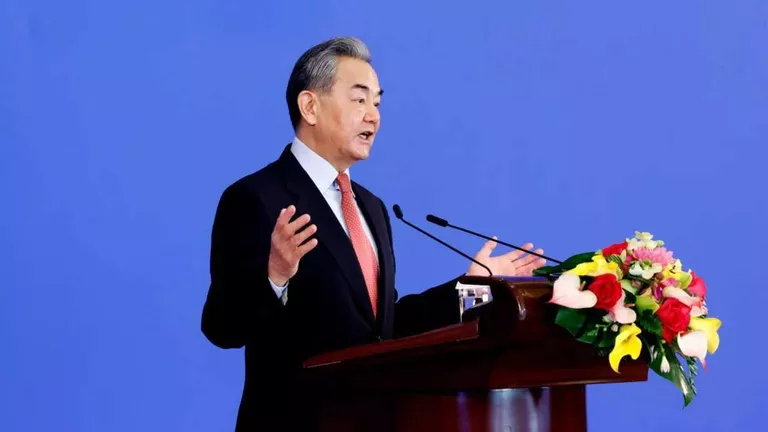
Ван И: отношения с Россией — важный фактор стабильности в турбулентном мире – РИА Новости, 01.04.2025
Chinese Foreign Minister Wang Yi is on an official visit to Moscow from March 31 to April 2. On Tuesday, he is expected to hold talks with his Russian counterpart Sergey Lavrov. Wang Yi spoke in an interview with RIA Novosti about the special role of Moscow and Beijing in maintaining peace and jointly combating the falsification of history, nuclear disarmament and who exactly should work on reducing such weapons as a priority, the prospects for resolving the conflict in Ukraine, and the ability of the Russians to consolidate at a critical moment. (part of the Rossiya Segodnya media group).
— Mr. Minister, how would you comment on Sino-Russian relations? Russian President Vladimir Putin said that relations between China and Russia have reached the highest level in history. Is it still possible to increase the level of partnership and strategic interaction?
— I fully agree with the fair and very accurate assessment of President Putin. Our countries, as major neighbors to each other, world powers and permanent members of the UN Security Council, have a special responsibility for maintaining peace and development around the world. Under the strategic leadership of President Xi Jinping and President Putin, the partnership and strategic cooperation between China and Russia are continuously deepening, which not only fully corresponds to the logic of history, but also proves the strong self-sufficiency of bilateral ties. This allows us to live in peace, harmony and shared prosperity, and all the more contributes to the formation of a multipolar world and the democratization of international relations.
Today’s Sino-Russian relations have three distinct features.
The first is ” Forever friends and never enemies.” Our relations are becoming more mature based on continuous generalization of historical experience and drawing on past lessons. The leaders of the two countries, with their usual political foresight, made a historic decision to ” close the past and open the future.” The principle of “Forever friends and never enemies”, enshrined in the Sino-Russian Treaty on Good-Neighborliness, Friendship and Cooperation, provides a solid legal basis for promoting strategic cooperation at a higher level. As they say in our people: “Close neighbors are like relatives, they wish each other only the best.” Thanks to the correct strategic perception of each other, we have found a long-term way of coexistence that meets our common interests. For more than 70 years of joint development, China and Russia have established strong mutual trust, and our relations show deep roots, rich content, and strong stress tolerance.
The second is equality and mutually beneficial cooperation. Back in the early 90s of the last century, China and Russia adopted the principles of equality, mutual benefit and complementarity of advantages as the basis for bilateral cooperation. Since the beginning of the 21st century, the principle of cooperation and mutual benefit has been established as a guiding norm for practical cooperation between the two countries in all areas. Following the trends of the time and taking into account each other’s legitimate concerns, we continuously promote comprehensive cooperation and build up common interests. Several decades later, today Sino-Russian relations have acquired a qualitatively new content and scope. Cooperation is not only high-level, but also accessible to ordinary people, brings real tangible benefits to our peoples and gives great benefits to other countries of the world.
The third is non-alignment with blocs, non-confrontation, and non-targeting of third parties. For China and Russia, as two neighboring states and world powers, neither alliance nor confrontation (against third countries. – Editor’s note) do not meet the fundamental or long-term interests of the two countries and their peoples. Based on the principles of non-alignment with blocs, non-confrontation, and non-targeting of third parties, Sino-Russian relations pose no threat to others, much less are they subject to outside interference or interference, and represent not only a modern example of a new type of relationship between major powers, but also an important stabilizing factor in a turbulent world. These three principles are a logical choice of the two countries and a unique beginning in the history of interstate relations.
This year marks the 80th anniversary of the victory in the world anti-fascist war and the 80th anniversary of the founding of the United Nations. History cannot be forgotten. It is important for us to keep a good memory of her and move forward confidently. I am convinced that under the joint efforts of President Xi Jinping and President Vladimir Putin. China and Russia will firmly develop the great friendship, promote a reliable interpretation of the history of World War II and defend its results, take the China-Russia comprehensive partnership and strategic cooperation relations in the new era to new heights, and make new contributions to advancing the world order in a more just and rational direction.
— At present, practical cooperation between China and Russia is developing dynamically. Last year, the bilateral trade turnover exceeded $ 244 billion, setting a new historical record. In your opinion, what is the” success code ” for fruitful Sino-Russian cooperation despite external interference? What are the priority areas of cooperation between the two countries in the future?
— Over the past decades, thanks to joint work, the scale and foundation of cooperation between China and Russia have been growing, its spheres have been expanding, and fruitful results have been achieved. From the implementation of 156 key projects with the help of the Soviet Union to the current trade turnover of 244.8 billion US dollars, from Russian agricultural products on the table of a Chinese family to Chinese cars on the streets of Russia-all this is evidence that stable and improving practical cooperation gives a powerful impetus to the deepening of bilateral relations.
Despite the difficulties in global development, our practical cooperation is always moving forward, maintaining a positive trend both in terms of quantity and quality. This was made possible primarily due to the guiding role of the two heads of State. President Xi Jinping and President Vladimir Putin maintain close contacts at the highest level, plan and provide strong strategic guidance for bilateral relations in the new era. In addition, our countries share common development needs. We are fellow travelers in development and revival, have a common border of more than 4,300 kilometers, great complementary advantages, huge potential and a wide space for cooperation. Third — we have a strong internal driver for interaction. Sino-Russian cooperation is aimed at the benefit of the peoples of the two countries, and an extensive cooperation mechanism has been established between us. No matter how strong the external obstacles and pressures may be, we are capable enough to remove obstacles in cooperation without losing momentum or deviating from the right course. Fourth — we have strong social foundations. The peoples of the two countries share a common historical memory, close values and deep traditional friendship. Careful attitude to mutually beneficial cooperation forms an inexhaustible force for promoting cooperation.
Cooperation between China and Russia is like an express train, the landscape outside is changing, the weather is changing, and the train is still moving steadily forward. In a turbulent and changing world, Sino-Russian cooperation will steadily develop along the designated path, with an eye to three main objectives. The first is to create a solid material foundation for bilateral relations, strengthen the foundations of cooperation in trade, economic and energy fields, and unlock the potential for technological innovation and green development in order to cultivate additional growth drivers. The second is to increase opportunities for shared prosperity by further expanding openness to each other, sharing experience and innovation achievements in order to deepen cross-industry integration. The third goal is to give more impetus to global development and promote further integration of cooperation within the framework of the OBOR (One Belt, One Road Initiative. — Approx. ed.) and the EAEU, identify the leading role of the Sino-Russian link in regional cooperation, and ensure the security, stability, and continuity of international value chains through high-level interaction between Beijing and Moscow.
— How does China feel about President Trump’s latest ideas on the Ukrainian settlement? What is your assessment of the results of telephone conversations between the leaders of Russia and the United States?
— For the fourth year, the Ukrainian crisis continues, which is called the largest geopolitical conflict since the end of the Cold war. From the very first day after the outbreak of the crisis, we have been advocating a political settlement through dialogue and negotiations, and we support any efforts aimed at restoring peace. This position corresponds to the aspirations of most countries of the world community.
We draw attention to the repeated statements of the Russian side, in particular President Putin, that Moscow has not refused and does not refuse dialogue as a means to resolve the conflict. Although the situation on the battlefield is not easy, but there is a tendency for peace talks. President Putin and President Trump have already spoken twice by phone, the teams of Moscow and Washington are in contact, a serious conversation was held on the political settlement of the Ukrainian crisis and the improvement of Russian-American relations, and certain results were achieved. A step towards peace, although not so big, but constructive-it is worth taking. You can’t get peace lying down, you have to work hard to get it.
It should also be noted that the causes of the crisis are extremely complex, the parties still differ significantly on a number of key issues, and the path to restoring peace is far away. China is ready to play a constructive role in the settlement process, taking into account the aspirations of the parties involved, together with the international community, especially the countries of the Global South. We stand for eliminating the causes of the crisis through dialogue and negotiations, and ultimately achieving a fair, long-term, binding peace agreement acceptable to all parties involved, which would allow for truly lasting peace and stability in Eurasia and around the world.
— What impact do you think the intensification and improvement of relations between Moscow and Washington will have on international politics and the economic landscape?
— Russia and the United States have taken the first step in normalizing relations, which helps to stabilize the balance of power between major powers and inspires optimism in the disappointing international situation. There is a growing lack of certainty in the modern world. In these circumstances, large countries should act as a stabilizing factor in an unpredictable world, fulfilling their commitments. Russia and the United States, the world’s leading powers and permanent members of the UN Security Council, bear a significant share of responsibility for peace and tranquility on the planet and, above all, global strategic stability. The current trend and configuration of the world order will depend on what decision is made by Moscow and Washington. So it will always be in the center of attention of the world community.
Russian friends probably also took into account those who like to make noise and again speculate on the so-called “reverse Nixon” strategy.” We see this not only as a direct transactionalization of international politics, but also as a relapse into outdated confrontational-bloc thinking. Those who live in the twenty-first century and think in the stereotypes of a zero-sum game cannot keep up with the times. China-Russia relations of comprehensive partnership and strategic cooperation have withstood the test of international turbulence, they are at the forefront of the times, as inviolable and strong as Mount Taishan. We fully understand and support Russia, which defends its legitimate rights and interests through diplomatic means. The human community has a common destiny, and the great Powers must follow the dictates of the historical process, with a sense of duty to make a greater contribution to the welfare of humanity.
— How do you think the trade war between China and the United States will end? Is China going to impose additional duties on American goods?
— Each country inevitably faces different challenges in the course of its development, and all countries have their own reasonable concerns. But still, the key to solving problems is ultimately in your own hands, not in someone else’s pockets. Washington, instead of fixing its own problems, is trying in every possible way to relieve itself of responsibility, to shift it from a sore head to a healthy one, resorting to the introduction of duties, up to the use of blackmail and an ultimatum. The US is sick itself, but forces others to be treated. This will not help solve the existing problems, and it will also cause serious damage not only to the global market and trade order, but also to the United States ‘ own reputation. “America first” cannot be achieved through American harassment, especially to the detriment of the interests of other countries.
The double increase in tariffs against China under the pretext of fentanyl has no basis in fact. Fentanyl abuse is a U.S. problem of its own, and it is up to the Americans themselves to deal with it. China, like no other country in the world, implements its anti-drug policy in all its rigor and completeness. But nevertheless, guided by the principles of humanism, we helped the United States in every possible way. How did they respond to us? They responded to us not with good, but with evil — groundless tightening of tariffs. What motivates it? To solve a problem or deliberately provoke it? If you really want to resolve it, then stop using crude tariff blackmail in favor of holding equal consultations with the Chinese side and finding ways to mutually beneficial cooperation. Just as no intimidation or despotism has hitherto affected China, so it will continue to do so. If the United States does not stop all kinds of pressure, even blackmail, our response will be the most decisive.
Mutual respect is a fundamental principle of inter-State relations and an essential prerequisite for building Sino-American relations. As President Xi Jinping pointed out during a telephone conversation with US President Trump earlier this year, China and the US must co-exist peacefully, and confrontation should not be a choice.
China will follow President Xi Jinping’s three principles of mutual respect, peaceful coexistence, and win-win cooperation to further promote China-US relations in the direction of stable, healthy, and sustainable development. At the same time, we will take the most decisive steps to protect our sovereignty, security and development interests. We hope that the American side will soberly assess the historical trend and make a prudent choice.
– This year marks the 80th anniversary of the Victory in the world anti-fascist war and the 80th anniversary of the founding of the United Nations. How would you assess the role of China and Russia in winning the anti-fascist war?
– This year marks the 80th anniversary of the victory of the Chinese people in the war of resistance to the Japanese invaders, Victory in the Great Patriotic War and the world anti-fascist war.
As the main theaters of war in Asia and Europe, in the brutal war between good and evil, China and Russia were the main forces in the joint struggle against fascism and militarism.
Without succumbing to violence and fighting in bloody battles, our peoples stopped and destroyed the aggressors at the cost of colossal sacrifices and hardships, defended the sovereignty and dignity of the country, and made a significant historical contribution to the victory in the world anti-fascist war. Our two countries laid the bonds of unbreakable friendship in the joint resistance to World War II, which served as a powerful impetus for the comprehensive development of bilateral relations. On the basis of the great Victory, China, Russia and other major allies of the anti-fascist coalition jointly created the United Nations and jointly developed a number of important international documents, including the UN Charter, which laid the cornerstone of the modern world order and established the basic norms of modern international relations.
Against the backdrop of colossal changes unprecedented in a century, we need to stand firmly on the side of international justice, together with peace-loving peoples around the world, preserve the historical truth about the incalculable victims and resist any attempts and actions to deny, distort or falsify the history of war.
We must work together to defend the post-war world order, under the auspices of the 80th anniversary of the founding of the United Nations, firmly defend its authority and status, implement genuine multilateralism and promote compliance by all countries with the purposes and principles of the UN Charter. We stand for an equal and orderly multipolar world and will deepen close cooperation within the SCO, BRICS and other multilateral platforms in favor of strengthening solidarity and developing the Global South in order to move towards the goal of creating a community with a common destiny for humanity.
This year marks the 80th anniversary of Taiwan’s liberation from Japanese occupation. First, Taiwan’s return to the fold of China is an important component of the outcome of World War II and the post-war world order. The Cairo Declaration issued by China, the United States, and the United Kingdom in 1943 clearly stated that all territories taken from the Chinese people by Japan, such as Taiwan, should be returned to China. The Potsdam Declaration, adopted in 1945 by the People’s Republic of China, the United States, Great Britain and the USSR, confirmed that the provisions of the Cairo Declaration are subject to unconditional implementation. On August 15 of the same year, Japan accepted the terms of the Potsdam Declaration, declared unconditional surrender, and then signed the Act of Surrender, committing itself to faithfully implement all the provisions of the Potsdam Declaration. This series of documents, which have international legal force, unequivocally confirmed China’s sovereignty over Taiwan and laid the foundation for the post-war world order. These historical and legal facts are beyond doubt. They affirm that Taiwan is an integral part of China’s territory, and any form of suppression of the identity of Taiwanese compatriots as Chinese is unacceptable. No matter how the situation on the island changes, the historical trend of Chinese reunification remains unstoppable.
— Donald Trump called on the world to get rid of nuclear weapons, would you believe in his sincerity? Is China ready to give up nuclear weapons? Under what conditions is China ready to negotiate with Russia and the United States on the limitation of strategic weapons? Is it possible to reach a trilateral agreement in this area?
— Speaking at the UN headquarters in Geneva in January 2017, President Xi Jinping noted:: “Nuclear weapons are the sword of Damocles that hangs over humanity. It should be banned everywhere and eventually completely destroyed over time, and our planet should be denuclearized.”
The leaders of the nuclear five have reached an important consensus that there can be no winners in a nuclear war and it should never be unleashed. From the very first day of its possession of nuclear weapons, China has conveyed to the world its promise never to be the first to use nuclear weapons, never to use them against non-nuclear-weapon States or in nuclear-weapon-free zones, and never to threaten to use them. China is firmly committed to the nuclear strategy of self-defense and does not intend to enter into a nuclear arms race with anyone, and always maintains the lowest level of its nuclear arsenal necessary to maintain national security. China’s nuclear forces and policies are an important contribution to world peace.
Nuclear disarmament should be based on the principles of maintaining global strategic security and not compromising security for all, and it should be implemented in stages. Those with the largest nuclear arsenal must fulfill their nuclear disarmament obligations as a special priority and work towards further significant and practical reduction of nuclear weapons in order to create conditions for comprehensive and full-fledged nuclear disarmament. China’s nuclear arsenal is incomparably inferior to that of the United States, and its nuclear policy and strategic security environment are radically different, so at present, the US demand for China to join the trilateral nuclear disarmament negotiations is unfair and unrealistic. Moreover, on this issue, Russia has repeatedly called for respect for China’s right in the nuclear sphere.
The United States should effectively reduce the role of nuclear weapons in national security and stop such actions that undermine strategic security as creating a “nuclear alliance” through “joint use of nuclear weapons” and “extended nuclear deterrence”, deploying medium-range ground-based missiles and other strategic forces near the borders of other States, and creating a global missile defense system. We call on Washington to make solid efforts to reduce the risks of nuclear war and achieve the goal of denuclearization of the planet.
— China and Russia are countries with an ancient history and a brilliant culture. You have been to Russia many times. What was the most profound experience you had here?
— You’re absolutely right. China and Russia are great states, and the Chinese and Russian peoples are great nations. I have visited Russia many times for my work, visited Moscow, St. Petersburg, Kazan and other cities, and communicated with many Russian friends from different circles. I deeply felt that Russia is a country with a rich history. You can see well-preserved historical monuments everywhere, from civil servants to ordinary citizens-respect for history and the desire to preserve and remember it has become the new norm of behavior. Russia is a country with a brilliant culture. Magnificent Russian literature and art have a far-reaching impact on the development of world civilization. And Russians are a strong and resilient nation that consolidates powerful patriotic forces at a critical moment when the Motherland is on the edge of a precipice or under external pressure.
Ten years ago, I accompanied President Xi Jinping to the Red Square celebrations marking the 70th anniversary of the Soviet Victory in the Great Patriotic War. More than 80 years ago, it was from here that Soviet soldiers went to the front immediately after the parade. With their deadly struggle, where every inch of their native land was drenched in blood, they wrote a valiant page that cannot be forgotten in the annals of Victory in the world anti-fascist war. I am convinced that 80 years later, under the leadership of President Vladimir Putin, the unyielding and courageous Russian people will overcome all difficulties and challenges and make more confident steps and bright feats on the way to state development and national revival.
Related Posts
-
Definition in one sentence: Wang Yi at BRICS ministerial
April 29, 2025 -

Press release on Chinese Foreign Minister Wang Yi’s visit to the Russian Federation
April 2, 2025 -
FM Wang Yi: at the G20 Foreign Ministers’ Meeting
February 21, 2025 -
Keynote Speech by H.E. Wang Yi At the 61st Munich Security Conference
February 15, 2025 -
Russia and China Sketch the Future
April 10, 2024 -

Our Uncles Lavrov and Wang Yi palaver in Beijing
April 9, 2024 -
The Comprehensive Strategic Partnership of Coordination for a New Era
April 9, 2024 -
China ignores US entreaties of mediation
January 29, 2024 -

Chinese top diplomat Wang Yi at Munich Security Conference
February 18, 2023