

Saudi Arabia’s $600 Billion Investment in the United States: Strategy and Economics

Saudi Arabia’s recent announcement of a $600 billion investment and trade commitment to the United States over the next four years marks a significant milestone in bilateral relations, reflecting both economic ambition and geopolitical strategy. Let us examine the context, motivations, and implications of this historic pledge.
The Announcement and Context
On January 23, 2025, Crown Prince Mohammed bin Salman (MBS) informed U.S. President Donald Trump of Saudi Arabia’s intention to invest $600 billion in the US during their first phone call following Trump’s inauguration. Thepledge dwarfs the 450 billion agreement linked to Trump’s 2017 visit to Riyadh, which included arms deals and infrastructure projects.
Key drivers behind the announcement include:
- Trump’s Renewed Focus on Gulf Ties: Trump’s suggestion of revisiting Saudi Arabia as his first foreign trip—contingent on Riyadh purchasing $500 billion in U.S. products—highlights his transactional approach to diplomacy 11214.
- Saudi Vision 2030 Alignment: The investment aligns with MBS’s economic diversification agenda, reducing reliance on oil revenues through global partnerships. Projects like NEOM, a $500 billion futuristic city, and preparations for the 2034 FIFA World Cup require foreign capital and expertise 1516.
- Post-Pandemic Economic Pressures: Depressed oil prices since the COVID-19 pandemic have strained Saudi finances, necessitating strategic investments to stabilize long-term revenue streams.
Economic and Political Motivations for Saudi Arabia
- Diversification Beyond Oil: Saudi sovereign wealth funds, such as the Public Investment Fund (PIF), have already acquired stakes in U.S. tech firms, sports teams, and infrastructure projects. The $600 billion pledge aims to deepen these ties, leveraging U.S. innovation and markets to fuel Saudi non-oil sectors.
- Defense Dependencies: Saudi Arabia remains heavily reliant on U.S.-made weapons systems, which likely form a portion of the investment. Past deals, such as the $12.5 billion arms sale in 2018, underscore this interdependence 115.
For the United States
- Job Creation and Economic Growth: The influx of capital could revitalize industries like renewable energy, AI, and defense manufacturing, aligning with Trump’s “America First” agenda.
- Geopolitical Leverage: Strengthening ties with Riyadh bolsters U.S. influence in the Middle East, strengthens the internally powerful myth of countering Iran and a promise of stabilizing regional conflicts.
Strategic Implications and Controversies
-
- Ethical Concerns: Critics highlight potential conflicts of interest, such as Saudi Arabia’s 2-billion investment in Jared Kushner’s private equity firm. The lack of transparency aroundthe 600-billion allocation—whether from public or private funds—raises questions about accountability.
- Regional Rifts: Trump’s 2017 visit triggered a Saudi-led boycott of Qatar, illustrating how U.S.-Saudi collaborations can destabilize regional dynamics.
- Human Rights Tensions: Despite bipartisan criticism over the long since forgotten Jamal Khashoggi’s assassination (Trump played judge at the time and said he does not think Saudi did this) and Saudi human rights abuses, Trump has prioritized economic gains over ethical scrutiny. Saudi Arabia leaves the global majority with the question of whose side they are on? Global Majority, BRICS or Empire.
Challenges and Risks
-
-
- Budgetary Pressures: Saudi Arabia’s ability to meet this pledge is uncertain. With oil revenues declining and massive domestic projects like NEOM underway, the kingdom risks overextending financially.
- Market Volatility: The investment’s success hinges on stable U.S. economic policies. Trump’s deregulatory reforms, while praised by MBS, could face opposition, impacting projected returns.
-
Conclusion: U.S.-Saudi Relations
Saudi Arabia’s $600 billion investment signifies a bold fusion of economic pragmatism and geopolitical ambition. For the U.S., it offers short-term economic benefits but poses long-term ethical and strategic dilemmas. As both nations navigate shifting global power dynamics, this partnership will test the balance between profit and principle. Whether it fosters mutual prosperity or deepens existing divides, the deal underscores the internet age’s reality: in modern geopolitics, capital is as influential as diplomacy or the strategy of chaos.
I discussed this matter with some Muslim commentators and came away from there with little trust, in anyone.
-One of the issues that were discussed was that investment, of course, is not only supportive to the investee but hugely extractive, i.e., such an investment could extract as much as 5 to 6 dollars for each dollar invested, and it is a good thing to extract that from the empire. This looks good, but we all know that the US is currently on a tear for money. This seems to me valid, but short-term. Who knows how long this empire will still stand on its feet, and who can balance the two concepts, investment and extraction, in today’s turbulent circumstances?
-Another discussion point was that this is a-national money, i.e., it cannot be seen in the same light as a national investment. An investment of this nature is from the big and quiet money, that has no conscience. Yet, in our eyes standing on the outside, it sure seems as if the locus of this money is in Saudi Arabia. Who, then is the one that must have a conscience? While all of this happening, which direction are the guns pointing to?
Finally, the support and empowerment for Trump or what he already has taken and owned as support, is clear. In his World Economic Forum speech to Davos, here are two takeaways:
🔹I will ask Saudi Arabia and OPEC to bring down oil prices. (On the other hand, the US has so much oil that it will dominate the market, he says, so he is begging for a cheap entry to the world market and feels he has Saudi Arabia in his pocket now.)
🔹If oil prices came down, the Ukraine conflict would end immediately (Wishful thinking.)
This remains an uncomfortable event, no matter how you slice it or how pragmatically you approach it.
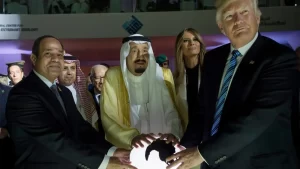
Trump’s previous visit with the Orb:

Related Posts
-
Pilgrims are under threat
May 28, 2025 -

Saudi Arabia spearheads ‘Arab alternative’ to Trump’s ethnic cleansing plan for Gaza: Report
February 14, 2025 -

Saudi Arabia: The philosophy, the views, the future
February 6, 2025 -
Chronicle of a Death Foretold
June 14, 2024 -

How Saudis overcame “reputational damage”
December 5, 2023 -

What Are The Saudis Really Preparing For?
November 27, 2023 -

The US is dangerously playing with fire off the coast of China
June 7, 2023 -

From Enemies to Friends: The Surprising Rapproachement between Saudi Arabia and Syria Explained
April 14, 2023 -

Five days with Wang Yi: winners and losers + update
March 11, 2023
Trump has upped the ante and asked that Saudi Arabia up its investment to 1 trillion dollars: “I’ll be asking the crown prince, who’s a fantastic guy, to round it out to around one trillion. I think they’ll do that because we’ve been very good to them,” Trump said. Trump… Read more »
Does “investment” mean the same in this case as it does for US “investment” in other countries? If so it will mean that The Saudis will own a great big chunk of what used to be America.
They already do. Vast stretches of US/Canada are owned by Asians with more money than sense. It is like owning fiat monopoly money or Russian forex deposits in West — it will be taken away at will. Useful ploys to prevent development of their own lands, or the Global South,… Read more »
Yes. I quipped during the conversation that we had. “So that does mean crudely stated that Saudi is buying the empire?” lol. It did not go down well. I picked up somewhere that this is the biggest investment of this kind ever.
yes i have never heard of anything close to this. Its as insane as everything else going on right now.
they shall be milked until the teats fall off!
And thus ends the current 5,000 year cosmic time cycle, which reached its apex in a toxic soul denying and one sided Patriarchal egoism. Right on time to clear space for the emergence of a new world uniting civilizational paradigm. But first the clearing operation.