

BRICS: The Real Reason why Asian nations are joining
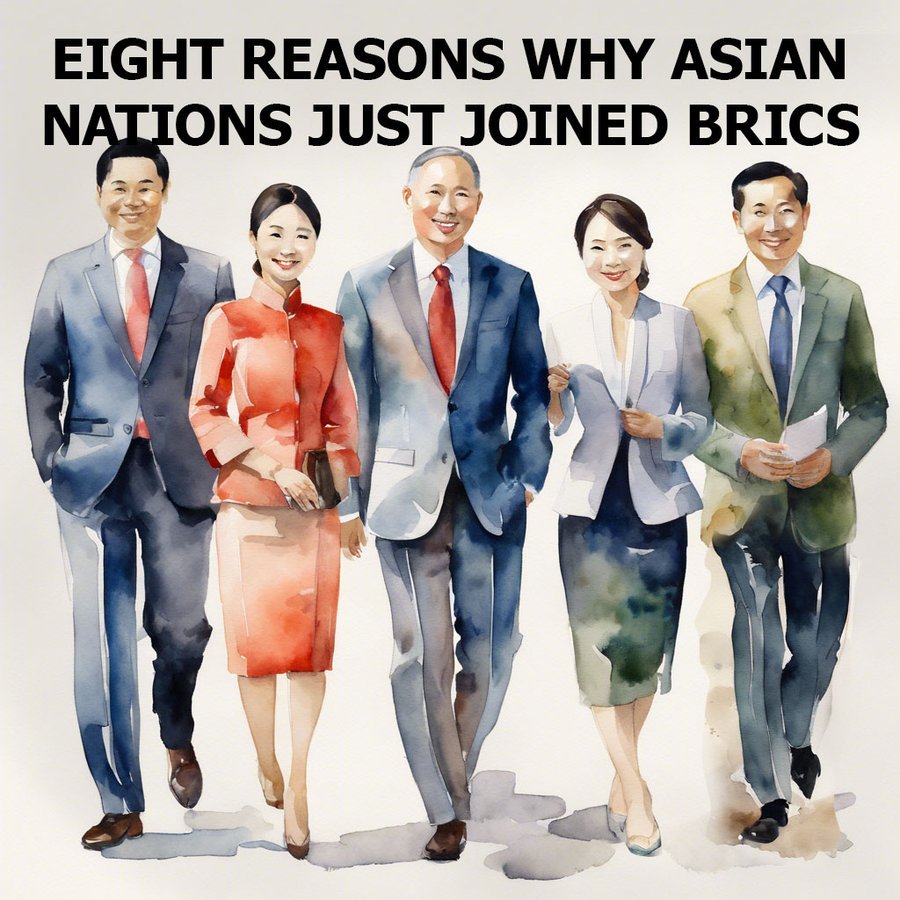
THE REAL REASON why Asian nations (next week, Indonesia, Malaysia and Thailand, among multiple new members) are officially joining BRICS has nothing to do with politics.
It’s about rice. And schools. And the Ringgit. And most of all, it’s about Not Having Another War.
Eight under-the-radar BRICS issues:
1) NEW CUSTOMERS: In October this year, BRICS launched a plan for a Grain Exchange, proposed by Russia. Asian countries see it as a huge trade opportunity. BRICS is already the world’s biggest producer of grains, oilseeds, and legumes.
Thailand’s rice exports are climbing, and Malaysia and Indonesia produce roughly 80 per cent of the world’s palm oil. Malaysia is an import buyer of wheat.
Vietnam, edging towards full BRICS membership, wants to sell more rice.
) VALUING EDUCATION: China is famous for its strong education systems: a key component of development.
The country will open 10 learning centers in BRICS countries in the next five years, and provide training opportunities for 1,000 local education administrators, teachers and students.
3) A FAIR CURRENCY SYSTEM: BRICS encourages and enables countries to find ways to use local currencies, to make trade more fair.
Compare this to the United States where Donald Trump is making dire economic threats against any nation that dares to stop using the US dollar for international trade. The difference in attitude is breathtaking.
Research is progressing on creating an impartial bank transfer system after the US politicized SWIFT, tainting it.
4) SCIENTIFIC CO-OPERATION: Western geopolitics has led to insane decisions, such as moves to cut Russia and China out of scientific academia. (If scientists in Samara discover a new element, does the west have to pretend they live in a world without it?)
In contrast, BRICS is creating venues for MORE cross-border collaboration. In 2019, the BRICS Technology Transfer Center online platform was launched, with translation functions in 17 languages. More recently, the China-BRICS AI Development and Cooperation Center, and the China-BRICS Science and Innovation Incubation Park for the New Era, were established.
Chinese and Russians are good at science. You have been warned.
5) DEVELOPMENT: Many Asian (and Western) countries have watched in amazement as China came from nowhere to overtake them in 100 different ways. The country wants to help other nations to develop.
BRICS not only supplies Chinese knowhow and expertise for infrastructure projects, but provides investment funds through the New Development Bank. Since 2018, the bank has financed projects totalling US$33 billion.
6) FAIRNESS: Both Biden and Trump bleat regularly that “America must be number one” but no one ever asks “Why?”
Compare that with the “true multilateralism” that is the focus of BRICS meetings. It’s not a case of “who is going to win, east or west?” It’s a case of asking: Why does one side’s leadership not want a fairer world?
In October 2023, even the ludicrously pro-swamp magazine Foreign Policy printed an article titled: “Yes, the World Is Multipolar”.
7) A GLOBAL MANDATE: US Secretary of State Antony Blinken talked endlessly about the “rules-based order” while his country was and is one of the worst offenders against the international guidelines that try to make the world a fair place.
America has refused to sign and/ or ratify at least 40 international treaties.
The US has also extracted the teeth of the World Trade Organization.
And the US-backed slaughter in Gaza has turned the west’s moral high ground into a gulf the size of the supermassive black hole in the Ton 618 galaxy.
At present rates of growth, BRICS will soon have a mandate of the majority of the world’s population. But China has already made itself the champion of free trade and the WTO, while the west has increasingly reversed into thinly disguised protectionism.
This has been true for several years. In a 2020 publication, the Barcelona Center for International Affairs think tank said: “Xi Jinping is now the strongest defender of free trade on a global scale and of action to combat climate change.”
8.) ANTI-WAR: But perhaps the strongest argument in favor of BRICS is that it is anti-war. War is bad for trade. It’s also bad for humans. Sorry, Elbridge. Asians don’t want another war.
The western model is to make security alliances focused on a designated “hot war” enemy. Aukus, the Quad, NATO, and so on, are designed to train armies to jointly fight wars against US competitors or “adversaries” such as China or Russia or Iran. (On Saturday, Donald Trump said NATO members must double their military spending to 5 per cent of GDP.)
This is in stark contrast to the message from BRICS. Member countries are called upon to “advocate a new type of security that features dialogue over confrontation and partnerships over alliances” – a summing-up by Chinese leader Xi Jinping at the October 2024 BRICS gathering in Kazan.
THINK ABOUT THAT
Think about those words for a moment. For decades, Chinese officials were infamous for turgid impenetrable speeches—but look at how clear and carefully chosen Xi’s words were: “dialogue over confrontation” and “partnerships over alliances”. In an alliance, the focus is on ganging up against others. In partnerships, the focus is on collaborating positively.
The west’s stranglehold over the international media means that it is almost impossible to get this message out into the world. Luckily, the people in Southeast Asia are not looking at Fox or CNN or the BBC or AFP or Reuters.
They just want someone to buy their rice. And a BRICS grain exchange, which will be open to the Ringgit or Baht in their pockets, might just be the answer to their dreams.
Related Posts
-
BRICS : The excitement grows
September 10, 2026 -

Da Demented Donroe Debacle
January 7, 2026 -

Apocalypse in Gulf is now or never
October 8, 2025 -

Russia on Iran Snap-Back Sanctions
September 26, 2025 -

The Choice is Stark – Global Governance or Barbarism
September 21, 2025 -

From Tianjin and Beijing to Vladivostok, the Eurasia High-Speed Train Keeps-a-Rollin’
September 9, 2025 -

New World Order
September 5, 2025 -

From Zhongnanhai to Vladivostok
September 4, 2025 -

Last Chinese warning
August 31, 2025 -

Russia-China: From The Memory of WWII to BRICS/SCO Synergy
August 29, 2025