

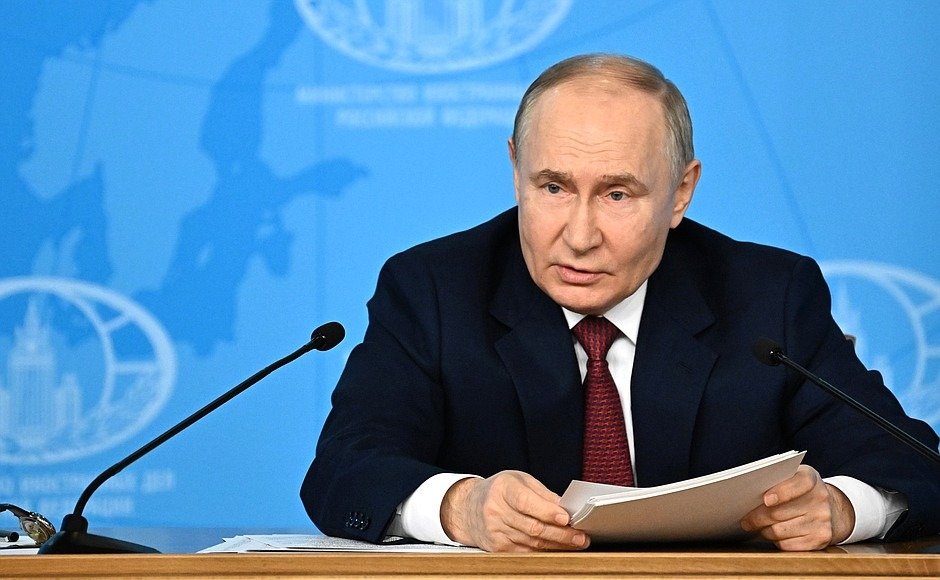
President Vladimir Putin: speech at the extended meeting with the collegium of the Russian Ministry of Defense (MoD).
Update: Formal transcript added
Comments from Sputnik:
President Vladimir Putin addressed the Russian Defense Ministry board, summing up the year’s developments in the military operation in Ukraine. He also discussed the global situation and outlined other measures to ensure the country’s security.
Russian President Vladimir Putin outlined key objectives for strengthening the country’s defense capabilities and advancing the Armed Forces during an expanded session of the Defense Ministry board.
He also highlighted significant achievements and ongoing challenges faced in 2024.
“Today, we will review the main results of work over the past year, define tasks for strengthening defense capabilities and further develop the Armed Forces,” Putin stated.
He stressed the importance of improving the armed forces’ combat readiness and capacity.
“We are paying serious attention to improving the combat structure of our Armed Forces and increasing their potential,” Putin said.
Advances Against Ukraine
Reflecting on 2024, Putin called it a pivotal year in achieving the goals of the special military operation. “This year, 189 settlements were liberated,” he said, noting that Russian forces hold the strategic initiative along the front line. “Thanks to the professionalism and courage of our soldiers, the heroic work of defense industry workers and the nationwide support for our army and navy, our troops maintain firm control over the strategic initiative,” the president said. He expressed deep gratitude to those on the front lines and in supporting roles.
“I want to sincerely thank our heroes — soldiers and officers — who fight selflessly on the front lines, as well as the personnel of the Ministry of Defense, the National Guard and special services,” Putin said. “They carry out even the most difficult tasks without sparing themselves or their lives for victory and for the Motherland.”
The president underscored the need for continued vigilance and unity, reaffirming the government’s commitment to ensuring the country’s security and achieving its strategic goals.
Turning to external challenges, Putin accused the United States of fueling the conflict in Ukraine by supplying weapons, funds and military advisors.
“In an effort to weaken our country and inflict a strategic defeat, the US continues to pump weapons and money into the illegitimate regime in Kiev, encouraging further escalation of the conflict,” he said.
US Aspirations for World Dominance
Putin described the global military-political climate as both challenging and unstable, pointing to ongoing conflicts and heightened tensions in multiple regions.
“Today, the military-political situation in the world remains challenging and unstable,” Putin stated during an expanded session of the Defense Ministry board.
He highlighted the persistent violence in the Middle East and the growing risk of conflict elsewhere. “The bloodshed in the Middle East does not cease, and there is significant conflict potential in several other parts of the world,” Putin noted.
He also accused the US of waging covert warfare and enforcing a policy of containment against nations it calls its opponents, including Russia.
“The US imposes its so-called ‘rules’ on the international community, constantly changing and manipulating them as it sees fit,” the Russian leader said. “For them, the only stable rule is that there are no rules.”
“We see the US administration and the collective West relentlessly trying to preserve their dominance, pushing their rules on the global community and manipulating them as they see fit,” Putin said.
He also noted the formation of new military-political alliances, driven by the US, which he argued are undermining decades-old security frameworks.
“The US is initiating the creation of new alliances that disrupt the established security architecture,” he said.
Putin expressed concern over NATO’s growing presence in the Asia-Pacific region and its preparations to deploy ground-based missiles with a range of up to 5,500 kilometers.
“The alliance is expanding its presence in the Asia-Pacific, and there are already plans to deploy these missile systems in Europe and the Asia-Pacific,” he warned.
The president stressed that those actions pose significant risks to global stability, further eroding trust and cooperation on international security.
US Stokes Russian Threat Fears
Russian President Vladimir Putin outlined the US tactics toward Russia of pushing the country to its limits while frightening its own people with imaginary threats.
“Under the pretext of a so-called Russian threat, [the US] frightens its population by claiming we are planning to attack someone,” Putin said.
The tactic is simple: they push us to the red line, beyond which we cannot retreat, and when we respond, they escalate fears of a Russian threat.”
He also stressed that Russia’s updated military doctrine maintains a policy of nuclear deterrence, dismissing accusations of nuclear saber-rattling.
“We have clarified the basic principles for the use of nuclear weapons, as outlined in the updated foundations of state policy in the area of nuclear deterrence,” Putin stated. “Let me stress again: we are not rattling nuclear weapons — this is a policy of deterrence.”
Russia to End INF Limits if US Deploys Missiles in Europe or Asia
Putin warned that Russia would lift its self-imposed restrictions on deploying medium-range missiles if the US begins deploying such systems.
“We have repeatedly warned that the termination of this treaty would negatively impact global security,” Putin stressed. “Russia has voluntarily refrained from deploying intermediate- and shorter-range missiles as long as American systems of this type are not stationed anywhere in the world.”
If Washington goes ahead with those deployments, Moscow will “remove all voluntary restrictions,” he vowed.
Putin also emphasized the importance of ensuring the military’s readiness to detect and intercept intermediate-range missile launches if the US deploys them.
“We have already discussed the risks of US deploying intermediate-range missiles in Europe and the Asia-Pacific,” he added. “We will respond comprehensively to such threats, with the priority being the timely detection and interception of missile launches.”
Russia Needs to Create Single Hub for Intel and Retaliation
Putin said it was necessary to establish a single hub for processing intelligence and launching attacks.
“Now, due to the introduction of advanced developments in the defense industry, it is necessary to form a single information space as soon as possible, combining intelligence and destruction tools at the strategic, operational and tactical management level,” Putin said.
US Fuels Conflict in Ukraine by Sending Mercenaries, Advisers
The US is encouraging the escalation of the conflict in Ukraine by sending mercenaries and military advisers there, the president noted.
“In their effort to weaken our country and deliver a strategic defeat, the US continues to supply the regime in Kiev that is in fact illegitimate with weapons and money, while sending mercenaries and military advisers, thereby encouraging further escalation of the conflict,” Putin said.
The US government tries to frighten its people with claims that Russia plans to attack other nations, Putin added.
Mass Production of Oreshnik Missile to Begin Soon
Mass production of the Oreshnik missile complexes will be ensured in the near future, Russian President Vladimir Putin said.
“We pay serious attention to improving the combat strength of the armed forces, increasing their capabilities,” Putin said. “It is necessary to tweak all issues of mass production and deployment of such domestic strike systems, including hypersonic ones. He pointed out that the medium-range Oreshnik ballistic missile, recently combat-tested in Ukraine was Russia’s newest weapons, and assured that it would enter mass production.
Russia needs to increase the production of UAVs, the president added.
“It is necessary to increase the production of robotic complexes and unmanned systems of various classes and types,” Putin said.
Russian forces receive several thousand drones every day, he added.
Russia Will Not Let Arms Race Stop Economic Development
Russia is getting involved into a full-scale arms race to the detriment of socio-economic development, Vladimir Putin said.
“Given the growing geopolitical tension, we are forced to take additional measures to ensure the security of Russia and our allies,” Putin said. “We do this carefully and thoughtfully, without getting drawn into a full-scale arms race to the detriment of the socio-economic development of our country.”
Tracking of the launch of medium-range missiles and intercepting them was now crucial to Russia’s defense, the president added.
Formal Transcript:
President of Russia Vladimir Putin: Comrades,
Today, at an expanded meeting of the Defence Ministry Board, we will discuss the main results of our work in 2024 and chart objectives for strengthening the defence capability of the Armed Forces and their future development.
I would like to emphasise from the very beginning that the outgoing year has been crucial in achieving the goals of the special military operation. Thanks to the professionalism and courage of our soldiers, the heroic efforts of defence industry workers, and the truly nationwide support for the army and navy, Russian troops maintain a strong strategic initiative along the entire line of contact.
This year alone, 189 communities have been liberated. I would like to warmly thank our heroes – officers and men who are selflessly and staunchly fighting on the frontlines, the personnel of the Defence Ministry, the National Guard, our special services and other security and law enforcement agencies that effectively accomplish all objectives, no matter how complicated. They do not spare themselves or their lives for the sake of victory and the Fatherland.
It is our duty to always remember our comrades-in-arms who died while defending the Motherland and our nation, and to always care for their families and children. I have said this many times, but I will repeat once again that their children are also our children. We must never forget this.
I would like to ask everyone to honour the memory of our fallen comrades with a moment of silence.
(A moment of silence.)
Thank you.
Members of the Board,
The military-political situation in the world remains challenging and unstable. Bloodshed continues in the Middle East, and there is a high potential for conflict in a number of other regions of the world.
We observe the current US administration and practically the entire collective West attempting to maintain their global dominance. They continue to impose their so-called rules on the international community, which they change time after time, juggling them as they see fit. Properly speaking, there is just one stable rule – no rules whatsoever for those who engage in this behaviour, for those who believe they are at the head of the world, for those who regard themselves as God’s vicars on earth, although they do not believe in God themselves.
At the same time, they conduct hybrid wars and implement containment policies against dissenting states, including Russia. In a bid to weaken our country and inflict a strategic defeat on us, the US continues to pump the actually illegitimate Kiev regime with weapons and money, as well as sending mercenaries and military advisors, thereby encouraging further escalation of the conflict.
Simultaneously, under the pretext of a non-existent Russian threat, they scare their population with allegations that we intend to attack someone. This is a very simple tactical ploy: they push us to a red line that we cannot help but cross; when we begin to respond, they frighten their population with the Soviet – in the olden times – and with the Russian threat today. Meanwhile, NATO countries are boosting their military spending and the alliance’s assault groupings are being formed near the Russian border. For example, the number of US servicemen in Europe has exceeded 100,000.
NATO’s ambitions have long surpassed its so-called historical responsibility zone. Apart from the so-called eastern flank, it is also building up its presence in the Asia-Pacific region. At America’s behest, new military-political alliances are being formed, which undermine the decades-old security architecture.
Equally concerning is the US activity in developing high-precision ground-based strike systems with a firing range of up to 5,500 km and preparing them for deployment in forward zones. Moreover, the transfer and deployment of these missile systems are already being prepared in Europe and the Asia-Pacific region.
Let me remind you that in the past, these measures were prohibited under the Intermediate-Range Nuclear Forces Treaty, which ceased to be in effect at the initiative of the United States. We have repeatedly stated that the termination of this treaty will have negative consequences for global security as a whole, while stressing that we will not deploy intermediate- and shorter-range missiles until American weapons of this kind appear in any region of the world. In fact, Russia has taken on these obligations unilaterally. However, as I said, if the United States begins to deploy such systems, then all our voluntary restrictions will be lifted.
Given the escalating geopolitical tensions, we must adopt additional measures to ensure the security of Russia and its allies. We are doing this carefully and thoughtfully, without becoming drawn into a full-scale arms race that would damage the socioeconomic development of the country.
We pay significant attention to improving the combat strength of the Armed Forces and increasing their capabilities. As part of these efforts, the Leningrad and Moscow military districts, as well as a number of new units and formations, have been created. The authorised strength of the Armed Forces has been increased to 1.5 million servicemen.
The army and navy are being re-equipped with up-to-date weapons and equipment at an accelerated pace. For example, the share of such weapons in the strategic nuclear forces has already reached 95 percent.
Meanwhile, we have specified the fundamental principles for the use of nuclear weapons envisaged in the updated Basic Principles of State Policy on Nuclear Deterrence. Let me stress once again, so that no one accuses us of trying to scare everyone with nuclear weapons: this is a policy of nuclear deterrence.
General-purpose forces are developing at a rapid pace together with the nuclear triad. The troops are receiving advanced robotic systems, including those using artificial intelligence technologies, such as reconnaissance and attack UAVs, unmanned boats and multi-purpose robotic platforms.
It is imperative to continue deploying progressive and systematic efforts with an eye towards enhancing the army and navy capabilities, to achieve the objectives of the special military operation, and to be prepared to provide a prompt and effective response to potential challenges to our country’s security. It is likewise imperative to focus on addressing the following priority tasks while working on the above objectives.
First, strategic nuclear forces remain, without a doubt, a key tool for maintaining stability and protecting Russia’s sovereignty and territorial integrity. We will keep maintaining their potential and balanced growth, and continue working on creating new deterrent force systems and complexes. It is likewise important to keep non-strategic nuclear forces on constant alert and to continue holding exercises involving their potential use.
Second, earlier today, I spoke about the risks associated with the United States deploying medium-range missiles in Europe and the Asia-Pacific region. We will respond to such threats in a comprehensive manner. The most important task is to ensure the timely detection of the launch of such missiles and to intercept them. Also, it is necessary to streamline the serial production and the deployment of such domestically manufactured attack systems, including hypersonic systems.
As is well known, Oreshnik medium-range missile system is Russia’s most recently deployed powerful weapon. In November, in response to the attacks using Western weapons which targeted our country’s territory, a ballistic hypersonic missile with a non-nuclear payload was successfully used. The serial production of such complexes to protect Russia and our allies’ security should begin in the near future. Without a doubt, this will be accomplished.
Third, it is necessary to more widely implement the experience gained during the special military operation into the combat training of troops, as well as into the higher military training institutions’ curricula. Concurrently, it is necessary to improve the methods for conducting military operations, to update the fundamental statutory documents, and to raise the level of masterful use of weapons and equipment, as well as to increase the effectiveness of troop command and control, especially at the tactical and operational-tactical levels.
To reiterate, talented officers and non-commissioned officers who have proved themselves in difficult combat situations must join the core command staff of the Armed Forces and teach at military training institutions.
Fourth, the experience gained from conducting the special military operation should be fully considered when determining the priority areas for the development of domestic weapons and equipment, and the tactics for their use. For example, high-precision weapon systems employ new methods for guiding missiles at the end of their trajectory, enabling successful engagement against complex and fortified targets.
The interference immunity of onboard missile weapon systems has been significantly improved, and new methods of communicating flight missions have been tested. In the future, it is essential to identify targets in real-time, which is a crucial task for our military-industrial complex. I will elaborate on this later.
Another important innovation has been the direct exchange of information between the units directly involved in the special operation and the organisations within the defence industry complex that I previously mentioned. As a result, for a number of items, the average time for addressing identified defects has now been reduced to five to seven days. However, this is not sufficient; we must act even faster.
There has been some progress in the organisation of equipment repair and its adaptation to the requirements of the combat situation. However, challenges remain, and these must be systematically addressed. Furthermore, we must continue to take all necessary steps to accelerate the introduction of advanced technologies and other innovations in the military domain.
Fifth, to reduce the time required for decision-making in unit control on the battlefield, an inter-service information exchange system based on mobile devices has been created and has proven effective. Over 6,500 such systems have already been delivered to the troops. As a result of their use, the time taken for decision-making has decreased by 1.5 to 2 times. It is now imperative to establish a unified information network that integrates reconnaissance and engagement capabilities at the strategic, operational and tactical levels of control, through the introduction of advanced developments in the military-industrial complex.
Sixth, it is necessary to increase the production of robotic systems and unmanned systems of various classes and types. At the beginning of the special military operation, we faced challenges in this area, as some products turned out to be expensive and difficult to operate. Today, several thousand drones of various types are being delivered to the troops each day. We must continue to enhance their combat and operational characteristics. It is equally important to train the operators of such systems under programmes developed based on the experience of real combat operations.
Seventh, we need to continue to further expand military and military-technical cooperation with allies and partners who are ready and willing to work with us, which includes most countries around the world.
Comrades,
I mentioned Russian society’s tremendous support for the army and navy earlier today. People know what we are fighting for, and what we are defending. They help the frontline troops and join their ranks. This is an extremely important thing that reflects the state of our society.
Let me give you some numbers: this year, on average, over 1,000 men have been joining military service under contract every day. They are doing so voluntarily. Social guarantees for servicemen and their families must be constantly reinforced and expanded. This is the most important and systemic task of the state.
Indeed, much has been done in this area over recent years. This year alone over 55,000 servicemen have been provided with housing. In the next three years, another 113 billion rubles will be made available to provide military personnel with housing subsidies.
The savings and mortgage system proved to be highly effective. Over the 20 years it has been in operation, over 202,000 servicemen have been provided with housing. In addition, we should continue to improve military towns and, of course, medical care.
Addressing social issues of the participants in the special operation, taking care of the families of those who died in action – I mentioned this earlier in my remarks today – and those who were gravely injured during hostilities should be high on the list of priorities of all government bodies. This should be the centre of our attention. It is necessary to delve deep into the issues faced by our combat comrades and their families and to really help solve them. This task should be addressed by the Defence Ministry and the Government, as well as every senior official at all levels of government.
In closing, I would like to once again thank all the participants in the special military operation for their valour, courage and heroism and wish the personnel and the civilian staff of the Armed Forces, as well as the Defence Ministry senior officials every success in their service, in the difficult and responsible work aimed at protecting Russia’s sovereignty and national interests, and our people’s security.
I am confident that you will continue to fulfill your every assignment with honour.
Thank you for your attention.
<…>
Allow me, as is tradition, to share just a few words to conclude this segment of your work.
The minister referred to the illegitimacy of the regime in Kiev, with which we are fighting. I would like to emphasise once more: we are not fighting with the Ukrainian people, but with the regime – the neo-Nazi regime in Kiev, which seized power back in 2014. The source of their authority is a state coup.
All the troubles in both Ukraine and Russia began precisely after this bloody, anti-constitutional state coup. It remains relevant today because those in power are committing crimes against their own citizens and our citizens every day. This regime has lost – or is at least evidently losing – the signs of statehood.
When we speak of illegitimacy, what do we mean? They did not organise the elections, did they? They did not. Does the Constitution provide an option to extend the President’s powers? No. The Constitution only allows for an extension of the powers of the representative body – the Rada, and nothing more. And the reference to martial law is irrelevant: there are no provisions in the Constitution to extend the President’s powers.
And where is the Supreme Court? Where is the Constitutional Court? A legitimate question. The Chairman of the Supreme Court is in prison – they simply remain silent about it, no one mentions it, yet they have incarcerated him. The Supreme Court is authorised, among other things, to overturn illegitimate decisions made by the President. Several reversals occurred, and thereafter – go to prison. And the head of the regime immediately, on the same day, announced: he will be jailed. As is known, in all civilised countries, only the court determines whether a person is guilty or not, whether they will be imprisoned or not. No, here the administrative authorities declared: he will be jailed. This is the Supreme Court.
There is also the Constitutional Court. Do you know what happened to the Constitutional Court? The Chairman of the Constitutional Court is no longer permitted to attend office – the guards simply do not allow him to enter. In the end, the Constitutional Court as a whole became paralysed, and the Chairman of the Constitutional Court himself fled abroad, where, as far as we know, he is provided with state protection in his host country, because there is a threat to his life.
Are these signs of statehood? No, these are signs of the loss of statehood. That is why crimes are committed one after another.
I believe that the next offence will be the lowering of the mobilisation age to 18. This is unequivocally a crime, because even if it were reduced to 14, as in Hitler’s Germany, creating the Hitler Jugend, it would not change the situation on the battlefield. This is clear to everyone.
However, I believe that at the behest of those countries whose interests the Kiev regime is protecting – it is clear today that it is not safeguarding the interests of the Ukrainian people but rather those it serves and protects – they will also reduce mobilisation age to eighteen years, and young lads will be sent to the slaughter. Just as people are currently being rounded up on the streets, like stray dogs, during forced mobilisation and thrust into the line of fire, it seems to me that these boys will likewise be sent to their doom in the same manner. And then, these individuals of the regime will simply flee abroad under the cover of those they are working for today, and that’s all. This is the most likely outcome.
Some individuals from recent years have already escaped – they are already residing abroad, as is well known. And they feel good about it because they have stolen money from the Ukrainian people, looted it into their pockets. All these ”pockets“ are also abroad, with those sponsors who keep them on this hook: they have stolen money, their accounts are there, everything is in place – and they dance to any tune, fulfilling any task.
It appears to me that this will continue until we achieve the objectives of the special military operation.
I have outlined what is happening with mobilisation in Ukraine, and you are all well aware of it. I mentioned our current standing in terms of personnel. Last year, over 300,000 of our citizens, our men, came to military enlistment centres and signed contracts to serve in the Armed Forces – over 300,000.
This year, to date, the number has already exceeded 430,000, and this influx of volunteers shows no signs of stopping. Thanks to this commitment to the fate of their country and the future of their children, we have what I mentioned and what the Minister [of Defence Andrei Belousov] spoke about: in fact, this constitutes a break in the line of contact and our combat operations, a complete interception of the strategic initiative. But, of course, this is not enough.
Related Posts
-
The Zionist grip on Russia
December 22, 2025 -
Beijing Talks: Vladimir Putin and Xi Jinping
September 3, 2025 -

🚨 PRESIDENT PUTIN SPEAKS AT SPIEF PLENARY SESSION
June 20, 2025 -

Putin peels off the Masks of the Ceasefire Kabuki
March 14, 2025 -

Putin, Xi reaffirm partnership after Russia-US contacts
February 26, 2025 -

Russia’s President Vladimir Putin’s answers questions from journalist Pavel Zarubin
February 25, 2025 -
What else happened on inauguration day? Vladimir Putin and Xi Jinping had a video chat:
January 21, 2025 -

Putin weighs in on the Syrian situation
December 22, 2024 -
Putin’s Q&A and the Forever Wars Riddle
December 20, 2024 -
Putin Outlines The ‘Moment of Truth’
November 8, 2024
Mister Putin: “The tactic is simple: they push us to the red line, beyond which we cannot retreat, and when we respond, they escalate fears of a Russian threat.” But … You cannot keep coming up with threats without carrying them out. Two or three warnings is already a lot… Read more »
The day after this beautiful speech, one of the attendees, and most important professionals in all of Russia and our entire world, was blown up in front of his home. The torment of Russia has only begun. For a preview of what comes to those who do not kneel nor… Read more »
AHH, we are in war. We will mourn dead soldiers. I am also broken about Kirillov. Give it a little time so that everyone can find their ‘new feet’. Maduro, Venezuela has just been threatened – he must vacate his presidential office. Its horrifying. I’m trying to pull it together… Read more »
It is difficult to understand Nico. What is happening in reality is that everything is changing. The empire is out tooth and nail and now we are in a real war. I’ve been saying this since about 3 months ago. With the faffing and flailing (The Russian SMO will change… Read more »
When you watch Mr Putin over time he exhibits extraordinary patience, and he does not rule alone. behind him are more patient people who will wait until the very last minute to unleash war on their people. It must seem inevitable at this point but every day waited brings the… Read more »