

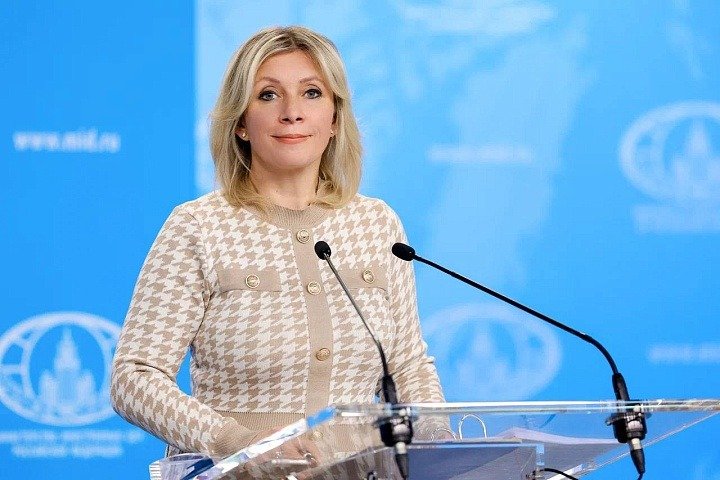
Selections from today’s briefing by Foreign Ministry Spokeswoman Maria Zakharova,
https://mid.ru/en/foreign_policy/news/1985339/
Selections: Republic of Korea, Worsening situation in Syria, Ukraine
The Republic of Korea update
We are watching with concern the tragic developments underway in the Republic of Korea. We hope that they will not affect the socio-political situation on the Korean Peninsula, which has been complicated by the incendiary activities of the United States and its allies.
We recommend the Russian citizens and compatriots in South Korea to maintain contact with our Embassy in Seoul, which regularly issues updates for both Russian citizens and the general public.
According to reports from our Embassy in South Korea, the situation in Seoul and other cities and provinces of the Republic of Korea has normalised following the lifting of the martial law. There is no danger of mass unrest that could affect people’s lives. At the same time, Russian citizens have been recommended to closely monitor the situation, to refrain from taking part in political public events, and to have the hotline telephone numbers of our Embassy on hand.
Worsening situation in Syria
On November 27, militants from the international terrorist organisation Hayat Tahrir al-Sham operating in the Idlib de-escalation zone, alongside other armed groups, including the ones that are part of the Syrian National Army, launched a large-scale offensive in northwestern Syria. According to reports, the militants managed to seize Aleppo, Syria’s second largest city, as well as a number of population centres in Idlib and Hama provinces. Notably, the attack was carried out on the day a ceasefire agreement between Israel and Lebanon’s Hezbollah came into effect.
We strongly condemn this attack led by terrorists recognised as such by the UN Security Council. Notably, there are many foreign combatants among them, including those from the former Soviet Union. Clearly, Ukraine was also involved, based on the information we are receiving about cooperation between the Kiev regime’s special services and Hayat Tahrir al-Sham, including the transfer of UAVs and sharing the experience of using them. This is not the first or the last region where the Kiev terrorist regime is using its criminal experience. Before that, there were African countries, and now it’s Syria.
The actions of terrorist groups accustomed to wreaking havoc and leaving a trail of destruction behind them have aggravated the already tense situation in Syria. There is no doubt they would not have dared to go ahead with such an audacious action without incitement and comprehensive support from external forces seeking to provoke a new round of armed confrontation and a spiral of violence in Syria. The radicals clearly aim to undermine many years of efforts to achieve sustainable normalisation in that country by creating a serious threat to the safety of civilians in the combat zone, whom they plan to use as human shields in accordance with their established tactics.
The militants’ crimes have provoked a sharp deterioration in the already difficult humanitarian situation in the Syrian Arab Republic and a new wave of refugees and internally displaced persons. Only recently, Syria itself provided shelter to about half a million migrants fleeing the war from neighbouring Lebanon.
We express our solidarity with the leadership of Syria and its people in this difficult situation. We reaffirm our commitment to the sovereignty, unity and territorial integrity of the Syrian Arab Republic. We strongly support the Syrian authorities’ efforts to counter terrorist groups and to restore the constitutional order.
We engage with our international partners to ensure the speedy stabilisation of the situation in Syria, primarily by harnessing the Astana format potential. The foreign ministers from the troika of guarantor countries – Russia, Iran and Türkiye – remain in close contact.
We hope that all countries that have influence on the situation on the ground in Syria use it in the interest of restoring security and stability in that country as soon as possible. The strengthening of the positions of terrorists in Syria will create additional serious security threats not only to the countries of that region, but also to the entire Middle East.
As a reminder, the Foreign Ministry’s recommendations to our citizens to refrain from travelling to Syria due to complex military and political situation in that country remain valid.
Ukraine crisis update
December 1 this year marked the 33rd anniversary of the Ukrainian national referendum of 1991, when the vast majority of Ukrainians expressed their support for the Act of Declaration of Independence of Ukraine. This decision endorsed the course towards implementing the core principles of the Declaration of State Sovereignty of Ukraine dated July 16, 1990 concerning the nation’s nuclear-free, neutral, and non-aligned status. Presently, Kiev appears to overlook these fundamental pillars upon which Ukrainian statehood was constructed. Furthermore, the regime under Mr Zelensky continues its deliberate dismantling of Ukraine, thereby depriving it of any prospect for a viable future.
We have consistently highlighted that the resolution of the Ukraine crisis hinges on Kiev’s return to the principles enshrined in those foundational documents upon which modern Ukraine was established. Currently, there is a discernible trend towards transforming Ukraine into a terrorist state, at least the regime in power fits such a description.
The Ukrainian Nazis, with unabashed complicity from the West, persist in terrorising civilians both in Russia and within their own nation.
On November 26, in Novaya Kakhovka, Kherson Region, five civilians were killed and 21 injured due to terrorist gunfire on a bus.
On November 27, a large-scale drone attack was thwarted in the Krasnodar Region; a woman sustained injuries from the debris of a downed drone in Slavyansk-on-Kuban.
On the same day, 25 Ukrainian UAVs were intercepted and destroyed over the waters of the Black Sea and the territory of Crimea.
Ukrainian terrorists have launched 345 munitions and 154 UAVs at residential areas in the Belgorod Region. Drone attacks on civilian vehicles in the villages of Ustinka, Berezovka, Kolotilovka, and Chaika, as well as the residential area of Malinovka, resulted in eight individuals being wounded.
During the night of December 1, a child was killed due to a targeted drone attack by Ukrainian Nazis on the residential areas of the Starodubsky municipal district in the Bryansk Region.
All perpetrators involved in these and other heinous acts by the Kiev regime will be identified and will undoubtedly be held accountable to the fullest extent of the law.
Russian courts continue to convict Ukrainian neo-Nazis and mercenaries for war crimes, relying on the evidence gathered by the Investigative Committee.
Georgian mercenaries Giorgi Rusitashvili, Nodar Petriashvili, and Vano Nadiradze have been sentenced in absentia to 14 years’ imprisonment, while Ushangi Mamulashvili, involved in recruiting foreign mercenaries for the Ukrainian armed forces and the creator of the so-called Georgian Legion, has been sentenced to 23 years’ imprisonment.
A commander of the Ukrainian armed forces, Alexander Zhakun, received a life sentence in absentia. His criminal orders to shell residential neighbourhoods in Uglegorsk (Donetsk People’s Republic) in January 2015 resulted in the deaths of four civilians, including two children, and injuries to one adult and a child.
The court has ordered that British mercenary James Scott Rhys Anderson, captured in the Kursk Region, be detained in connection with a criminal case opened against him for participating in hostilities on Russian territory as a member of the Ukrainian armed forces.
Russian law enforcement agencies will persist in their efforts to bring Ukrainian Nazis and foreign mercenaries to justice for war and other crimes.
In the pursuit of an illusory victory over Russia, the administration of the outgoing US President, alongside European “hawks” – more akin to “lame ducks”– have gambled on intensifying conflict. They are endeavouring to arm the Kiev regime to the fullest possible extent before the new US President assumes office, thereby seeking to ensure the perpetuation of hostilities into 2025.
According to media reports, about 150 British and French Storm Shadow and Scalp-EG long-range missiles have been send to Kiev. The Netherlands have supplied three Patriot air defence systems. Washington and Berlin have approved the new Ukraine weapons aid packages worth $725 million and $650 million. The Americans also plan to send hundreds of thousands of artillery shells, thousands of missiles, and other weapons to Kiev by mid-January 2025.
Norway is particularly active in increasing financial aid to Ukraine. It has approved the allocation of about $3.2 billion in 2025 and at least $13.9 billion by 2030. This generous move is easy to explain: the longer the conflict and confrontation between the West and Russia, the higher will global hydrocarbon prices be, with Norway receiving high revenues from that. This simple logic is frightening. Therefore, we are not surprised by the pro-escalation statements Norwegian Foreign Minister Espen Eide made in an interview with a Norwegian newspaper on November 23, 2024, encouraging the use of long-range missiles inside Russia. There is no other explanation or interpretation of that.
NATO Secretary General Mark Rutte spoke in an interview with the UK media on December 2, 2024, about prioritising the supply of both defensive and offensive weapons to Ukraine in order to reinforce its negotiating position. This is nonsense. What negotiating position of Kiev are they talking about if the Kiev regime has legally banned any talks with Russia, yielding to pressure from the British and the Americans?
The inadequate Ukrainian leader, Zelensky, makes statements every day on the impossibility of any talks with Russia, while NATO Secretary General Rutte says that weapons deliveries are vital for strengthening Kiev’s negotiating position. Do the NATO and other Western leaders ever look out of their windows? Do they know what their predecessors or allies mired in the NATO negativism said two days ago and what statements and decisions they made? They are out of synch.
UK Prime Minister Keir Starmer is echoing Rutte. According to his warped logic, London must continue to arm Kiev to put an end to the conflict and start peace talks. Doesn’t he know that Britain is waging a proxy war against Russia, as former Prime Minister Boris Johnson admitted in an interview with a UK newspaper on November 28, 2024? Johnson, Starmer’s predecessor, said that he went to Ukraine in the spring of 2022 to preclude any talks with Russia. This is outright shamelessness and lies.
The Kiev regime has long learned to use the Western aid smartly, getting profits (read: stealing) from the resale of weapons and plundering financial aid. How can the increased supply of weapons and money to Kiev improve its negotiating position? The weapons are stolen or resold. The money is channelled into the pockets of Zelensky and his junta, although some of it goes back to their masters. These funds are being split up between them. However, there are indications that some people in the West are coming to see through this scheme.
Zelensky’s statements about the inability of the Ukrainian army to retake the occupied territories show that the strategy of pouring weapons and money into Ukraine has failed, and that Ukraine’s military capability has been exhausted. This could be a tactical move to up the stakes and demand more of everything. But we also know what other Western officials say.
The sponsors of the Kiev regime are planning an escape route that would explain the Ukrainians why they have been betrayed so badly. When commenting on Kiev’s potential refusal to give up some of its territories for peace, US National Security Adviser Jake Sullivan said that it is for Kiev to decide its future. In other words, the West is starting to realise that the realities on the ground make it impossible for them to defeat Russia. Now they are trying create a philosophical and ideological basis for extricating themselves before the inevitable failure of their wards, like they did in other cases. That is why they are not only shifting responsibility but also blame to them.
The confessions made by former German Chancellor Angela Merkel are also rather symptomatic. Back in 2022, she publicly admitted that the Minsk Agreements had been necessary to prepare Ukraine for a war with Russia. This time, she opened up in her recently published memoirs where she shocked many “fans” of Vladimir Zelensky. She wrote: “Upon first encounter, Vladimir Zelensky appeared to me a very narcissistic person with a lack of restraint – a person capable of unleashing a war to satisfy his own ambition. The horrendous consequences for Ukraine were predictable even back then.” The German leader of many years with so much experience and weight in NATO (considering the former performance of the German economy, the EU listened to her, too) already knew and saw who they were dealing with back when Vladimir Zelensky was only introduced to the Western circle. Why was Vladimir Zelensky made a hero of the new Western ideological paradigm? Why did the West put him on a pedestal, making him a king for an hour? They do it all the time. It is a question that Western leaders will have to answer.
Everything we start to read, listen to and see coming from Western leaders now (recollections, memoirs and revelations) looks more like confessions about creating a monster and bringing him into the halls of power – and what they did to Ukraine and its people. I believe it is just the beginning and many more revelations are to come. It is not a confession and penance but an exhibitory attempt to justify oneself and shift the responsibility onto others. Then, neither Germany, nor the official Berlin nor Angela Merkel will be responsible. The responsibility will rest with Vladimir Zelensky who, as Angela Merkel describes, is nonsensical, narcissistic, unrestrained and ambitious.
On December 1, 2024, before they even officially took office, the new high-ranking European officials urgently travelled to Kiev. President-elect of the European Council Antonio Costa and EU High Representative for Foreign Affairs and Security Policy Kaja Kallas wanted, I quote, “to show their unwavering support to the Ukrainian people from the first day of their mandates.” They also needed to make sure that Zelensky’s regime would continue fighting “until the last Ukrainian.”
Antonio Costa spoke to the political leadership of Ukraine and promised to the Kiev puppets that he would allocate, before the year is out, some 4.2 billion euros to close gaps in their budget, and would transfer 1.5 billion euros every month throughout 2025, as a loan from G7, to be paid from the interest on Russia’s frozen (in our opinion, stolen) sovereign assets. Kaja Kallas also pitched in with a statement that it is acceptable to send ally troops to Ukraine, without specifying who exactly she had in mind.
Despite the change of the composition in the EU bureaucratic ranks, the ideology of destruction and disconnection from reality has been passed down in full. It can be concluded from their statements that the EU bureaucrats completely lack concern about the wellbeing of EU citizens. As soon as they took office (perhaps even before it became fully official), they immediately flocked and ran to Ukraine that is not a member of the EU. They did not conduct the inventory of the European economic affairs; they did not visit any European cities that may be challenging and problematic in terms of humanitarian situation. They did not talk to European citizens, simply to listen to their point of view or even understand how the European Union lives and what it breathes. They are not interested. Although they do have a mandate exactly to handle European matters. These matters concern them less than Ukraine. After all, it is Ukraine where the money is sent, embezzled and returned from.
Head of the Lvov Regional Administration Maxim Kozitsky reported that there are no more churches of the canonical Ukrainian Orthodox Church left in his region. According to him, out of 54 parishes, 27 joined the schismatic Orthodox Church of Ukraine along with their churches. The other 27 closed. He did not mention though that this result was achieved primarily by force, deceit and threats of repression against any dissenters.
We see similar cases happening all over Ukraine. The Kiev regime will not be able to hush up the problem of religious persecution and outrageous violation of believers’ rights in Ukraine. The regime will take full responsibility for its religious crimes against the international community and the Ukrainian people.
The real attitude of the Zelensky’s regime to the canonical Orthodox Church is clear from the events in the Kursk Region, where the Ukrainian Nazis completely destroyed two cathedrals and damaged ten churches during the invasion.
The facts I mentioned and numerous others once again confirm that the problem of denazification and demilitarisation of Ukraine remains relevant, along with eliminating the threats coming from the Ukrainian territory. All these goals will certainly be achieved.
In his interview with American public figure and publicist Tucker Carlson, Foreign Minister Sergey Lavrov explained, in extensive detail, what is currently happening in Ukraine and what the Kiev regime is doing outside Ukraine against the civilians, the civilian infrastructure, and which terrorist attacks it commits. He also spoke about the origins of the Ukrainian crisis and about the future of our region. The interview will be released shortly. We will disseminate it by all means. Please follow the media of the Russian Foreign Ministry.
Related Posts
-

George Galloway on MOATS with some hard truths
August 3, 2025 -

Brian Berletic: Russian Arms Overwhelm Ukraine as War Escalates Following False US “Peace” Offers
July 20, 2025 -
The other side of the SMO
July 17, 2025 -
Dmitry Trenin: This is a long war, and it’s not just about Ukraine
July 9, 2025 -

Formal Statement: Vladimir Medinsky, Ukraine Talks
June 2, 2025 -

U.S. Begs Russia to End War. New Russian Offensive Gathers Momentum
May 31, 2025 -
US Plays “Mediator” in its Own War on Russia
April 22, 2025 -

American ‘mercenaries’ and Russia’s appearance in the circus
March 24, 2025 -
Russian Forces Are at Center of Ukraine’s Kursk Area of Operation – massive encirclement
March 8, 2025 -

Statement to UN: Nebenzia at a UNGA Emergency Special Session on Ukraine
February 25, 2025