

The Spoiling of the Hegemon
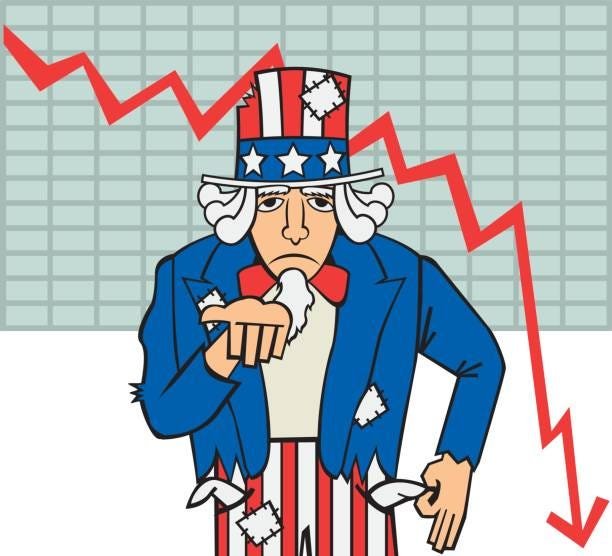
America in the Crab Pose: Why the US Can’t Be Saved
by Marat Khairullin on his substack
America is a business. A business succeeds when there is profit (or when the revenue is greater than the losses). As soon as the losses exceed the profit, the business is over.
2024 was a turning point for the US. The country officially became unprofitable. The main problem here is that America became unprofitable in the middle of a normal economic situation. There were no shocks, major crises, hurricanes, epidemics, and so on. Everything is fine and outwardly stable, but the country is frankly in the ass.
Even a non-specialist can see – this is such a powerful trend that it will no longer be possible to change it. This means that business and America as a Hegemon is over. A strong economy has always been the US’s main asset, but over the past eight years (one Trump term and one Biden term), the country has done so much to its economy that there is no longer any point in talking about any advantages of the American way of doing business.
The American economy has turned into a black hole. Even the United States itself, represented by their excellent economic schools, see all the problems very well, but they can do nothing. The country has firmly embarked on an extensive path of deconstruction.
President Biden’s last term has clearly demonstrated this. It is no coincidence that Vladimir Putin, before the start of the summit in Kazan, in an interview with foreign media, focused on the US national debt ($35 trillion) and the national budget deficit of $1.8 trillion. The amounts themselves are simply mind-boggling.
But that’s not the point. A budget deficit means there’s not enough money, and the government usually borrows it – preferably from foreign markets. But the United States borrows it from commercial banks, primarily the bank known as the Federal Reserve. In theory, it is supposed to pay off the debt with future profits.
Let’s now go back four years. Biden inherited an economy that was growing at an annual rate of about one and a half trillion in a year. Inflation under Trump was cumulatively 7 percent. Before the Covid pandemic, the annual budget deficit was about 800-900 billion dollars per year with a budget of almost $5 trillion. That is, about a fifth of the budget was deficit spending. At the same time – 400 to 500 billion – was spent on servicing the national debt.
These are not great indicators, of course, but you can live. Biden didn’t have to do anything special, just not interfere with the work of a well-oiled machine, in which case the country’s economy could have remained stable for many years. The above indicators could have provided an acceptable standard of living in the US for decades to come. You just had to behave somewhat sensibly. However, Biden has more than doubled the budget deficit and continues to print dollars (borrow from banks) without restraint.
For the first time in U.S. history, interest payments on the national debt have exceeded one trillion dollars. This is the largest expenditure item in the U.S. government budget – more than medical and military expenses. Now let’s do the math: with a budget revenue of 4.9 trillion dollars, the deficit plus mandatory interest is 2.8 trillion dollars. That is more than a third of the budget – and, apparently, this figure will only grow.
Cumulative inflation under Biden has grown from 7 percent to 20 percent – an almost astronomical figure for the US economy. I’ll explain why below. In other words, once America can no longer borrow, the people of the United States will face a very hard landing. Life there is not so sweet as it is, and after this, there will not be enough money even for the basics.
If we talk further about the budget deficit, the problem is not that the US is not going to live within its means, but that this borrowed money is going nowhere. It is the same as if a person takes out a loan and spends it on trinkets. To understand, we need to delve a little deeper into the problem of the US national debt.
At the turn of the 2000s, the US national debt was quite comfortable and modest by today’s standards – about 7 trillion dollars, but then came the big financial crisis of 2007-2008 (also called the mortgage crisis). The US, in order to avoid a repeat of the Great Depression of the 1930s, began to actively flood its economy with credit money, increasing the national debt. Thus, by the time Trump came to power, the US national debt had reached 20 trillion. This was already an alarming signal, but America reassured itself and others by saying that in any case, the country’s economic growth, caused by the infusion of borrowed funds, would pay off these loans.
It seemed like a long way off from a financial collapse. The dollar was in great demand on the international stage, there was no alternative to the Federal Reserve’s treasury bonds (in this form borrowed funds were issued), and the US itself was recognized as the hegemon by absolutely everyone. Everything was very beautiful and stable until the pandemic hit.
Then it suddenly became clear that the economy of the most powerful country in the world is a very fragile thing. Unemployment in the US immediately increased 6 fold. Therefore, Trump, in order to avoid another Great Depression, resorted to a tried and tested method – he began to flood the country with borrowed money. In just two years, the US national debt had grown by seven trillion dollars, reaching 28 trillion.
But the worst thing was that this money did not bring the desired effect. Moreover, a huge part of this money was simply stolen. For example, out of the $2.3 trillion of the “pandemic package,” almost eight hundred billion were stolen by scammers – people and corporations received this money through fake schemes, without needing it at all. A separate article should be written about how Trump’s crazy trillions went nowhere. But the point is that the stated goals were not achieved – Trump expected, by stuffing so much money into the economy, that he would increase its growth at the level of 3-4 trillion per year. By maintaining such a pace for 10 years, America could well survive the consequences of the Pandemic and digest 7 trillion in increasing national debt. In the end, it turned out to be half as much. By the time Biden came to power, as mentioned above, the annual economic growth was approximately one and a half trillion with fairly low inflation of less than 2 percent.
This was no longer very comfortable for a country accustomed to cheap loans, but it was still possible to live. Although, even then, the economy was no longer able to digest so much money. Imagine a seriously ill person whose body is very worn out and simply refuses to take traditional medications. Such a patient needs a radical remedy. So America needed something radical.
As a result, Trump’s efforts did not even lead to the US economy reaching its pre-pandemic level, let alone any real development, but the situation was not as catastrophic as it is now.
The trouble came from where no one expected it – Biden decided to wipe Trump’s nose and borrowed another seven trillion, increasing the national debt to the current monstrous $35 trillion. This is already more than the country’s GDP. Unlike Trump, who had to deal with the pandemic crisis, Biden did not face any economic crisis. Roughly speaking, the sea was not stormy. Even in calm conditions, Biden’s team was unable to achieve its stated goals.
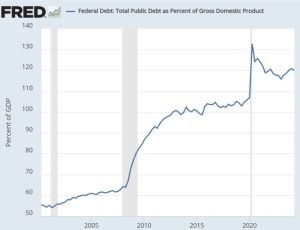
Colossal amounts of money not only went nowhere, the economy began to openly collapse. Inflation rose to 9 percent out of nowhere. In Russia, for comparison, this figure is now about 8 percent per year, but the difference is that we are an actively growing economy, and also waging a serious war. Specifically for the US, Biden’s economic failure resulted in electricity prices jumping by 40 percent and fuel prices rising by almost 60 percent, which led to an increase in the price of the entire consumer goods chain.
Along with prices, tax liabilities have also increased. In the US, there is a very important indicator called the “household tax bill,” and under Biden it has increased by almost 20 percent – by $13,000 per year. But despite tax increases and a monstrous $15 trillion in injections into the economy, the country still lacks money.
Since this year, the United States has been experiencing a specific shortfall of almost 50 percent in money to service its debt. In other words, in order to simply continue servicing its national debt, the US would have to borrow an additional $500 billion from its own banks every year, but that would only be if the country stopped borrowing. Of course, the American elite has no intention of stopping.
For example, Trump promised an additional 7 trillion in his election campaign, Harris a little less – 4 trillion (on top of the already expected deficits). That is, in any case, the debt will continue to grow under the next president. One of the consequences of high inflation is the growth of interest rates on loans. If Trump borrowed his seven trillion at 0.9 per annum, then Biden borrowed his seven at more than 4 percent, and the next president will borrow at an even higher interest rate. The flywheel has been set in motion – you can’t not borrow, but each new loan will be more expensive, and to service it, you’ll have to borrow again. Ultimately, debt servicing could reach another crazy figure: $2 trillion per year in interest payments alone.
And here’s another problem – US allies are starting to dump dollars. For example, a huge problem for America right now is that Japan has to dump $400 billion in US Treasury bonds to support its Pension Fund, which is already effectively bankrupt. Japanese commercial banks will soon be dumping another $200 billion, or are already dumping. This generally affects the cost of treasury bonds, considered some of the safest securities in the world. Therefore, the US will have to buy these bonds in order to support the system, that is, incur unplanned expenses again. And next year, international bond holders are ready to dump another $2 trillion. Thus, US securities are really starting to lose international markets, which means that America may end up alone with the problem of its debt.
In the meantime, we state that the Hegemon has already taken the crab pose and is starting to back away. The fact that the country’s next presidents are not going to stop with the debts shows that America has already resigned itself to its collapse, and everyone is engaged in the last and sweetest robbery of their own country. Prosperous and bountiful – at some point it simply began to choke and drown before the eyes of the whole world. This is what everyone needs to think about. What can I say? Other than a big “hello” to Fukuyama…

Too true Marat, and neither U$ presidential candidate offers any solution, other than more of the same policies that led directly to this inevitable debt death spiral in the first place. I always like to refer back to one incredibly simplistic graph (illustrated) which shows the diversion of the two… Read more »
dear col, thank you! yes, it’s a fabulous incredible chart!
Colin Maxwell, please don’t ever stop writing here about sound money, and please keep citing the BIS move to turn allocated gold into a Tier 1 asset, thus giving banks a greater incentive to hold physical gold in their own possession as part of their balance sheet. I’m still studying… Read more »
Yes, Grieved – it is my understanding that JP Morgan did make a very clear distinction between money and CREDIT which remains the essential difference more than a century later. The only other close contender that I can think of is silver, which I believe will soon be remonetized as… Read more »
https://fofoa.blogspot.com/
Have you studied economics?
Yes Loyal – but it is a long time ago – half a century ago, back in the early 70’s.
Sadly 90% of it was based on false maxims, mysticism and flat-out tripe.
I had to spend the next 50 years unlearning what I call eCONomics aboard life’s hamster wheel.
The money system with debt and interest is a pyramid system. It can only survive if there is growth and that is where the empire fails because it has reached its limits. Nothing could be done to prevent bankruptcy. Biden is doing it for his own wealth, he and his… Read more »
The money system with debt and interest is a pyramid system” I think this is only true when the soveriegn right to create the means of exchange passes into private hands. Creating money as debt is a no brainer compared to using silver, gold or share certificates, doubly so if… Read more »
Precisely John33 – money created as a public utility, as opposed to the ruling Ponzi-casino model, and deployed wisely, can provide massive ongoing and wealth-building efficiencies which in turn increase the efficiency of providing real goods and services. The natural result is, if anything, a deflationary monetary environment – something… Read more »
There probably already is a term for it but I think almost all economists are centerists, that is they like the idea of things being generated top [center] down.Or maybe it’s just a habit of thought? I completely agree that an FTT, which I believe we both learned of from… Read more »
Yes, John…you said… “It would allow people to create their own money as debt to the community they live in and create a stable base level of consumption for themselves and their fellow citizens to service.” Absolutely – these localised systems bring into play a much more direct moral hazard… Read more »